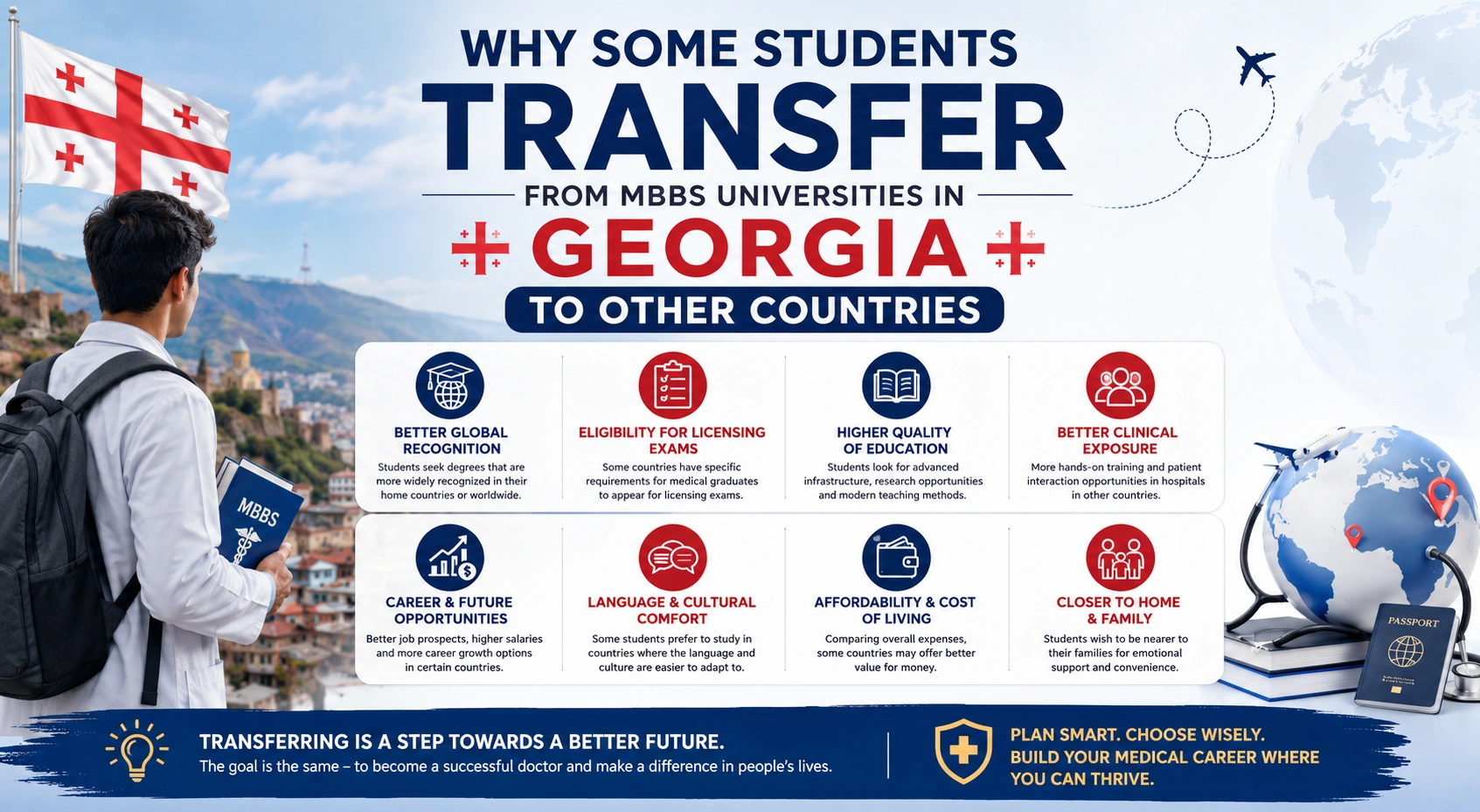
Pursuing an overseas medical degree has long been a major life decision requiring careful consideration from Indian students and their families. In recent years, MBBS in Georgia programs have become a popular choice among Indian international students, backed by four core strengths: low tuition costs, full English-language instruction, modern campus infrastructure, and high international recognition of its medical universities.
Every year, thousands of Indian students travel to Georgia to chase their career dreams in medicine.
However, many prospective applicants and their parents almost always raise the same set of three questions:
- If some students transfer from Georgia to study at institutions in other countries, does that mean Georgia is not a reliable study-abroad destination?
- Are students who transfer dissatisfied with the local quality of education?
- Do Georgia’s medical schools themselves have fundamental flaws?
As a creator of study-abroad educational outreach content tailored specifically for prospective Indian medical students, I must first clarify that transferring schools is a common phenomenon across all medical schools worldwide, and is by no means unique to Georgia.
Most transfer decisions are driven by:
- Changes in personal circumstances
- Adjustments to career goals
- Fluctuations in financial situations
- Needs to care for family members
- Personal educational preferences
Furthermore, transferring is never the mainstream choice among the Indian student community in Georgia; the vast majority of students complete their studies smoothly.
The small number of students who transfer do so entirely out of individual choices, which can in no way be used to prove that Georgia’s medical education quality has problems.
Specifically, motivations for transferring fall into two main dimensions
First, changes in career goals
Including:
- Wanting to apply for residency training in another country
- Wanting to be closer to one’s extended family
- Choosing a school that aligns with one’s intended medical specialization
- Adapting to a healthcare system that fits one’s future plans
Second, family relocation and unexpected personal emergencies
Including:
- Family immigration
- Sudden financial crises
- Personal health issues
- Changes in parents’ wishes
- Mental health needs
- Adjustments to guardianship
Almost all transfer decisions are driven by practical life demands, and have no connection to the academic and teaching standards of Georgian medical institutions.
This study focuses on the transfer behavior of Indian international students pursuing MBBS degrees in Georgia
This study focuses on the transfer behavior of Indian international students pursuing MBBS degrees in Georgia, and sorts out five core driving factors behind this behavior.
Each factor is developed following a unified framework: introducing the core theme, laying out contextual background, breaking down core conflicts, and linking the issue to transfer behavior.
The first and primary driver is financial challenges
All students in this group carefully calculate the cost of studying MBBS in Georgia and make advance financial budgets before enrollment, yet they may still encounter five types of unexpected financial risks:
- Interruption of household income
- Exchange rate fluctuations
- Unexpected medical expenses
- Increased family responsibilities
- Loan pressure
The study suggests that students should make comprehensive financial plans before enrollment, and students facing difficulties can transfer to institutions with lower living costs and suitable support plans.
The second driver is challenges adapting to a foreign country
Studying abroad requires completing an emotional adjustment period, and these international students often face five types of adaptation difficulties:
- Lack of family support
- Inability to participate in local Indian festivals
- Discomfort with unfamiliar food
- Separation from their original social circles
- Lack of cultural compatibility
Individual adaptation capacity varies; struggling to adapt does not indicate insufficient personal ability.
Students who cannot adjust over a long period of time often consider transferring to a more comfortable environment.
The third driver is mismatches with the educational environment
Students have individual differences in learning styles:
- Some suit self-directed learning systems.
- Others are more suited to structured teaching.
Five types of educational preferences generate demand for transfer:
- Small-class instruction
- Differentiated teaching methods
- Sufficient teacher-student interaction
- Diverse assessment models
- Curriculum structures that match their needs
The level of educational compatibility directly affects students’ study abroad satisfaction and academic performance.
The fourth driver is preferences for clinical internships
Closely aligned with the core clinical training requirements of medical education, five types of demands for clinical resources shape transfer decisions:
- Length of clinical rotations
- Resources of the institution’s cooperative hospitals
- Diversity of patient populations
- Access to specialized internship opportunities
- Permission to participate in research projects
These preferences are highly personalized.
The final driver is misguidance from non-objective information
Some transfer decisions are not based on rational information, and five types of information sources interfere with students’ judgment:
- Social media discussions
- Opinions of friends studying in other regions
- Marketing language from education agents
- Incomplete institutional comparisons
- Misleading success stories
Even students who were originally satisfied with their current programs may waver in their choices.
The study reminds students considering transfer to first conduct independent research, to confirm that transferring aligns with their core personal goals.
Many international students planning to pursue a bachelor’s degree in medicine abroad often fall into the misconception
Many international students planning to pursue a bachelor’s degree in medicine abroad often fall into the misconception that transferring to another university or country will automatically solve their problems once they encounter academic difficulties.
In fact, the academic bottlenecks faced by most international students stem from five core root causes:
- Insufficient time management
- Language adaptation barriers
- Irregular class attendance
- Ineffective learning habits
- High exam pressure
Instead of rashly transferring schools, it is usually more feasible to first refine one’s learning skills and proactively seek help from on-campus academic support departments; no new environment can replace personal self-discipline and consistent effort.
Before submitting admission applications, students must complete two core verifications
First, they must fully grasp the regulatory rules of their destination country
Many students who regret transferring after the fact cite insufficient understanding of medical practice regulatory requirements before enrollment as their core mistake.
For example, international students planning to practice medicine in India after graduation must proactively track the guidelines for foreign medical graduates released by India’s National Medical Commission (NMC), as well as official update notices for the NEET exam.
Conducting thorough research on regulatory rules before enrollment reduces future uncertainty.
Second, students must verify the official accreditation of their target institution
No matter which country they choose to study in, they must confirm that their target university is listed in the World Directory of Medical Schools (WDOMS).
They may also refer to relevant resources from the World Health Organization (WHO) to expand their understanding, and treat independent verification as a core priority of the application process.
Students must never transfer schools hastily
Students must never transfer schools hastily; they must first assess seven core factors:
- Academic continuity
- Credit transfer policies
- Financial impacts
- Visa procedures
- Emotional adjustment
- Compliance with professional qualification requirements
- Graduation timeline
They must work through a set of seven self-reflection questions to clarify their true motivations, and must not make rushed decisions due to temporary setbacks or external pressure.
Every year, thousands of international students who travel to Georgia to pursue an MBBS degree complete their studies successfully
Every year, thousands of international students who travel to Georgia to pursue an MBBS degree complete their studies successfully, and most recognize six core advantages of their study abroad experience:
- An international perspective
- A diverse community
- Low tuition fees
- Personal growth
- Improved independence
- Lifelong friendships
Many regard Georgia as their second home, and the very small number of transfer cases must never be used as a reason to discourage all prospective applicants from pursuing this path.
Students across the globe commonly transfer between higher education institutions, a widespread phenomenon driven by four core categories of reasons:
- Changed personal goals
- Family circumstances
- Financial considerations
- Individual preferences
For Indian students applying to pursue an MBBS (Bachelor of Medicine and Bachelor of Surgery) degree in Georgia
For Indian students applying to pursue an MBBS (Bachelor of Medicine and Bachelor of Surgery) degree in Georgia, it is essential to fully investigate the full scope of tuition fees, verify their chosen university’s official accreditation, assess their own long-term goals, and prepare psychologically for living overseas.
The core of successful overseas study lies in adaptability, commitment, and informed decision-making, rather than focusing solely on one’s study abroad destination.
Students must also clarify two common cognitive misconceptions:
- Transferring between universities is neither a sign of personal failure nor a guarantee of a better future.
- It is simply a common choice along the path of pursuing a medical career.
All decisions must be anchored in factual information, self-awareness, and one’s own core personal needs.