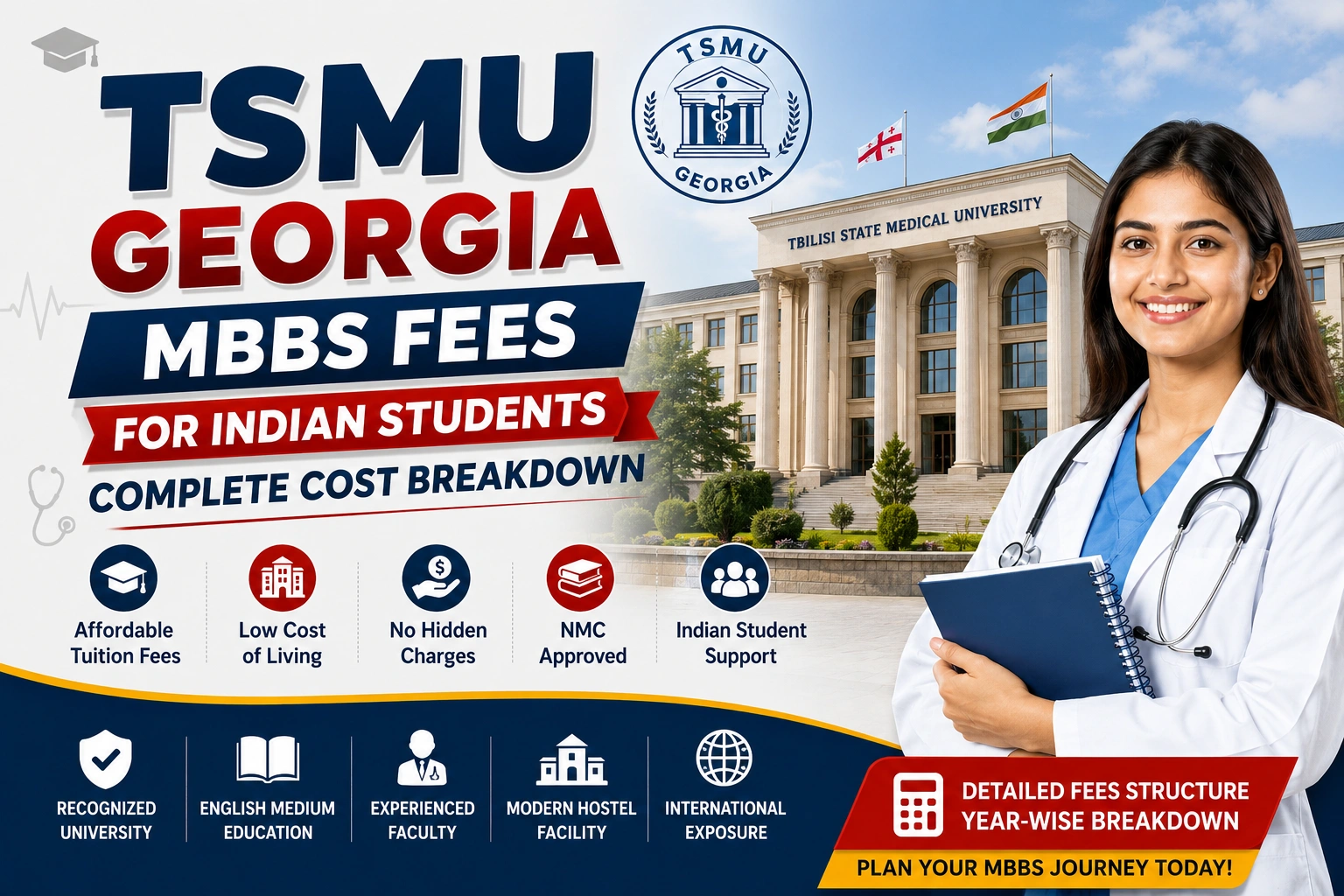
For many Indian students planning to study medicine abroad, the first question isn't really about classrooms or campus life. It's about money. "Can my family actually afford this?", And that's exactly why the Tbilisi State Medical University (TSMU) fee structure deserves a closer look.
TSMU is one of the better-known medical universities in Georgia, particularly among international applicants looking for an English-medium medical program. However, tuition is only one part of the story. Hostel rent, food, insurance, visa-related costs and other small, unpredictable expenses can add up. A university may look affordable on paper. Living there is a completely different calculation.
For students considering MBBS in Georgia, understanding the complete cost before applying can help avoid surprises in the future. So, we're going to break this down-not just the university fee, but the total estimated cost of studying at TSMU.
TSMU, located in Tbilisi, is among the established medical education institutions of Georgia and has a long respected history of academic excellence. The city is another draw for students. Tbilisi is growing its student population from India as well as others.
TSMU provides medical education in English for international students, which is very helpful since students don't have to complete the degree in Georgian. However, students should be aware that knowledge of the local language can help them during daily routine and clinical activities.
For most Indian aspirants, TSMU Georgia stands out for the following reasons:
- An English-medium medicine program
- An opportunity to learn in an environment similar to Europe
- A more predictable fee structure compared to others
Reputation should NOT be the sole reason to pick a university. TSMU may be the best match for one student, expensive or academically challenging for another. Cost and long-term licensing are important factors.
MBBS Fees at TSMU Georgia for Indian Students in 2026
Here is the most important thing. Generally, a medical degree at TSMU spans six years, with tuition charged annually.
Exact amount charged may vary depending on the program, the university program, the USD amount of currency conversion at the time of charging, and the year of Admissions. Based on these fluctuations, Indian students may expect approximately the range of USD 7,000 to USD 9,000 per year.
NOT everyone pays the same amount for TSMU tuition. Always double check the official offer letter and university’s current fee schedule before transferring money. Tuition fees charged by different agents may include fees that are not part of university tuition and are service related. This is confusing. And avoidable.
Fruit Cost Breakdown
|
Expense Type |
Approximate Cost per Year |
|
Tuition |
USD 7,000 to 9,000 |
|
6 Year Tuition |
USD 42,000 to 54,000 |
|
Hostel/Accommodation |
USD 1,500 to 3,500 |
|
Food and other Year |
USD 2,000 to 3,500 |
|
Health Insurance, etc |
USD 200 to 500 |
|
Visa, Travel, Documentation |
Variable |
- Roughly, the budget is between USD 60,000 and USD 80,000.
- How much you pay in Indian rupees depends on foreign exchange fluctuation, and it's why giving a single rupee figure for a 6-year program is a guess. Because currency fluctuates, sometimes drastically.
What does the tuition include?
The tuition includes the cost of instruction and access to the University academic system, but it is better to be safe.
Possible additional costs include:
- Tuition for instruction and practical
- Laboratory costs
- Exam and Assessment Fees
- Library and Clinical training
- Student Administration
- Miscellaneous
It is worth noting that many additional costs are outside the core tuition fees: Hostel Accommodation, food, lodging and medical insurance.
Bohot dhyan dena zaroor hai. Before paying any money, ensure you ask for a written itemization. Verbal promises are good, but written is better.
How much do students need to budget for living expenses in Tbilisi?
Tbilisi is not the cheapest place and students shouldn't think of a tiny budget, but relative to many western countries, living costs in Tbilisi are low.
An apartment or university accommodation will cost between USD 300 to USD 600 a month, depending on lifestyle and preference.
- Mobile and internet: USD 10–30
- Personal expenses: USD 50–150
Overall costs depend heavily on personal habits, and cooking regularly will likely reduce expenses.
The initial prolonged spending also accounts for the cost of bedding and winter clothing, along with other buying essentials.
Course Duration and Academic Structure at TSMU
Generally, studying Medicine at TSMU takes six years, and the students go through different phases of learning and training. The curriculum consists of theoretical knowledge, and practical studies with a number of exams and training periods at hospitals.
Importantly, for students considering MBBS in Georgia, compared to Indian medical education, one shall consider the terminology and how the qualifications are awarded. The qualifications at the Georgian Universities can be awarded with the titles of MD, or Doctor of Medicine, and not the Indian MBBS title; students often refer to these as "MBBS in Georgia".
It is of less importance what the titles of the qualifications given by the Universities are, as long as you can confirm the other important aspect of your prospective institution, which is the structure of the studies offered, and its flexibility in meeting your future licensing pathway requirements.
Eligibility Criteria for Indian Students
Once again, it is worth noting that the admission requirements are at the discretion of the universities, and can change frequently. However, Indian applicants generally have to fulfill the following requirements:
- Class 12 or equivalent
- Physics, Chemistry and Biology as major subjects
- An adequate academic percentage as per the university’s requirements.
- Valid passport and academic documents.
- NEET qualification for Indian student’s future eligibility pathway.
Indian students have to pay special attention to the regulations of the National Medical Commission (NMC) and similar acts.
There is a distinction between applying to medical schools in India and being eligible to practice medicine in India. Most people fail to understand this
There are a few things that Indian MBBS aspirants should keep in mind before applying to a medical college
First, NEET qualification is considered mandatory by many if the objective is to return to India and clear the medical licensure examination post graduation.
It is essential to check the official page for NEET and go through the latest release for the cut off and qualifying criteria. Having a vague idea from a post or a blog about NEET cut offs makes no sense, because NEET cut offs differ based on category and examination year.
Even if a foreign university is willing to offer admission, Indian students should consider what will happen after 6 years.
Students have various licensing restrictions after they complete their medical education, and therefore, recognition and WDOMS are a few things Indian students should keep in mind.
Recognition is one of the most ambiguous parts of overseas medical education. Students come across a university years after they have received recognition, and assume that the rest has been taken care of.
The World Directory of Medical Schools (WDOMS) plays an important role in confirmation of accreditation of medical schools and publication of institutional data. However, having a university listed does not mean that the university would fulfill the requirements for medical licensure in every country.
Similarly, the World Health Organization (WHO) is an important authority in global health, however, students should not believe the saying "WHO approved university" and should understand what it means.
My advice is to verify the university, program duration, medium of instruction, internship or clinical training arrangement and the recent Indian regulations.
It takes an afternoon. Could save years of trouble.
TSMU Admission Process: A Detailed Guide
Admission of international students into a university usually happens before the start of the academic session and can take up to a year. Applicants for the 2026 sessions are advised to start the admission process early enough since there are procedures that can take time like processing of documents and making the necessary travel arrangements.
The admission process is typically as shown below.
- Verify Admission and Course Requirements.
- Upload the documents and scan your passport.
- Wait for the admission or offer-related documents.
- Complete the verification and payment procedures.
- Make the necessary travel and residency document applications.
- Make travel and accommodation arrangements.
- Complete University registration upon arrival.
September is usually the starting month for most academic activities, however, dates may vary. For clarification, you can also confirm with TSMU.
For students interested in studying in Georgia, it will also make sense to compare other universities.
TSMU has a number of advantages for the right student, such as:
- The university has developed its medical education well and therefore is well recognized in Georgia and easy to attract international students.
- Students studying medicine in Tbilisi have easy access to hospitals and urban centres.
- First, often the easiest route should not be taken or recommended by an admission counselor. It is important to thoroughly evaluate options. It also makes sense to compare more than one university
- •Students in TSMU have the opportunity to study medicine in English. This has an establishing effect on Indian applicants. For many new students the medical environment and practices are a culture shock. Having most of the language readily available has a positive impact on the students as well as the parents.
The six-year option gives students a set framework. Often demanding, of course. Medical school is medical school.
Some Trade-offs to Think About
TSMU, along with the rest of the universities, has their share of downsides. So, this is not an automatic solution for everybody.
The cost is much greater than what students have budgeted for. Moreover, it may take a lot of planning to cover living costs in Tbilisi. There are acquainting costs to consider when you are not accustomed to the food, weather, language, or education system. There are habits to develop. It takes time to adjust to the education system in Georgia.
Students need to be current on Indian regulations through the course, rather than checking after they graduate. This is something students don't tend to discuss.
How Does TSMU Stack Up With Other Universities for MBBS in Georgia?
TSMU may not always be the most budget-friendly option that Georgia offers. Some medical universities charge different annual tuition; some may charge slightly less, and others charge more based on the amenities that their program can offer.
Affordability is dependent on the total cost for the set program, and not only the initial fee.
A university that is slightly lower than TSMU in their annual fees may not save as much as one would expect. On the other hand, a university that charges a moderately high fee for the program may be more desired for its academic and professional offerings.
Students who would like to learn more about the MBBS program in Georgia can find all the information that they may need regarding the universities, the estimated costs, and the admission process around the program.
How much does an Indian student pay annually for MBBS studies at TSMU?
Typical annual tuition fees for an English medium medical program range from around USD 7,000 to USD 9,000. The amount may vary depending on the program and the university’s fee structure. Students are advised to verify the exact amount before applying.
How much does MBBS cost at TSMU in total?
The total cost of a six year program (including living expenses) can range from USD 60,000 to USD 80,000.
Is NEET a prerequisite for Indian applicants?
Indian students should keep in mind the current status of NEET and other related regulations in India, especially if they wish to practice medicine in India after completing their studies.
How long will it take to complete MBBS at TSMU?
The medical program usually takes 6 years, consisting of both academic and clinical training.
Is Tbilisi expensive for Indian students?
Tbilisi can become moderately expensive depending on the type of accommodation and your lifestyle. Carefully managing food expenses can be useful.
Conclusion
TSMU can be an option for Indian students who are looking for established medical universities in Georgia. Keep in mind, a serious case of sticker shock can set in when considering the tuition fees. Add in living costs. Add in insurance. Then consider the cost of the unexpected.
That's the real budget.
If you’re considering MBBS in Georgia, be sure to compare TSMU to other medical universities, confirm the latest fee structure, and consider how the course fits the rest of your plans in India.
A well thought out plan in the first year can solve most troubles in the following six years.