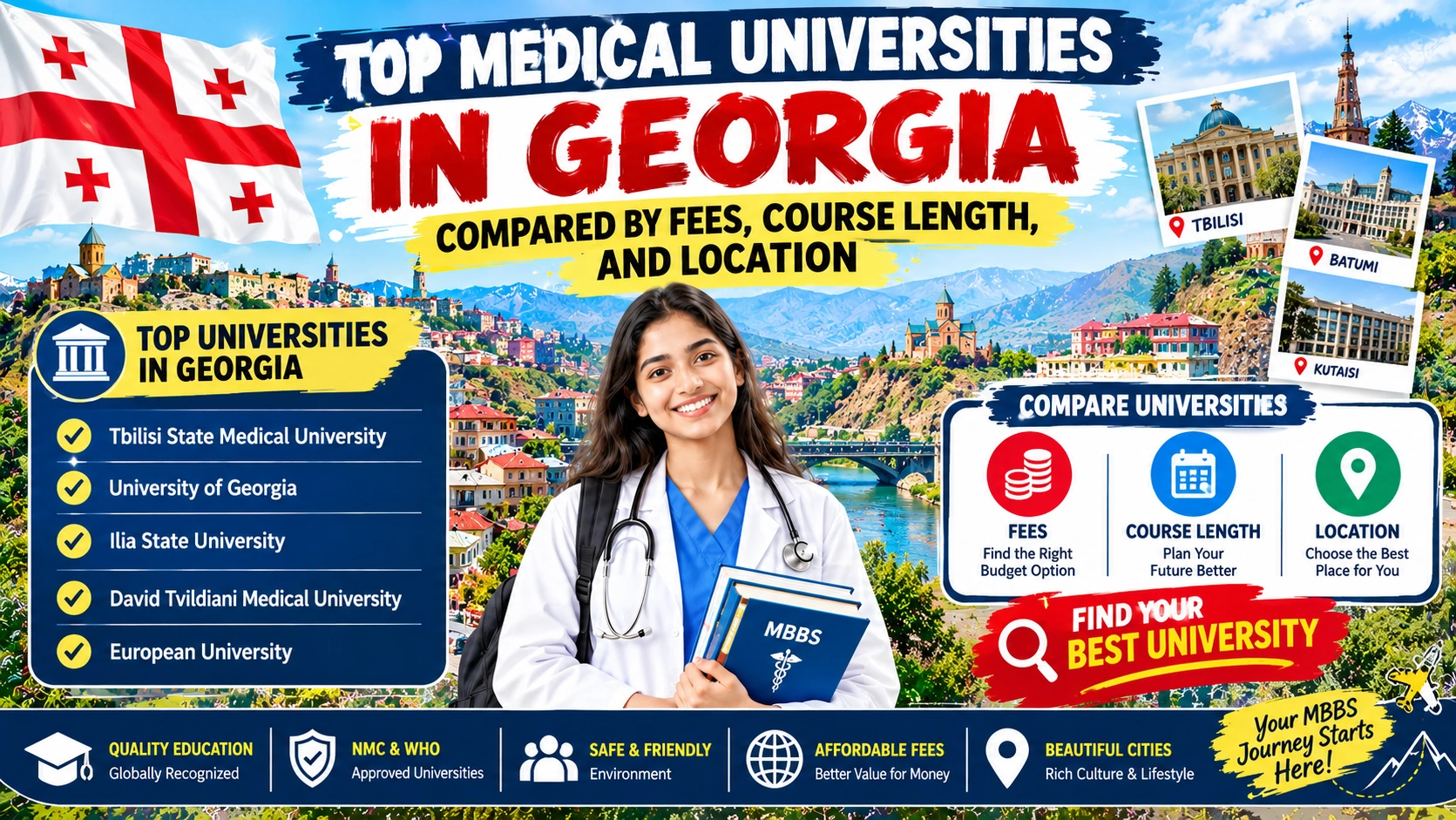
Choosing a medical university in Georgia looks easy until you actually start comparing options. One university quotes tuition of around $5,000 per year, another sits closer to $8,000, and then there are differences in city, hospital access, living expenses, course structure, and recognition. Suddenly, the cheapest option isn't automatically the smartest one. For Indian students considering MBBS in Georgia, the practical comparison should come down to three things first: what you'll pay across the full course, how long you'll study, and where you'll spend those years. Tbilisi offers the widest choice of universities and hospitals but generally comes with higher living costs. Batumi is smaller, coastal, and quite different as a student environment. Kutaisi is another option worth looking at. Then comes the bigger question — whether the program fits current NMC requirements for an Indian student who eventually wants to practise medicine back home. That part can't be treated as a checkbox.
Quick Comparison of Top Medical Universities in Georgia
Here is the comparison most students actually want before getting buried under brochures. Tuition figures below are approximate because universities can revise fees by intake, program, or academic year. Always confirm the latest official fee before paying an application or admission amount.
|
Medical University |
Location |
Approx. Annual Tuition |
Typical Course Length |
|
Tbilisi State Medical University |
Tbilisi |
$8,000–$9,000 |
6 years |
|
University of Georgia |
Tbilisi |
Around $6,000–$7,000 |
6 years |
|
Georgian National University SEU |
Tbilisi |
Around $5,500–$6,500 |
6 years |
|
European University |
Tbilisi |
Around $5,500–$6,500 |
6 years |
|
Caucasus International University |
Tbilisi |
Around $5,500–$6,500 |
6 years |
|
East European University |
Tbilisi |
Around $5,000–$6,000 |
6 years |
|
New Vision University |
Tbilisi |
Around $7,000–$8,000 |
6 years |
|
Batumi Shota Rustaveli State University |
Batumi |
Around $4,000–$5,000 |
6 years |
|
BAU International University Batumi |
Batumi |
Around $4,500–$6,000 |
6 years |
|
Akaki Tsereteli State University |
Kutaisi |
Around $4,000–$5,000 |
6 years |
One warning here. Don't calculate your total MBBS budget by multiplying annual tuition by six and stopping there. Hostel or rented accommodation, food, insurance, residence documentation, travel, books, local transportation and personal spending can add a sizable amount.
Tbilisi State Medical University: Expensive, but a Serious Option
Why does Tbilisi State Medical University keep appearing near the top of student shortlists despite its higher fee? Reputation and medical focus are major reasons. TSMU is based in Tbilisi, Georgia's capital, where students have access to a large healthcare environment and a wider range of clinical institutions than they may find in smaller cities.The English-medium medical program generally runs for six years. Tuition can fall roughly around $8,000–$9,000 annually depending on the applicable program and intake, putting TSMU toward the expensive end of this comparison. For a student whose budget is already tight, that difference becomes substantial across six years. Still, students shouldn't judge it purely by the tuition number. Clinical exposure, curriculum, teaching hospitals and the university's current program details matter just as much.
University of Georgia: A Popular Tbilisi Choice
A lot of Indian applicants hear about the University of Georgia fairly early in their research. There is a reason. It combines a Tbilisi location with an English-taught medical program and usually lands in a fee bracket below the most expensive options. Expect approximately $6,000–$7,000 per year as a working tuition estimate, although the current university fee must be checked before admission. The medical course is normally six years. Being in Tbilisi is useful for students who prefer a large city, better connectivity and access to a broader medical ecosystem. The downside? Monthly spending can creep up. Rent especially. A university that looks affordable on tuition may not remain equally cheap after accommodation and daily expenses are added.
Georgian National University SEU: The Mid-Budget Candidate
Here is where comparisons get interesting. Georgian National University SEU sits in Tbilisi and is frequently considered by international medical applicants looking for a balance between cost and location. Approximate tuition commonly falls around $5,500–$6,500 per year for the medical program, subject to the university's latest published structure. The program generally follows a six-year format. Students comparing SEU should look beyond classrooms and campus photographs and ask about clinical training arrangements, the point at which practical exposure becomes substantial, affiliated hospitals and the actual structure of later clinical years. Honestly, these questions don't get asked enough during counselling sessions.
European University: Worth Comparing on Clinical Exposure
European University is another Tbilisi-based name you'll encounter while researching MBBS in Georgia. Its approximate tuition tends to sit in the $5,500–$6,500 annual range, though current official figures should always take priority. Six years is the usual duration for the medicine program. The Tbilisi location is a practical advantage, particularly for students who value city infrastructure and access to healthcare facilities. But don't select it simply because another student did. Ask for the current curriculum, hospital affiliations, clinical rotation structure and complete fee schedule. One batch's experience isn't necessarily identical to the next batch's.
Caucasus International University: Another Tbilisi Option
Not every student needs the most famous university name. Sometimes the right combination of tuition, curriculum and clinical opportunity makes more sense. Caucasus International University generally falls into that conversation. CIU's medical program is usually around six years, with approximate annual tuition commonly falling near $5,500–$6,500. Its Tbilisi location gives students the usual capital-city advantages, though living costs should be budgeted carefully. Before admission, Indian applicants should also check the university and medical qualification through the World Directory of Medical Schools and understand what a directory listing does — and does not — mean for Indian licensing eligibility.
New Vision University: Higher Fee, Different Proposition
New Vision University isn't usually the first name for someone searching only for the lowest fee. Annual tuition may sit around $7,000–$8,000 depending on the current program structure, with a typical six-year medical course. Its Tbilisi location keeps students close to the capital's medical and urban infrastructure. The higher fee, though, means families should compare the full six-year financial commitment against alternatives rather than looking at a one-year figure. A difference of even $2,000 annually becomes $12,000 over six years before exchange-rate movement is considered. That's not pocket change.
Batumi Shota Rustaveli State University: Lower Cost Outside Tbilisi
Now move away from the capital. Batumi Shota Rustaveli State University is located in Batumi, the well-known Black Sea coastal city, and its tuition can be noticeably lower than several Tbilisi universities. An approximate annual range of $4,000–$5,000 is a reasonable comparison point, subject to current official confirmation. The medicine program is generally six years. Batumi offers a smaller-city experience compared with Tbilisi, which some students genuinely prefer. Yet lower tuition alone shouldn't close the decision. Check the English-medium program, curriculum, clinical exposure, internship structure and compliance with the rules applicable to Indian foreign medical graduates.
BAU International University Batumi: A Medical-Focused Alternative
This one feels different from the typical Tbilisi shortlist. BAU International University Batumi is located in Batumi and attracts students specifically looking at medical education in Georgia's coastal region. Approximate tuition can be around $4,500–$6,000 annually, depending on the latest university schedule.The course is typically six years. Location can be a plus for students who don't want the pace or expense of the capital. Still, compare hospital training opportunities carefully. A pleasant city is nice. Medical training comes first.
Akaki Tsereteli State University: Kutaisi Deserves Attention Too
Kutaisi gets less attention than Tbilisi and Batumi, but that doesn't mean students should ignore it. Akaki Tsereteli State University is a public institution located there and can fall among the more economical choices, with medical tuition roughly around $4,000–$5,000 annually depending on the current fee structure.Its medical program generally runs for six years. Living expenses in Kutaisi may also be easier to manage than in central Tbilisi, although accommodation choices and individual lifestyles change the calculation. For budget-conscious students researching MBBS in Georgia, this is exactly why comparing cities alongside universities makes sense.
Is the Medical Course Really Six Years?
Mostly, yes. But here's the part that needs careful reading. Indian students shouldn't simply see “6 years” on a brochure and assume every regulatory requirement has automatically been satisfied. The structure of the medical qualification, clinical training, internship, subjects studied, medium of instruction and licensing eligibility in the country of study can all matter under India's foreign medical graduate rules.
Check the latest regulations directly with the National Medical Commission before taking admission. Regulations can change, and an agent saying “NMC approved” isn't a substitute for verifying the actual program yourself. Also review the university's entry in WDOMS and relevant international health information through the World Health Organization. These checks serve different purposes, so don't treat WHO or WDOMS visibility as automatic permission to practise in India.
NEET Requirement for Indian Students
This part is much simpler. Indian students planning to pursue undergraduate medical education abroad and later seek registration in India need to pay close attention to NEET and the applicable NMC eligibility rules. Students should check the latest qualifying requirement and official result information through the NEET portal.
Universities in Georgia can have their own admission requirements as well. Commonly requested academic conditions include Physics, Chemistry and Biology at 10+2 level, English, a valid passport and the relevant qualifying documents. Admission cycles can vary, although applications for major intakes are often processed several months before classes begin. Applying early helps with document processing, accommodation and visa or residence formalities.
Fees Are Only Half the Budget
Tuition gets all the attention. Daily life quietly takes the rest. Depending on the city and accommodation style, students should budget separately for hostel or apartment rent, food, local transport, medical insurance, residence-related charges, study materials, airfare and personal expenses.A rough living budget might fall around $300–$600 per month for many students, but it can go below or above that range depending heavily on city, shared accommodation and lifestyle. Tbilisi will generally require a more comfortable budget than smaller Georgian cities. Currency movement matters too. If the rupee weakens against the dollar during a six-year program, the INR cost can rise even if the university doesn't increase its dollar tuition. Here’s—well, this is exactly where families often underestimate the final bill. A university advertised at $5,000 tuition doesn't mean your annual expenditure is $5,000.
Which Georgian Medical University Should You Choose?
There isn't one answer for everyone. If budget is the main concern, Batumi Shota Rustaveli State University or Akaki Tsereteli State University may deserve closer investigation. Students who specifically want Tbilisi can compare SEU, European University, CIU and the University of Georgia. Those comfortable with a higher budget may also examine TSMU and New Vision University.
For MBBS in Georgia, build a shortlist using total six-year cost rather than annual tuition alone. Then compare curriculum, clinical rotations, teaching language, location, hospital exposure, accommodation and current regulatory compatibility. Do that in this order and the flashy campus photos suddenly become much less important.
Pros and Cons of Studying Medicine in Georgia
The appeal is understandable. Georgia has several English-medium medical programs, multiple university choices, six-year course structures and cities where international students already study. Compared with expensive private medical education in some countries, certain Georgian universities can also appear financially manageable. There are trade-offs. Tuition varies considerably, living expenses add up over six years, and students returning to India must satisfy the licensing and regulatory requirements applicable at that time. Language can also matter during patient interaction in clinical settings even where classroom instruction is in English. That's a practical issue, not a minor detail.
FAQs
Which medical university in Georgia has the lowest fees?
Among commonly compared options, universities outside central Tbilisi can sometimes offer lower tuition. Batumi Shota Rustaveli State University and Akaki Tsereteli State University may fall around $4,000–$5,000 annually, but students must verify current official fees before applying.
How long is MBBS in Georgia for Indian students?
Medical programs commonly run for six years. Students should verify the exact academic and clinical structure of their chosen program and check whether it satisfies the latest NMC requirements applicable to foreign medical graduates.
Is NEET compulsory for studying medicine in Georgia?
For Indian students who intend to maintain eligibility under Indian regulations and pursue registration in India after their foreign medical qualification, NEET requirements are highly relevant. Check the current rules through NMC and the official NEET website rather than relying on older admission information.
Is Tbilisi or Batumi better for medical students?
Tbilisi offers a larger urban and healthcare environment with more university choices, while Batumi provides a smaller coastal-city setting and may offer lower-cost options. The better choice depends on the university, clinical training, budget and student's preference.
How much can the complete six-year medical course cost?
There is no single figure. Tuition alone could roughly range from $24,000 to above $50,000 across six years depending on the university, before accommodation, food, insurance, travel and other expenses. Always calculate the full budget university by university.
How should I verify a Georgian medical university?
Start with the university's official information, check its WDOMS entry, understand the latest NMC foreign medical graduate regulations and verify the complete course and clinical structure. Don't rely only on phrases such as “internationally recognized” or “NMC approved.”
Conclusion
The best university isn't necessarily the cheapest one, and the most expensive option isn't automatically better either. A sensible MBBS in Georgia decision sits somewhere between affordability, six-year academic structure, clinical training, location and future licensing eligibility. Compare Tbilisi, Batumi and Kutaisi realistically, calculate expenses for the entire course, and verify current NMC requirements before paying anything. If you're still comparing universities, fees and admission routes, use the university guides on MBBS in Georgia to narrow the shortlist before making the final call.