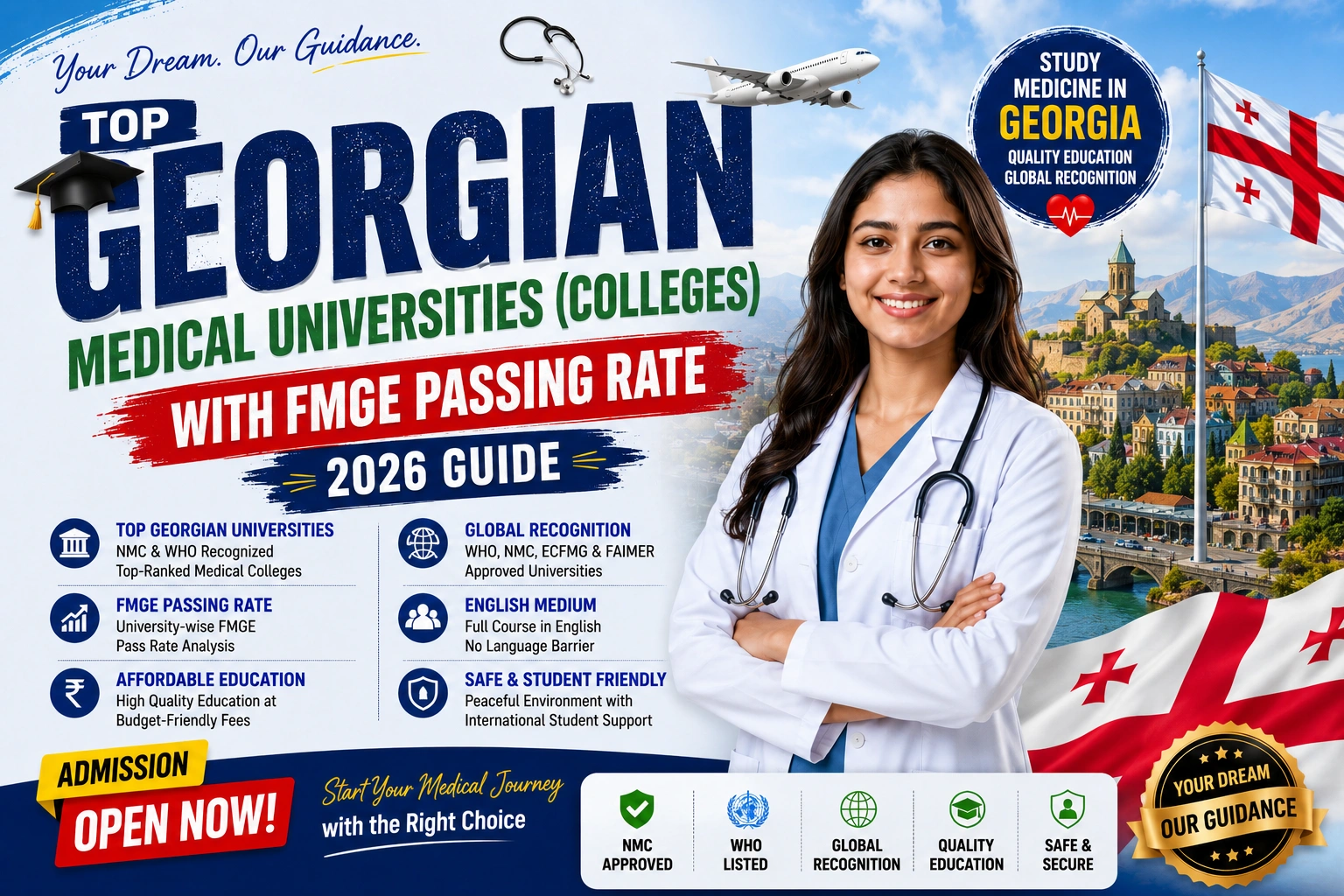
If you are an Indian medical student planning to pursue an MBBS in Georgia in 2026, this exclusive guide is tailored for you. In recent years, Georgia has become one of the most popular destinations for Indian students seeking an overseas bachelor’s degree in medicine, with thousands of Indian students traveling to Georgia to study medicine each year. Studying medicine in this country offers multiple core advantages: internationally recognized academic credentials, low tuition fees, full English-language instruction, modern campus facilities, simple application requirements, manageable living costs, and teaching that fully meets European medical standards.
For students who passed India’s NEET exam but failed to secure a spot in a domestic public MBBS program, Georgia’s six-year medical programs combine theoretical coursework and clinical training, allowing you to build solid practical experience at university-affiliated teaching hospitals.
That said, choosing the right school is a critical decision for studying medicine abroad, and requires evaluation across several key dimensions: institutional recognition, curriculum design, clinical resources, faculty experience, support services for international students, and FMGE pass rates.
This guide will provide comprehensive, detailed information covering the application process, eligibility requirements, costs, and available institutional options, among other key details.
Understanding FMGE Performance for Georgian Medical Universities
The core evaluation objective of the FMGE is to assess whether the medical knowledge of overseas-educated medical students meets the same standard as that of domestically graduated medical students in India.
As a popular destination for Indian students to pursue MBBS degrees overseas, the FMGE pass rates of local medical schools in Georgia have become a core reference indicator for Indian international students when selecting an institution.
While high pass rates can indirectly reflect the teaching adaptability of a medical school, this exam outcome is influenced by multiple factors: an individual’s level of learning investment, exam preparation strategies, as well as an institution’s curriculum quality, clinical resources, Indian faculty members, dedicated FMGE tutoring, and hospital training facilities can all affect a student’s final score.
Therefore, when choosing a medical school, pass rates must never be used as the sole evaluation criterion.
Recognition and Accreditation of Medical Universities in Georgia
Attention all Indian students planning to pursue an MBBS degree in Georgia: multiple local medical schools meet international medical education standards, are listed in the WDOMS, and their awarded degrees qualify holders to pursue advanced academic study internationally or practice medicine overseas.
Before selecting a school, you must verify the institution’s accreditation qualifications through the official platform of India’s National Medical Commission (NMC).
English Medium MBBS Programs in Georgia
Most leading medical schools in Georgia offer MBBS programs delivered entirely in English, which eliminates language barriers for Indian international students.
The curricula of these programs cover 11 core medical subjects, including:
- Anatomy
- Physiology
- Internal Medicine
- Surgery
Among others.
MBBS Fees and Living Costs in Georgia
Tuition fees for medical programs at India’s domestic private medical colleges are prohibitively high, making them unaffordable for most students.
Universities in Georgia offer affordable medical education with reasonable tuition and living costs.
The total cost of studying medicine in Georgia, which covers:
- Tuition fees
- Accommodation
- Meal expenses
- Medical insurance
- Visa documentation fees
Varies depending on the specific university a student attends and the city where that university is located.
Medical Education Standards and Clinical Training in Georgia
Georgian medical schools align their teaching and clinical standards with European standards.
They adopt a training model that combines academic theory and practical application, and rely on their cooperative affiliated hospitals to give students exposure to real clinical scenarios.
The clinical training provided by these schools supports students preparing for the FMGE and NExT exams, and meets the requirements for international medical practice and hospital job positions.
Top Georgian Medical Universities with FMGE Passing Rate (2026 Overview)
Georgia has become one of the preferred destinations for Indian medical students planning to pursue MBBS abroad. Along with affordable tuition fees, English-medium medical programs, European-style education, and modern clinical training facilities, Georgian medical universities are also evaluated based on their performance in licensing examinations such as FMGE.
The FMGE passing rate is an important reference point for Indian students because it provides an idea about how effectively a university’s curriculum, clinical exposure, academic support, and exam preparation approach help graduates prepare for India’s medical licensing requirements. However, students should remember that FMGE results depend on multiple factors, including individual preparation, study discipline, exam strategy, and university support systems.
Before selecting any medical university in Georgia, Indian students should verify the university’s eligibility according to the guidelines of the National Medical Commission (NMC) and check international listings such as the World Directory of Medical Schools (WDOMS).
Top Georgian Medical Universities Based on FMGE Performance
The following universities are among the popular choices for Indian students seeking MBBS
|
Rank |
University Name |
Location |
Medium of Instruction |
FMGE Performance (qualitative) |
FMGE Pass % (reported / estimated) |
|
1 |
Tbilisi |
English |
Good |
~35–45% (country average range; TSMU generally around or above national average) |
|
|
2 |
Tbilisi |
English |
Excellent |
80.33% (explicitly reported for recent FMGE cycles) |
|
|
3 |
Tbilisi |
English |
Good |
~30–40% (typical for many Georgian private universities; no precise public % widely cited) |
|
|
4 |
Batumi |
English |
Good |
~21%–36% (similar cohort performance; specific % not consistently published) |
|
|
5 |
Tbilisi |
English |
Good |
~30–40% (in line with overall Georgia FMGE pass rate) |
|
|
6 |
Tbilisi |
English |
Moderate to Good |
~25–35% (often slightly below top performers; exact % not clearly isolated in reports) |
|
|
7 |
Tbilisi |
English |
Good |
~30–40% (common range for mid–upper tier Georgian universities) |
|
|
8 |
Tbilisi |
English |
Good |
~35–45% (historically considered one of the stronger private medical schools) |
|
|
9 |
Tbilisi |
English |
Good |
~35–45% (public university; performance generally around national average or slightly above) |
|
|
10 |
Tbilisi |
English |
Good |
~30–40% (typical of many private universities in Tbilisi) |
|
|
11 |
Tbilisi |
English |
Moderate to Good |
~25–35% (often in the moderate band in FMGE analyses) |
|
|
12 |
Tbilisi |
English |
Good |
~30–40% (no precise university‑specific % widely published) |
|
|
13 |
Batumi |
English |
Moderate |
~20–30% (generally reported as moderate performer in FMGE statistics) |
|
|
14 |
Batumi |
English |
Good |
~30%–33% (solid but not top‑tier in most FMGE summaries) |
|
|
15 |
Kutaisi |
English |
Moderate |
~20–30% (often in moderate band in FMGE performance discussions) |
FMGE data can vary every year depending on the number of students appearing, academic background, and preparation level of graduates. Therefore, students should treat passing rates only as one factor while comparing universities.
Factors to Consider Before Selecting an MBBS University in Georgia
Indian international students planning to pursue a medical degree in Georgia must not rely solely on high Foreign Medical Graduate Examination (FMGE) pass rates as their only criterion for selecting a university.
This decision-making logic carries clear hidden risks. Students must conduct a comprehensive assessment of multiple core factors before confirming their enrollment at an institution.
They can verify their options item by item against five dimensions:
- First, confirm that the institution’s qualifications meet India’s National Medical Commission (NMC) guidelines for overseas medical education, to secure eligibility for subsequent medical licensing exams and practitioner registration.
- Second, assess whether the institution’s supporting clinical training facilities meet required standards.
- Third, calculate the total cost of all expenses incurred over the full six-year program cycle.
- Fourth, confirm the dedicated exam preparation support the institution provides exclusively for the FMGE.
- Fifth, collect authentic feedback from currently enrolled students.
All these indicators are concrete, actionable items that can be verified in practice.
Tbilisi State Medical University (TSMU) – Top Choice for MBBS in Georgia
If you plan to travel to Georgia to pursue an MBBS degree, Tbilisi State Medical University (TSMU) is the top core recommended institution. This long-established leading Georgian medical school was founded in 1918. Since its establishment, it has trained thousands of medical students from across the globe, including Indian international students. It is also the most widely recognized mainstream choice among the community of Indian students studying for an MBBS in Georgia.
Its core strengths are highly prominent:
- Excellent academic reputation
- Senior and experienced faculty
- Advanced laboratory equipment
- Sufficient clinical training resources
The university adopts a European-style curriculum system that meets international medical education standards. Its entire MBBS program is taught fully in English to cater to the needs of international students.
The program’s training schedule is divided into two phases:
First Phase – Basic Medical Sciences
The first phase focuses on coursework in:
- Basic medical sciences
- Foundational medical concepts
- Theoretical medical knowledge
Second Phase – Clinical Training
The second phase transitions to studying clinical disciplines and completing hospital internships.
The program explicitly sets 13 core courses. Students who enter the clinical phase can also participate in the full practical process of patient diagnosis, treatment, and medical management through the university’s affiliated hospitals.
All the content above fully covers every piece of core information that prospective international students need to make their university selection decisions.
Why Choose Tbilisi State Medical University (TSMU)?
Tbilisi State Medical University (TSMU) is a popular choice for Indian medical students pursuing overseas study.
The university’s well-established medical education system and clinical resources support its graduates in preparing for India’s Foreign Medical Graduate Examination (FMGE). However, passing this examination also relies on individual test preparation strategies and a solid grasp of India’s medical exam format.
The university offers five forms of exam preparation support, including:
- A solid disciplinary foundation
- Access to senior and experienced faculty
- Academic guidance
- Clinical learning opportunities
- Exam-focused preparation support
Most students combine on-campus resources with dedicated exam preparation programs to improve their pass rates.
Why Choose to Apply to Tbilisi State Medical University?
Advantages
The Advantages module lists 6 concrete core strengths.
Ideal For
The Ideal For module clearly specifies the group of eligible applicants, to accurately screen potential study-abroad applicants with high matching compatibility.
Georgian American University (GAU) – Modern Medical Education in Georgia
The Georgian American University (GAU) is one of the most preferred institutions for Indian international students who travel to Georgia to pursue high-quality medical education.
The university adopts modern teaching methods, builds an internationalized learning environment, and balances both theoretical and clinical training.
It attracts students from many countries through:
- Full English-medium instruction
- Modern infrastructure
- Student-centered educational philosophy
- International learning environment
MBBS Program at Georgian American University (GAU)
The MBBS program at the Georgian American University (GAU) aligns with international medical education practices.
Its curriculum is structured around:
- Human health
- Disease mechanisms
- Diagnosis
- Treatment
The program adopts five categories of teaching formats and prioritizes the development of students’ problem-solving and clinical decision-making abilities.
FMGE Support at Georgian American University (GAU)
Georgian American University (GAU) has garnered considerable attention from Indian medical aspirants owing to its strong track record in the Foreign Medical Graduate Examination (FMGE).
The university has developed structured curricula aligned with the requirements for India’s medical practitioner license, which center on:
- Foundational medical concepts
- Clinical learning opportunities
- Mentorship system
- Academic support services for international students
While its annual FMGE results fluctuate year on year, the university remains the preferred choice for Indian candidates pursuing medical studies in Georgia.
Why Choose Georgian American University?
This university has 6 core strengths, including:
Modern medical teaching methodologies
It is well-suited for study-abroad students who prefer an internationalized, modern private medical school.
Alte University – Emerging Medical Institution in Georgia
Alte University in Tbilisi, Georgia, is a newly emerging local medical higher education institution.
It runs all-English-taught medical programs that attract international students, the majority of whom are from India.
The university adopts a model that combines:
- Theoretical learning
- Practical training
to cultivate professional medical talents that meet the demands of the healthcare industry.
MBBS Program at Alte University
The MBBS program at Alte University covers all core areas required to become a qualified physician.
The first academic year offers five foundational medical courses including Anatomy.
Subsequent academic years provide six clinical courses such as Internal Medicine.
Students can accumulate clinical practice experience at the university’s affiliated medical institutions.
FMGE Preparation at Alte University
Alte University is an up-and-coming medical school among Indian medical students planning to pursue overseas education.
Most graduates of this institution are required to take the FMGE medical licensing exam after completing their studies, so the university’s academic framework is critically important to support students’ exam preparation.
Four core factors influence passing this exam. Students enrolled at the university can increase their odds of passing by following a coherent exam preparation plan.
Why Choose Alte University?
Our institution offers:
- A full English-taught MBBS program
- Modern teaching resources
- An internationalized campus environment
- Dedicated support for international students
It is a suitable choice for applicants who prefer emerging medical schools.
Comparison of Top Four Medical Universities in Georgia
The following table lists the core school selection indicators for Georgia’s top four medical universities, including:
- Campus location
- Medium of instruction
- FMGE support
- Popularity among Indian international students
These indicators are tailored to suit the needs of Indian student candidates planning to study medicine in Georgia.
European University Tbilisi – Growing Medical Institution in Georgia
Continuing from the earlier list of leading medical schools compiled for Indian medical students planning to pursue an MBBS degree in Georgia, this section supplements an introduction to the European University in Tbilisi.
As a rapidly developing medical institution in Georgia in recent years, it is widely favored by international students, including Indian medical students.
The university offers an English-taught MD program that meets international medical education standards.
It adopts a teaching model that combines:
- Theory
- Clinical practice
- Modern teaching methods
- Simulation learning
- Laboratory training
- Clinical practice
It also provides students with exam preparation support for medical licensing tests such as the FMGE, fully matching the core needs of Indian students who travel to Georgia to study medicine.
Doctor of Medicine Program at European University
The Doctor of Medicine (MBBS) programs at European universities follow a six-year training curriculum, divided into two major phases:
Pre-Clinical Education Phase
The pre-clinical phase offers 8 core foundational courses including:
- Anatomy
- Physiology
to lay a solid base in medical sciences.
Clinical Training Phase
The clinical phase offers 7 core clinical courses such as:
- Internal Medicine
- General Surgery
allowing students to accumulate hands-on experience at university-affiliated medical facilities.
Simulation-based skills training is also integrated as a key teaching component of these programs.
FMGE Preparation at European University
European medical schools, with their structured medical curricula and practice-oriented training models, are the top choice for Indian international students applying to study at overseas medical institutions.
The pass rate of the Foreign Medical Graduate Examination (FMGE) fluctuates annually based on candidates’ test performance.
Graduates from schools that offer sufficient clinical exposure and comprehensive academic support have a clear advantage when preparing for this exam.
Such institutions hold five core strengths, including:
- English-medium instruction
- Solid foundational medical education
- Clinical exposure
- Academic support
- International learning environment
International students must combine their in-campus academic learning with targeted exam preparation work that covers:
- Practicing with past real exam papers
- Content review
- Mock exams
Why Choose a European University?
Why choose the medical study abroad program at this European university?
We have outlined seven core advantages of the program, including:
- English-taught MD program
- Modern simulation facilities
- Clinical practice resources
This program is specifically designed for medical study abroad applicants who prioritize comprehensive program support and hands-on practical training.
SEU National University of Georgia – International Medical Program
SEU National University of Georgia is a renowned medical education institution in Georgia.
It is widely favored by international students for its fully English-taught medical programs and welcoming academic environment.
The university offers a Doctor of Medicine (MD) program that integrates four core modules:
- Biomedical sciences
- Clinical training
- Research skills
- Professional medical development
The program aims to cultivate medical practitioners who can adapt to different healthcare systems and possess both clinical reasoning and practical capabilities.
Six-Year MBBS Program at SEU
The six-year MBBS program at the National University of Georgia (SEU) adopts a structured medical curriculum system.
It first offers six basic medical disciplines including:
- Anatomy
- Physiology
Then arranges seven clinical disciplines such as:
- Internal Medicine
- Surgery
Learning activities shift gradually from classroom instruction to hospital-based clinical practice.
The program ultimately cultivates five core professional competencies including:
- Diagnosis
- Physician-patient communication
FMGE Support at SEU National University of Georgia
The international medical program at Georgia’s National University SEU is highly popular among Indian students.
While individual self-directed exam preparation forms the core of successfully clearing the FMGE, the university provides four exclusive exam preparation support services for its students.
Launching preparation efforts early makes it easier to raise the pass rate of this exam.
Why Choose Georgian National University SEU?
This university offers:
- A six-year Doctor of Medicine program
- All instruction delivered in English
- Advanced facilities
- Opportunities for clinical research
- Practical experience
It is tailored for students who wish to pursue a cost-effective, internationally oriented medical degree in Tbilisi.
New Vision University (NVU) – Modern Medical Education in Georgia
New Vision University (NVU) of Georgia is a private university with official local recognition. Its core educational mission is to provide medical education for international students, and it adopts a modern teaching model focused on research, innovation, and clinical skills.
Its fully English-taught international programs have attracted students from many countries.
MBBS Program at New Vision University
The Bachelor of Medicine, Bachelor of Surgery (MBBS) program run by New Vision University sets producing qualified medical practitioners as its core training objective.
The program establishes four major integrated training module clusters, adopts a phased learning arrangement, and offers 10 core medical subjects.
All core program information is clear and specific, enabling the program’s target audience to quickly grasp its key structural arrangements.
FMGE Preparation Support at New Vision University
Attention all Indian test-takers planning to study medicine abroad: New Horizon University has attracted considerable attention for its alignment with international medical education systems.
The university can provide four core forms of support for FMGE exam preparation.
However, do not mistakenly believe that choosing this school alone will secure a passing score on the exam.
This test is highly competitive, so you must also implement four core personal exam preparation plans.
Why Choose New Vision University?
Our five core advantages:
- Modern medical education system
- International faculty
- Research-focused academic environment
- All-English MBBS program
- Hands-on clinical training
This university is an ideal choice for student applicants who prioritize research-oriented modern medical studies.
David Tvildiani Medical University (DTMU) – Research-Oriented Medical Education
David Tvildiani Medical University (DTMU) in Georgia is a well-known local private medical higher education institution.
It is widely recognized among international students from India for its focus on medical scientific research and its supporting training programs for international medical licensing examinations.
The university adheres to high academic standards and cultivates qualified candidates for physician qualification examinations in multiple countries.
MBBS Program at David Tvildiani Medical University
The MBBS program at David Tvildiani Medical University adopts an integrated medical curriculum that prioritizes conceptual understanding over rote memorization.
The program is structured into two major sections:
Basic Medicine
The basic medicine section focuses on developing strong medical foundations and understanding essential concepts.
Clinical Medicine
The clinical medicine section focuses on practical medical learning and patient-based training.
The program:
- Covers 11 core disciplines
- Cultivates four core medical competencies
- Provides structured medical education
FMGE Preparation at David Tvildiani Medical University
David Tvildiani Medical University (DTMU) has gained widespread attention among Indian medical students studying abroad who plan to prepare for the FMGE exam.
Its curricula lay the solid medical foundation required to pass the medical licensing examination.
A checklist lists five core advantages of choosing this institution:
- Strong academics
- Focus on fundamental concepts
- Internationalized curricula
- Clinical opportunities
- Experienced senior faculty
Even so, students still need to devote additional dedicated effort to prepare specifically for the FMGE.
Why Choose David Tvildiani Medical University?
This university has five core application advantages, making it a suitable choice for international medical applicants who wish to enroll in an academically outstanding, well-reputed medical school.
Comparison of Four Medical Universities in Georgia
The following table conducts a horizontal comparison of four medical universities in Georgia, using:
- School name
- Location
- Program duration
- Language of instruction
- FMGE support
as core school selection dimensions.
All four universities are in Tbilisi, and all offer six-year English-taught medical programs.
For the strength of FMGE support:
- The first three universities are marked as good.
- The last one is marked as strong.
Important Factors While Comparing Georgian Medical Universities
The Georgian medical schools included in this section are all popular choices for Indian students planning to pursue an MBBS degree in Georgia.
Among these institutions:
- European University and SEU count structured medical education programs as their core competitive strength.
- New Vision University and David Tvildiani Medical University have won widespread attention for their innovative academic models and abundant international resources.
When selecting a school, applicants must not use the FMGE pass rate as the sole selection criterion.
They should also verify six core indicators:
- NMC compliance
- Quality of clinical training
- Hospital resources
- Faculty experience
- Total cost of studying abroad
- Student support system
Ivane Javakhishvili Tbilisi State University (TSU) – Historic Public University
Ivane Javakhishvili Tbilisi State University (TSU), a long-established leading institution and one of Georgia’s oldest and most highly recognized universities, implements an integrated research-and-teaching training model at its medical school.
It attracts large numbers of international students with:
- Profound academic heritage
- Senior experienced faculty
- European-style education system
Medical Program at Tbilisi State University (TSU)
TSU’s medical program focuses on cultivating students’ solid theoretical grounding and clinical hands-on capabilities.
It offers 12 core courses covering both basic and clinical medicine.
Students follow a learning progression that moves from foundational to clinical content and accumulate practical experience through hospital-based practical training.
FMGE Preparation at TSU
Tbilisi State University (TSU) centers its training on cultivating competence in:
- Scientific research
- Medical concepts
- Clinical understanding
This builds a solid knowledge foundation for the university’s graduates to take the Foreign Medical Graduate Examination (FMGE).
Graduates are required to complete four categories of supplementary exam preparation work.
FMGE scores fluctuate annually, and their core determining factor is the adequacy of each individual’s exam preparation efforts.
Why Choose TSU?
- Long-established public university
- Solid, proven academic reputation
- Faculty with extensive professional experience
- Research-oriented medical education
Internationalized environment, making it suitable for students who prefer long-established public medical universities.
Caucasus International University (CIU)
Caucasus International University (CIU) is a private university widely popular among international students. It hosts a fully English-taught Doctor of Medicine (MD) program and is committed to cultivating medical professionals with international competency.
Medical Program at Caucasus International University
The curriculum of the CIU medical program introduced in this paper covers three core components:
- Theoretical education
- Laboratory training
- Clinical practice
It is divided into two major sections:
Basic Medicine
The basic medicine section builds strong foundational medical knowledge.
Clinical Medicine
The clinical medicine section focuses on practical medical education and improving students’ diagnostic and clinical decision-making abilities.
Its core goal is to improve students’ diagnostic and clinical decision-making abilities.
FMGE Preparation at CIU
Caucasus International University (CIU) is widely favored by Indian medical students for its internationalized medical training model.
Its four core resources support FMGE preparation. Candidates must supplement these resources with sustained personal effort to successfully pass the examination.
Why Choose CIU?
We maintain:
- A diverse international student community
- English-medium medical instruction
- Comprehensive modern facilities
- Ample clinical training opportunities
- A warm and welcoming student environment
Our offerings are well-suited for private medical school applicants seeking an international perspective and up-to-date teaching.
Eastern European University (EEU)
Eastern European University (EEU) provides medical education that meets international standards and has emerged as a popular new choice for Indian students pursuing medical study overseas.
It offers:
- Affordable tuition
- Full English-medium instruction
- A welcoming academic environment
MBBS Program at Eastern European University
The MBBS Program offered by East European University includes two core components:
- Core learning modules
- Talent development tracks
This program fully aligns with the universal common standards for global medical education.
FMGE Preparation at Eastern European University
Students enrolled at East European University (EEU) who are preparing for the Foreign Medical Graduate Examination (FMGE) must base their preparation on both the university’s internal academic arrangements and independent self-directed study for the exam.
The core scope of their exam preparation covers five major fields:
- Anatomy
- Pharmacology
- Pathology
- Internal Medicine and Surgery
- Clinical practical skills
Why Choose Eastern European University?
Our university holds five core advantages for students pursuing overseas study, including:
- English-taught programs
- Affordable tuition fees
- International campus environment
- Modern education
- Student-friendly atmosphere
Grigol Robakidze University (GRUNI)
Grigol Robakidze University (GRUNI), located in Georgia, offers medical education to international students, teaching both theoretical concepts and practical medical knowledge in a synchronized manner.
Medical Program at GRUNI
The GRUNI Medical Program offers five core courses, which provide students with academic guidance throughout the entire duration of their medical education.
FMGE Preparation Requirements
All FMGE candidates who graduated from GRUNI are required to follow a structured preparation plan.
The university has already laid the foundational base of medical knowledge. Candidates must fulfill four independent self-directed preparation tasks.
Why Choose GRUNI?
This institution offers:
- English-medium medical programs
- Exclusive support for international students
- Practice-oriented learning
- Comfortable academic environment
Batumi Shota Rustaveli State University
Located in Batumi, Georgia, Batumi Shuta Rustavli National University is a public institution that offers medical majors and focuses on the accumulation of scientific knowledge and clinical skills training.
Batumi is relaxed and friendly and is very attractive to international students.
Medical Program
The specialized module of this medical program covers four categories of core learning content, enabling students to prepare for their careers as professional physicians.
FMGE Preparation
Medical students studying at Batumi Shuta Rustaveli National University and planning to take FMGE need to:
- Start preparation for the exam at school.
- Implement four specific preparation requirements.
Why Choose Batumi State University?
It is:
- A public university
- Located in a safe environment
- Home to a diverse student population
- Affordable in terms of living costs
Akaki Tsereteli State University (ATSU)
Akaki Tsereteli State University, located in Kutaisi, Georgia, is a public government-run higher education institution.
Its medical program adopts a structured curriculum that integrates scientific knowledge and practical hands-on training.
MBBS Program at ATSU
The ATSU medical program features modules in:
- Basic sciences
- Clinical medicine
- Hospital practice
- Healthcare management
It provides a medical learning experience within a public university setting.
FMGE Preparation at ATSU
Students enrolled at ATSU must prepare independently for the FMGE while fulfilling their regular academic requirements at the university.
They should:
- Start preparation as early as possible.
- Use standard test preparation resources.
- Work through practice questions from the test item bank.
- Review high-weightage core exam topics that carry large score proportions.
NMC Guidelines for Indian Students Studying MBBS in Georgia
This guideline applies to Indian medical students pursuing an MBBS degree in Georgia.
Before applying to an overseas medical school, applicants must confirm that their intended institution and its corresponding program meet the latest NMC FMGL regulations, satisfy all five core compliance requirements including:
- Medical program duration
- English-medium instruction
- Clinical training
- Academic standards
- Other related mandatory criteria
Before enrolling, all applicants must verify the institution’s qualification information through official channels.
FMGE Preparation Strategy for Georgian Medical Students
We propose core examination preparation requirements for Georgian medical students preparing for the FMGE:
- Start preparation in the first year of medical school.
- Build a solid foundation in Anatomy, Physiology, and Biochemistry.
- Develop a full-process study plan to reduce preparation pressure in later stages.
The core mandatory examination subjects of the FMGE include:
- Internal Medicine
- Surgery
- Pediatrics
- Obstetrics and Gynecology
Among other clinical disciplines.
Strong clinical comprehension enables test-takers to successfully address all types of application-oriented exam questions.
Practice:
- Past years’ exam questions
- Authentic FMGE past papers
- Mock examination papers
- Subject-wise question banks
Be sure to strictly follow the review schedule.
This will help you thoroughly memorize all important exam preparation knowledge points before your test.
MBBS Admission Process in Georgia 2026
The first step for 2026 MBBS program applications in Georgia is eligibility verification.
Indian applicants must meet three requirements:
- Qualifying for the NEET
- Meeting the required PCB standards
- Holding valid academic documents
Required Application Documents
In the third step of this application process, six categories of general application materials must be submitted, including:
- Passport
- NEET score report
- Academic documents
- Supporting certificates
- Identity documents
- Other relevant documents
Step 5: Visa and Travel
After international students coming to Georgia to study medicine complete all their visa procedures, they may enter the country to begin their studies.
Frequently Asked Questions (FAQs)
Is an MBBS medical degree obtained in Georgia valid in India?
It is valid, but holders must follow the regulations of India’s NMC and complete two pre-registration prerequisites including the FMGL before they are eligible to practice medicine.
Is FMGE Mandatory After MBBS in Georgia?
Many Indian medical students who travel to Georgia to pursue an MBBS raise the question of whether they need to take the FMGE to practice medicine in India upon returning home.
The answer is that this requirement is mandatory: all Indian students who study medicine overseas must pass this examination.
Which University in Georgia Has the Best FMGE Performance?
Long-established institutions such as:
- Tbilisi State Medical University
- Georgian American University
- David Tvildiani Medical University
and other well-established schools, due to their excellent academic environments, are often considered by Indian medical students when selecting a university.
What Is the Duration of the MBBS Program in Georgia?
Most institutions run a 6-year program, which includes both medical education and clinical training components.
Is NEET Required for MBBS in Georgia?
Yes, Indian students planning to study medicine abroad need to qualify NEET according to Indian regulations.
Conclusion
Georgia continues to be one of the attractive destinations for Indian students planning MBBS abroad in 2026. The country offers internationally oriented medical education, English-medium programs, modern infrastructure, and opportunities for clinical exposure.
Universities such as Tbilisi State Medical University, Georgian American University, Alte University, BAU International University Batumi, European University, New Vision University, David Tvildiani Medical University, and other institutions provide various options for medical aspirants.
However, students should not choose a university only based on FMGE passing rates. A successful medical career depends on choosing a recognized university, maintaining academic consistency, gaining clinical experience, and preparing seriously for licensing examinations.
A careful evaluation of university recognition, curriculum, hospital training, fees, and FMGE preparation support can help students make the right decision for their MBBS journey in Georgia.