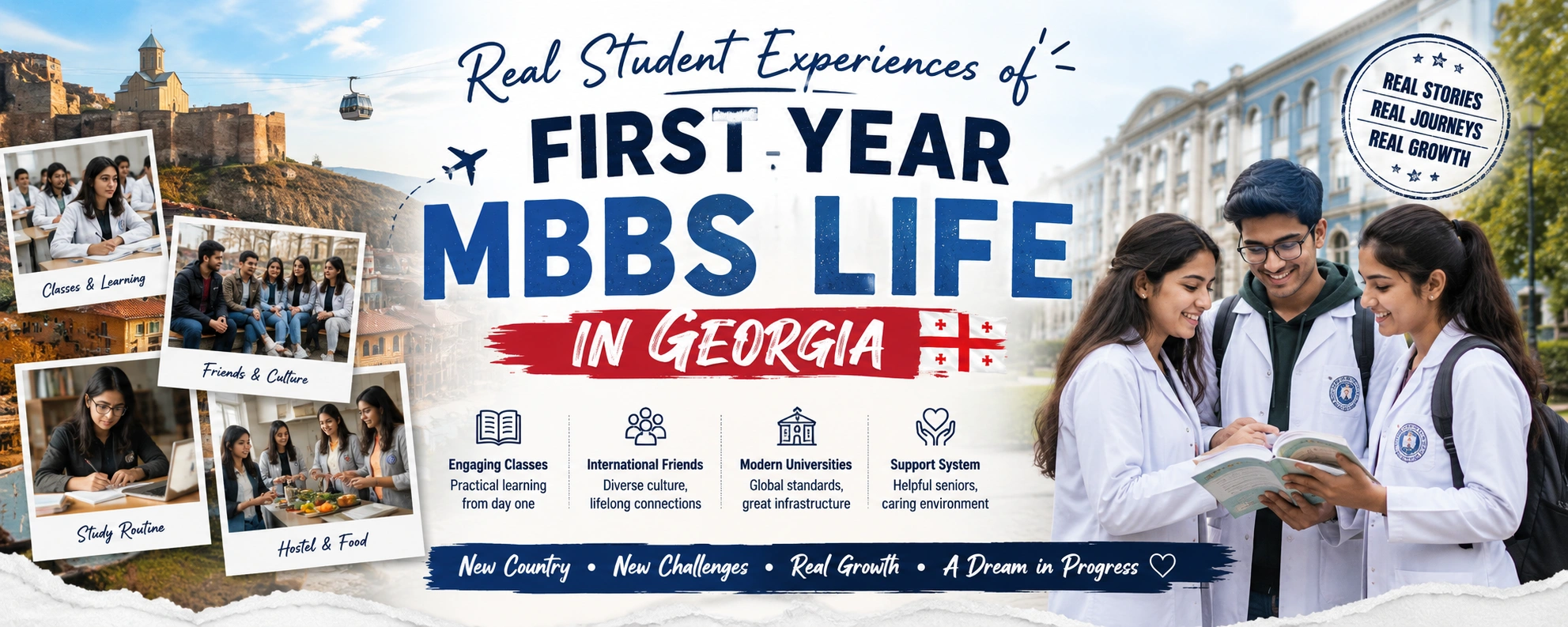
For every Indian international student planning to pursue an MBBS in Georgia, the inherently complex nature of the first year of an MBBS program will feel deeply relatable: it is a unique, life-altering period marked by overlapping excitement, confusion, and emotional upheaval, and for Indian students studying abroad, this mix of emotions is only amplified.
Many applicants only focus on three sets of hard metrics:
- The application process
- Tuition fees
- University rankings
Yet their core unspoken question remains: what is the actual reality of life during the first year of an MBBS in Georgia?
Most current study-abroad brochures only showcase modern campuses and smiling students, crafting an idealized picture of overseas education.
This paper aims to cut through that polished filter, compile the real experiences of Indian international students, and present a full, unfiltered account of the first year of MBBS study in Georgia.
We organize all core challenges and genuine personal accounts along the timeline of the study abroad journey
Before departure, students hold a mix of excitement to launch their medical career and anxiety about leaving home, while their parents worry about safety, local food options, and academic progress.
Students research life as an international student in advance through YouTube videos and blogs, carrying five core questions with them:
- Will I be able to make friends?
- Will I understand the course content?
- Will I struggle with overwhelming homesickness?
- Is Georgia safe?
- Can I handle all necessary tasks independently?
The initial period after landing
In an unfamiliar environment thousands of kilometers from their home country, students must complete six core tasks entirely on their own:
- Purchasing a local SIM card
- Exchanging currency
- Buying daily necessities
- Arranging dormitory accommodation
- Learning local transportation routes
- Submitting all required university registration materials
Even small, routine wins, such as successfully purchasing milk, can bring an enormous sense of accomplishment.
Three to six months after enrollment
Most students who have never left home before experience intense homesickness.
They miss:
- Home-cooked Indian meals
- Daily conversations with their families
- Traditional Indian festivals
- Their own bedrooms
- The familiar home environment they grew up in
However, building a supportive circle of friends and maintaining regular contact with family can speed up adaptation to the new environment, and negative emotions gradually ease over time.
In subsequent sections of this paper, we will discuss in depth Georgia’s medical education model, which differs drastically from that of India: local teaching prioritizes conceptual understanding rather than rote memorization, and this will be the core topic of the paper’s follow-up analysis.
This guide systematically sorts out all-dimensional first-year adaptation points
This guide systematically sorts out all-dimensional first-year adaptation points specifically for Indian international students traveling to Georgia to pursue an MBBS degree.
It first breaks down the seven core adaptation pain points new students face immediately upon arriving on campus, and lays out targeted adaptation pathways for each.
All details are closely aligned with the real circumstances of Indian international students, making this far from a generic, one-size-fits-all survival guide.
First, the learning culture dimension
Unlike the rote, cram-focused tutoring culture familiar to you in India, professors at Georgian universities require students to complete independent pre-class preparation and proactively participate in classroom discussions.
The five first-year compulsory courses—Anatomy, Physiology, Biochemistry, Histology, and Medical Terminology—paired with requirements for continuous assessment and practical classes, mean it is impossible to pass by cramming at the last minute before exams.
The friendship module
The core conclusion of the friendship module is that making friends will completely reshape your study-abroad experience.
Friendships formed with peers during the first year mostly develop into lifelong bonds.
You can support each other through:
- Exam preparation
- Adjusting to dorm life
- Overcoming language barriers
- Coping with emotional breakdowns
- Celebrating birthdays and holidays
This peer support system significantly reduces the difficulty of this transition period.
The language barrier module
The language barrier is real but temporary.
Georgian universities use English as the medium of instruction, but you will encounter Georgian and Russian in off-campus settings such as shopping, taking taxis, and visiting local markets, as well as in future clinical communications.
You will most likely feel intimidated by this at first, but the vast majority of international students can master basic phrases within a few months and adapt smoothly to all daily scenarios.
The dormitory life module
Dormitory life will teach you what true independence means.
Before coming to Georgia, your parents handled all daily chores for you, but after arrival you must complete all tasks independently, including:
- Doing laundry
- Managing your expenses
- Cooking simple meals
- Cleaning your room
- Paying bills
- Planning grocery runs
While this will leave you exhausted in the beginning, you will ultimately gain independence and self-confidence.
The dietary adaptation module
Diet is the most concerning issue for nearly all Indian parents.
In the first few weeks, you may feel unwell from missing home-cooked Indian food and struggling to adapt to local flavors.
Common adaptation strategies include:
- Cooking together with roommates
- Visiting Indian restaurants
- Purchasing Indian spices to prepare simple meals
- Sharing food with fellow Indian students during holidays
The international student community even jokingly refers to learning to cook as an unofficial mandatory course for first-year MBBS students.
The first winter module
Your first winter in Georgia is a unique experience.
Most of you come from warm regions of India and have never experienced a harsh cold winter.
You will go through milestones such as:
- Buying your first thick down jacket
- Stepping on snow for the first time
- Learning to operate your room heater
- Warming up with tea and coffee
While this period presents challenges at first, you will be fully adapted to winter life by your second year.
Finally, academic pressure
Although Georgia boasts beautiful scenery, the MBBS program has extremely high academic requirements, and self-discipline is the core to success.
Common mistakes first-year students make include:
- Skipping classes
- Delaying review
- Relying solely on friends’ class notes
- Underestimating the difficulty of Anatomy
- Neglecting the weight of daily assessments
Students who maintain consistent, continuous study habits achieve far better adaptation outcomes.
If you are an Indian student planning to pursue an MBBS degree in Georgia
If you are an Indian student planning to pursue an MBBS degree in Georgia, the first step is to dispel the illusion of overseas study prevalent on social media platforms—real overseas study experiences are never filled only with glamour; a mix of ups and downs is the core of this journey.
First, acknowledge all your unspoken, unaddressed anxieties about the unknown, then make step-by-step preparations for your relocation.
First, you must complete four official verifications before enrollment
- Check the latest enrollment eligibility requirements via updates from the National Medical Commission (NMC) of India and official NEET notifications.
- Verify the accreditation qualifications of your target university through the World Directory of Medical Schools (WDOMS).
- Access comprehensive medical and health-related information from the World Health Organization (WHO).
This set of procedures can greatly reduce the uncertainties you will face during your subsequent overseas study.
Next, you must make sound financial plans
Your family needs to balance enthusiasm for studying abroad with your realistic budget.
In addition to tuition fees, you must reserve funds for seven necessary expenses:
- Accommodation
- Meals
- Medical insurance
- Transportation
- Daily personal expenses
- Funds to purchase winter clothing suitable for the local climate
- An emergency fund
Reasonable planning can help you reduce extra stress during your academic studies.
While the first year of the MBBS program in Georgia is full of challenges
While the first year of the MBBS program in Georgia is full of challenges, it is a profoundly transformative experience.
You will:
- Go through excitement
- Make mistakes
- Experience homesickness
- Gain precious friendships
- Achieve personal growth while coping with academic challenges
In addition to academic preparations, you must also build the psychological readiness to live independently ahead of time, and be sure to verify the full tuition fee standard for Indian students. The most valuable gains from this journey are the friendships you build, your experiences of overcoming hurdles, the confidence you develop, and the true awakening of your aspiration to become a doctor.