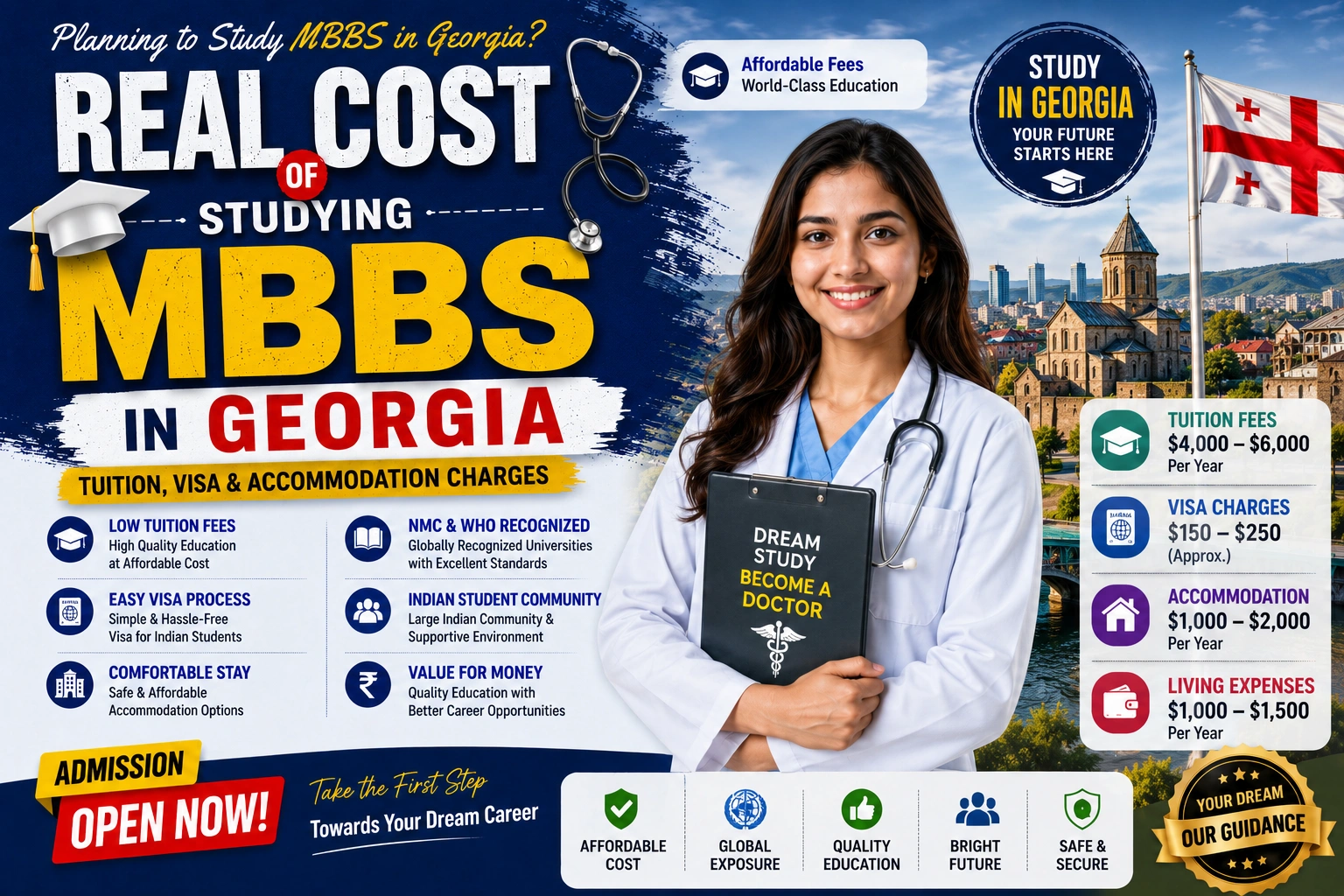
For many Indian students, studying medicine abroad has become the most effective way to achieve the goal of becoming a doctor. MBBS in Georgia is the best option among all other international destinations because of the low cost of tuition fees, world-class university facilities, programs in English, modern infrastructure, and the safe, welcoming, and supportive environment for international students.
Most students think that tuition fees are the only financial consideration when studying medicine abroad. The truth is that there are many other costs involved such as visa charges, hostel fees, daily meals, health insurance, documents, tickets, and personal expenses. Knowing these costs helps students and parents prepare a financial plan and helps students avoid other financial surprises during the program.
When choosing Georgia to study MBBS, you should also know all the other costs, not just the tuition fees of the universities. A good financial plan makes the whole admissions process easier and helps to make sure there are no financial deficiencies while the students are studying.
To know the complete admission process, compare universities, and get updated fee structures, students may visit MBBS in Georgia for the recent admission process information and available university options.
Why Choose to Study MBBS in Georgia?
Georgia has rapidly become an in-demand location for students pursuing international medical training over the last ten years. Thousands of Indian students travel here annually, as the medical universities in Georgia offer a better value for an internationally recognized medical degree.
The MBBS coursework offered in English helps eliminate any potential language barriers for Indian students since the programs are six-years in length. The curriculum also consists of clinical training in an inpatient setting, improving the medical students’ education by reinforcing classroom learning.
The opportunity to practice in a market, as well as the universities listed in the WDOMS, are additional benefits of choosing to study MBBS in Georgia. Listing provides the graduates with eligibility to take multiple international licensing exams, depending on the practice regulations of the countries.
The medical universities in Georgia offer Indian students the eligibility to pursue a degree that will be recognized by the NMC ensuring the students will be able to practice in India post-graduation.
Understanding the Total Cost of MBBS in Georgia
Georgia is a relatively affordable country to study medicine. Students should be aware that the total cost of obtaining a degree includes tuition, room & board, travel costs, medical/travel insurance, and the costs associated with visa applications.
Generally, these factors will influence total cost estimates:
- The university selected
- City of residence
- Hostel or apartment type
- Personal lifestyle
- Exchange rate
- How often you travel to India from Georgia
Students who plan their finances well before admission often experience fewer financial problems during their studies.
Tuition Fees: What to Expect in Your Budget
Tuition fees will be the most significant expenditure for any overseas study.
For the Georgian medical schools that are well regarded, the range of tuition fees per year will be USD 4,000 to USD 8,000, depending on rankings, infrastructure, the medical school’s clinics, and its global reputation.
The location of schools in Tbilisi or smaller cities will mean higher or lower fees respectively, but larger schools will provide clinical opportunities, better labs, research, and additional support to international students.
Choose a school that provides clinical opportunities and has good support over the lowest fees. When planning the total cost for studies, remember that Georgia’s MBBS program runs for six years.
Cost of Hostel and Accommodation
Hostel fees are the second highest expenditure after tuition.
Hostels built for international students are common in Georgian universities.
Most of the hostels provide furnished rooms, heating, Wi-Fi, laundry, CCTV, and common kitchens.
Hostel fees will range from USD 800 to USD 2,000, depending on the school and the type of room.
University Hostel
First-year students often opt for university hostels as they prioritize safety and convenience, as well as nearness to university.
Hostels help international students feel more comfortable adjusting to a new country since they also provide the opportunity to meet and socialize with students of different cultures.
Private Apartments
Senior students tend to rent private apartments after they become familiar with the city.
The cost of apartments varies based on:
- The city
- The locality
- The size of the apartment
- The distance from the university
The accommodation can also be shared or independent.
Sharing an apartment with students can greatly reduce cost of living.
Food Expenses
Compared to many European countries, food in Georgia is cheaper.
Indian students have an average food expense of USD 100 to USD 250. This average varies based on daily meal preferences and the choice of groceries.
Money is easily saved by those who prepare food at home compared to those who prefer dining out.
Students can easily find Indian grocery stores and restaurants in many Georgian cities.
They offer fresh seasonal vegetables and fruits, all dairy products, rice, bread, eggs, and chicken.
Visa and Immigration Expenses
Student visas should also be considered in the overall budgeting since they can be an important expense.
The costs related to visas may include:
- The cost of the visa application
- The notarization and translation of documents
- The medical insurance
- Biometric verification
Costs may be incurred on preparing or updating a passport.
Although costs related to the visa may be fairly small compared to the overall budget, students should ensure that all documents are prepared correctly, as the costs may increase and delays may be incurred.
After the admission letter is sent, most universities assist international students with the visa application process.
Travel Costs
While preparing budgets for studying abroad, travel costs often get overlooked.
The approximate cost for one-way travel from India to Georgia is impacted by:
- The city of departure
- Time of year
- Airline
- When the tickets are purchased
- Layover city
Traveling during the admission season can be more expensive because of ticket price surges due to high demand.
To decrease costs, parents and students should plan to book tickets several weeks in advance.
Parents should factor in additional travel costs if the student plans to return home to India during break.
Travel Insurance Policy Costs
Medical insurance is required for international students at most universities in Georgia.
While insurance is an added expense, it protects students from the financial burden of unexpected medical expenses.
Annual insurance policies are relatively inexpensive, and provide coverage for:
- Emergency medical visits
- Hospital stays
- Doctor visits
- Some medical tests and other procedures
Students should confirm the coverage of an insurance policy prior to purchasing.
Admission and Other Associated Costs
In addition to tuition and living expenses, students should allocate funds for admission-related documentation.
These expenses can include verification of documents, attestation of educational certificates, preparation of passports, translation, courier services, university application fees, and other administrative tasks.
Students planning to pursue medical education abroad also need to meet the eligibility requirements of the NEET as qualifying the NEET is required for Indian students who plan to study medicine abroad and practice medicine in India.
Planning for known one-off expenses helps to eliminate time-related financial pressure during the admission process.
Banking and Currency Exchange
When estimating the total cost of studying abroad, students tend to overlook currency exchange. Since tuition and living expenses are paid in a foreign currency, exchange rate fluctuations may increase or decrease the cost paid by students.
Transacting through an internationally linked debit/credit card can be made less frequent by opening a local bank account. Account maintenance or transaction fees could be levied, and should be accounted for while planning the yearly budget.
Unaccounted for Costs
While tuition and hostel costs dominate most students' cost analysis, there are numerous smaller costs that can add up. When these costs are ignored, they can cause a deficit in the monthly budget, especially the first year.
Some of these costs are:
- Mobile SIM, and recharges
- Transport
- Study material and medical books
- Lab coat and medical gear
- Internet (if not included in hostel fees)
- Laundry
- Winter clothing
- Residence permit (annual)
- Personal expenses and shopping
- Leisure expenses
While each of the costs can be considered minuscule, collectively they form a substantial part of the budget. An emergency fund for these unforeseen costs is advisable.
Cost of Living in Georgia
Your choice of city to study medical education will have a direct effect on your monthly expenses in Georgia. Larger cities will have higher accommodation and transport costs than smaller towns. Smaller towns will have less cost of living but may have fewer educational resources.
Tbilisi
Tbilisi, the capital of Georgia, is home to a number of prestigious medical universities. Because of its advanced public transportation, infrastructure, shopping centers, hospitals, libraries, and recreational facilities, living in Tbilisi is ideal.
However, living in Tbilisi can be expensive due to increased demand for living spaces and an urban lifestyle.
Batumi
Batumi is popular with foreign students for good reason. Located on the Black Sea, Batumi provides an even lower cost of living with a more serene learning environment.
Kutaisi
Kutaisi is often seen as the best value student city due to its lower hostel and rental costs, and is a great option for students looking to lower their costs.
Students should compare the cost of living in addition to tuition costs when choosing a city.
Transportation Expenses
Georgia's public transportation system is very affordable.
Types of transportation students frequently use are:
- Metro
- Public buses
- Mini buses
- Taxi
- Walking for nearby locations
Public transportation is very accessible for most universities and helps students save money on transportation costs.
Many students budget a small amount each month for transportation costs, especially those who use on campus housing.
Can Indian Students Work While Studying?
Many students want to know if they will be able to work while they study for their MBBS in Georgia.
While some international students may be able to find part time work depending on local regulations, the MBBS program is very demanding. There is a lot of work to be done for clinical rotations, as well as for laboratory work, lectures, and practical training.
Students shouldn’t rely on part-time jobs to cover their tuition. It’s better to have the funds secured before enrolling in the program.
Scholarships
Compared to other countries, available scholarships for international medical students in Georgia are few and far between, although a couple of the educational institutions may provide a form of financial funding based on the academic performance of the students and/or the policies of the institution.
Students should research their school of choice for:
- Availability of scholarships
- Awards for academic excellence
- Discounts for tuition
- Grants for international students
Partial funding via scholarship helps to lessen the financial burden of the total cost of education spanning six years.
Is MBBS in Georgia Affordable Compared to Other Countries?
Georgia has one of the best cost/quality ratios of medical education accessible internationally.
Compared to a number of the Western countries, Georgia emphasizes the importance of ensuring that medical education is accessible and affordable while adhering to the academic standards of medical education that are accepted and recognized internationally.
Additionally, students benefit from:
- Instruction in the English language
- Modern labs
- Clinical experience
- Recognized medical schools
- A safe, multicultural campus
Several of the medical schools are recognized by the WHO and included in the WDOMS, enhancing the prestige of their medical programs. Students should always verify the recognition of the medical school before applying.
Estimated Total Cost of MBBS in Georgia
Students should note that each school of medicine has an estimated cost of education that is more than just the tuition fees.
A realistic financial plan generally includes:
- Six years of tuition fees
- Hostel or accommodation expenses
- Food and daily living costs
- Visa and documentation charges
- Medical insurance
- Airfare
- Residence permit expenses
- Study materials
- Personal expenses
- Emergency fund
Comprehensive, detailed budgeting helps parents avoid course-related financial surprises.
How to Reduce Your Total Costs
Studying abroad is very costly, but smart financial planning can greatly reduce these costs.
Students can save money by doing the following:
- Staying in university hostels during the first few years
- Booking flights well in advance
- Preparing food rather than going out to eat
- Living off-campus and sharing accommodations with peers
- Using public transportation instead of taxis
- Buying used textbooks
- Watching exchange rates before paying for tuition
- Staying within a set monthly budget in order to limit spending
Even small amounts saved each month can greatly reduce study abroad expenses over the six years.
What to Consider Before Applying for Georgia MBBS
Indian students wanting to study MBBS in Georgia must consider each of the eligibility requirements.
These may include:
- Meeting the NEET exam requirements
- Meeting the National Medical Commission (NMC) requirements
- Attending a university listed in international medical directories of medicine such as WDOMS
- Verifying that all academic and travel documents are up to date and valid for the entire admission process
Students can check these requirements to avoid issues related to medical licensure and practice later.
The Importance of Financial Planning
Some students narrow their options for universities based solely on which ones charge the least in tuition. Meanwhile, educational consultants encourage looking at the overall cost of education.
A highly ranked university with marginally more expensive tuition might be worth it due to:
- Better faculty
- Better labs
- Better connections to hospitals
- Better exposure
- Better environments to learn in
- Better clinical training
On the other hand, selecting the university with the cheapest tuition doesn't guarantee good value.
Understanding the value of education as a whole and the recognition it carries, the quality of the learning environment, faculty, labs, opportunities to intern, and the overall student support at different universities all cost something, so parents need to evaluate all of these.
To learn about the different universities and their admissions process, tuition costs, and the most recent information about MBBS studies in Georgia, students can go to MBBS in Georgia.
Conclusion
Students wanting to study MBBS in Georgia should think about a lot more than just the cost of tuition. Though the tuition costs are the largest portion of the study costs, students should also think about their costs of food, housing, transportation, health insurance, documentation, and their personal expenses while also factoring in the costs of studying in Georgia. Knowing these costs helps parents and students plan finance and helps families complete the six year medical program in Georgia without financial strain.
Georgia has a lot to offer Indian medical students including great universities with unique modern teaching methods, affordable education, and safety. Careful consideration to every university’s details is critical to making the right choice. NMC recent guidelines, WDOMS listings, and the eligibility for practice should be verified with every medical university.
With timely preparation, informed decision making, and an appropriate budget pursuing MBBS in Georgia has great academic potential with high rewards and low cost. It will enable a medical career with an opportunity to practice internationally.