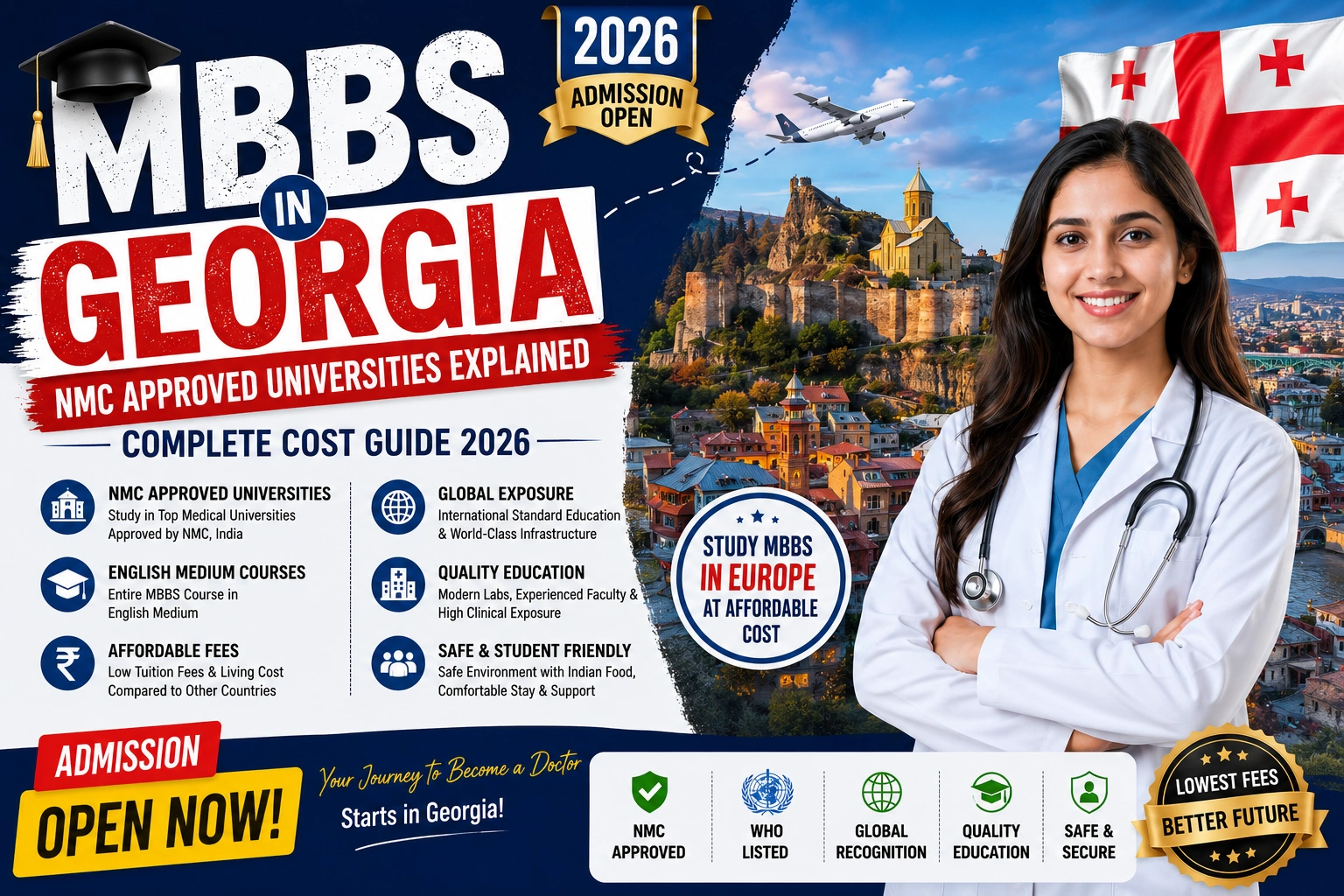
Affordable tuition and a simplified application process attract tens of thousands of Indian students for MBBS in Georgia each year. Georgia's NMC Approved Universities attract students for quality education that is recognized globally and offered in English, making Georgia a preferable destination for students looking for quality education that doesn't come with private colleges' steep price tags.
As you plan for your MBBS in 2026, it is crucial to understand NMC-approved Medical colleges, how to check their recognition, and what eligibility requirements you will need to meet. We have introduced a guide for Indian students that covers every aspect that you may need to know.
You can also visit MBBS in Georgia if you need detailed information about colleges, eligibility, fees, admission procedures, visas, and other related information for your entire admission process.
Why is MBBS in Georgia Trending Among Indian Students?
When it comes to international education for medicine, Georgia is one of the rapidly developing countries. Georgia has great infrastructure and facilities located in their universities along with experienced faculty and laborites and digital classrooms that have a fair amount of clinical exposure through the hospitals they are partnered with.
Compared to many other countries, Georgian medical universities are seen as being up to par with international standards which gives their graduates eligibility to sit for licensing exams of other countries after fulfilling the requirements of that country.
The other consideration is the language barrier that is eliminated as the entire MBBS program is offered in English.
Some of the other considerations are:
- Lower tuition fees
- Programs offered in English
- Modern pedagogy in education
- A pleasant atmosphere for international students
- High-quality support services for students
- Streamlined admissions
- A large and diverse population of international students
What You Should Know About NMC Recognition Before Selecting a University
Some students believe that the medical institutions in Georgia recognized by the Medical Council of India (MCI) is a complete list. This is a misconception.
The National Medical Commission (NMC) has issued certain advisories, which Indian students are expected to follow while selecting a foreign medical institution.
It is important that students determine whether a particular foreign medical institution is in compliance with the foreign medical education regulations issued by the NMC, before seeking admission. This information can be found on the NMC’s website.
Studying at a university that has NMC's compliance increases the chances of students being eligible to practice medicine in India after undergoing the licensing process.
Thus, in order to determine a university's eligibility to receive international students, NMC's compliance should be verified, before the cost of the program or the ranking of the university.
What NMC Approval Means
Some students have achieved a very poor understanding of the term, “NMC Approved University”.
There is no straightforward manner in which universities will receive approval from NMC, and students are expected to verify that foreign medical universities comply with the provisions based on the Foreign Medical Graduate Regulations.
The provisions of the Foreign Medical Graduate Regulations deal, among other things, with:
- Duration of the course
- Duration of internship
- Clinical training
- Eligibility for licensure
- Medium of instruction
- Medical curriculum
Students must never rely on advertisements or other unofficial assertions regarding approval.
Why is Recognition from the WDOMS Important?
Students must also check whether their chosen university is included in the World Directory of Medical Schools (WDOMS) in addition to complying with the NMC's requirements.
WDOMS is considered a credible directory of medical schools that comply with international standards of medical education. Many licensing authorities use this directory when reviewing the validity of foreign medical degrees.
WDOMS recognition verifies the university's international presence and acknowledgment.
Role of WHO in Medical Education
Another commonly used term in university research is WHO.
Students need to be aware that the World Health Organization (WHO) does not approve or evaluate medical universities. WHO does endorse the development of global health education standards and partnerships with agencies promoting quality medical education.
Citing WHO is a common practice among universities. However, students should only rely on official sources.
Eligibility Criteria for MBBS in Georgia 2026
The admission requirements for Georgian universities are not as rigorous as the rest of Europe. However, students still need to meet the fundamental eligibility criteria.
In general, students must:
- Complete 12th grade with the subjects of Physics, Chemistry, and Biology.
- Achieve the minimum qualifying percentage set by the university.
- Qualify the NEET, if they intend to practice in India after completing their degree.
- Have a valid passport.
- Fulfill other requirements as set by the targeted university.
Most universities in Georgia do not conduct their own entrance exams, but qualifying the NEET remains a mandatory requirement for students wishing to practice in India.
Why NEET Qualification Matters
Many students are of the view that NEET is not mandatory because Georgia has a direct admission policy.
This is a misconception for students intending to practice in India after completing their degree.
As per NMC guidelines, students intending to study MBBS abroad must clear the NEET exam. Failing to clear NEET may restrict students' chances for medical registration in India after the completion of their medical studies.
In view of this, students must be cautious about the admission process and the eligibility criteria in the near future.
Duration of MBBS in Georgia
Medical universities in Georgia offer 6-year MBBS courses. The courses in Georgia have the following components:
- Pre-clinical education
- Basic medical sciences
- Clinical subjects
- Hospital rotations
- Practical training
- Internship or clinical exposure as mandated by the university
Students are provided ample opportunities to gain practical medical training along with theoretical education.
Language of Instruction
One of the advantages of pursuing higher education in Georgia is that the majority of the universities offer their entire MBBS programs in English.
As a result, students are able to learn medical education in English without having to learn a foreign language for their studies.
However, during clinical training, universities may impart a basic level of Georgian to students to facilitate communication with the patients.
Teaching in Georgian Universities
Medical education in Georgia has transformed in the last decade. A significant number of universities have focused more on practical learning as compared to rote learning.
Some of the new learning techniques include:
- Digital Classrooms
- Simulated Clinical Learning
- Cadaver based learning of Anatomy
- Research
- Interactive Lectures
- Clinical Trainings in Hospitals
- Learning in Small Groups
- Problem Based Learning
These newer learning techniques have made students more equipped to clear various International Medical Examinations and be fit for medical practice.
How to Assess the Suitability of a University
The low tuition fees and advertisements for a university should not be the basis for choosing that university.
Evaluate compliance with NMC guidelines, WDOMS listing, English-medium curriculum, availability of clinical training and faculty, infrastructure, support for international students, graduate outcomes, internships, student reviews, and more. Conducting thorough research prior to university admission can minimize the risk of academic and licensing problems in the future.
Best NMC-Compliant Medical Universities in Georgia
Rightly deciding a university remains a significant decision for Indian students. Students should not opt for a university just for its low tuition fee; they should check its compliance with the recent Foreign Medical Graduate Licentiate (FMGL) Regulations of the NMC. Some regulations include the English-medium program, a minimum of 54 months of studies, and sufficient clinical training along with the fulfillment of other regulations.
Preferred Georgian Medical Universities by Indian Students
- Tbilisi State Medical University
- David Tvildiani Medical University
- Batumi Shota Rustaveli State University
- European University
- Georgian National University (SEU)
- East European University
- Caucasus International University
- New Vision University
- Akaki Tsereteli State University
- University of Georgia
Students must check the recognition status by themselves before making a decision as it is possible for the status to change.
MBBS Admission Criteria in Georgia 2026
MBBS admission criteria in Georgia are simple and transparent. The absence of a separate entrance exam in most universities adds to the convenience of the admission process for international students. The standard admission process involves:
- Selecting a university
- Submitting educational documents
- Receiving an admission offer
- Paying the fees
- Applying for a student visa
- Making travel arrangements
- Registering at the university upon arrival
To learn about personalized admission support, prospective MBBS candidates should go to MBBS in Georgia for information about the most current admission dates, university information, and how to enroll.
Documents Required for Admission
To speed up the process when it comes to applying for admission and receiving a visa, students should have all necessary documents ready prior to applying.
Certificates and documents usually needed are:
- Mark sheets of classes 10 and 12
- Class 12 pass certificate
- NEET score card
- Passport and 4 passport-sized photographs
- Admission letter
- Certificate of medical fitness
- Bank documents
- Birth certificate, if applicable
Depending on their admission policies, different universities may ask for additional documents.
Tuition Fees and Living Expenses
Affordable medical education is one of the many advantages to MBBS in Georgia. When comparing the cost of education to private medical colleges in India and many Western nations, Georgia stands out for their quality medical education.
Students will also need to plan financially for:
- Accommodation (hostels)
- Meals and groceries
- Transportation
- Health insurance
- Books
- Study supplies
- Personal expenses
Students from India manage the overall expense, especially when considering the low cost of living in Georgia compared to other European countries.
Hostels and Student Life
Hostels for international students in Georgian universities are comfortable.
Hostels usually have:
- Furnishing
- High speed internet
- Common areas
- Laundry services
- CCTV and security staff
- Recreational areas
Catering to international students, many universities host cultural festivals, sports meets, academic conferences, and events highlighting the presence of international students.
Clinical Training and Practical Exposure
Clinical training is essential for medical education.
In Georgia, top universities provide students the chance to learn in partnership with experienced faculty in affiliated hospitals. During clinical years, medical students acquire knowledge by training in the following departments:
- General Medicine
- Surgery
- Paediatrics
- Obstetrics and Gynaecology
- Orthopaedics
- Psychiatry
- Emergency Medicine
This training helps students learn more about diagnosing patients and managing patients.
Career Options After MBBS in Georgia
Graduating from any of the recognized medical universities in Georgia opens up various career options.
Depending on the country’s rules and regulations where one plans to practice, a graduate can do any of the following:
- Go back to India for practicing and registering
- Pursue higher studies
- Take up foreign medical licensing exams
- Work in hospitals after getting the local license
- Work in research or in the field of public health
Indian students should keep themselves updated with the guidelines from the National Medical Commission (NMC) regarding their career options.
FMGE/NExT Factors for Indian Students
Just getting the MBBS degree from a foreign university doesn’t allow one to practice in India.
Indian students have to undergo the Indian process of licensing and register through the Foreign Medical Graduates and NMC regulations and will have to comply with the NExT for the licensing requirements. Students should rely on official notifications and not on third party sources.
Before getting admission, make sure that:
- You have qualified NEET.
- The university adheres to the NMC guidelines.
- The duration of the course meets the prescribed guidelines.
- The clinical training is sufficient.
- The university is listed in the World Directory of Medical Schools (WDOMS).
For Self-Verification on University Recognition
Instead of falling for advertisements, we encourage students to cultivate the skill of verifying the information for themselves.
You can check for recognition by:
- Looking at the official NMC regulations.
- Checking if they are in the WDOMS.
- Looking through official university websites.
- Checking for updates on the latest admission notifications.
- Checking government advisories if relevant.
This verification could save you from many complications later on, regarding your studies or licensure.
Common Mistakes to Avoid
Admission problems are mostly due to the lack of research.
Some common issues you can avoid:
- The university you select has very low fees.
- Ignoring NMC's rule.
- No NEET qualification prior to admission.
- No verification if they are in WDOMS.
- Misleading advertisements.
- Ignoring requirements for internships and clinicals.
- Applying through dubious consultants while verifying neither credential nor university.
If you take these things into consideration, you can save a lot of time and money.
FAQs
Is it valid to do MBBS in Georgia and practice in India?
Yes, as long as the university is recognized by NMC and the student fulfills the requirements for licensure in India.
Is NEET mandatory?
Yes, Indian students must qualify NEET before taking admission in foreign universities if they wish to practice medicine in India.
Is IELTS a must?
Most universities in Georgia do not require IELTS, however, they might still evaluate your English.
Are MBBS programs in Georgia in English?
Yes, many universities even offer complete MBBS programs in English for international students.
Is Georgia safe for Indian students?
India and Georgia established diplomatic ties in 1992. Since then, the number of Indian students studying in Georgia has steadily increased. Georgia is safe for Indian students. Indian students must follow the rules and regulations outlined by their respective universities and the local laws of Georgia.
Conclusion
Indian students have opted to study MBBS in Georgia in 2026 for a number of reasons, including low tuition fees, MCI-approved universities, modern teaching and education methods, and strong clinical training. There are many factors to consider when selecting a university, and opting for the lowest-fee university is far from the most important.
Indian students must make sure that the university of their choice has been approved by the NMC. Indian students must have an understanding of the NMC and the licensing procedures in Georgia. Indian students must qualify the NEET exam. For more information, students should visit the official websites of the NMC, WHO, WDOMS, and NEET.
Before starting the admission process for 2026, Indian students can visit MBBS in Georgia for information such as university comparisons, admission procedures, fee structures, and more.