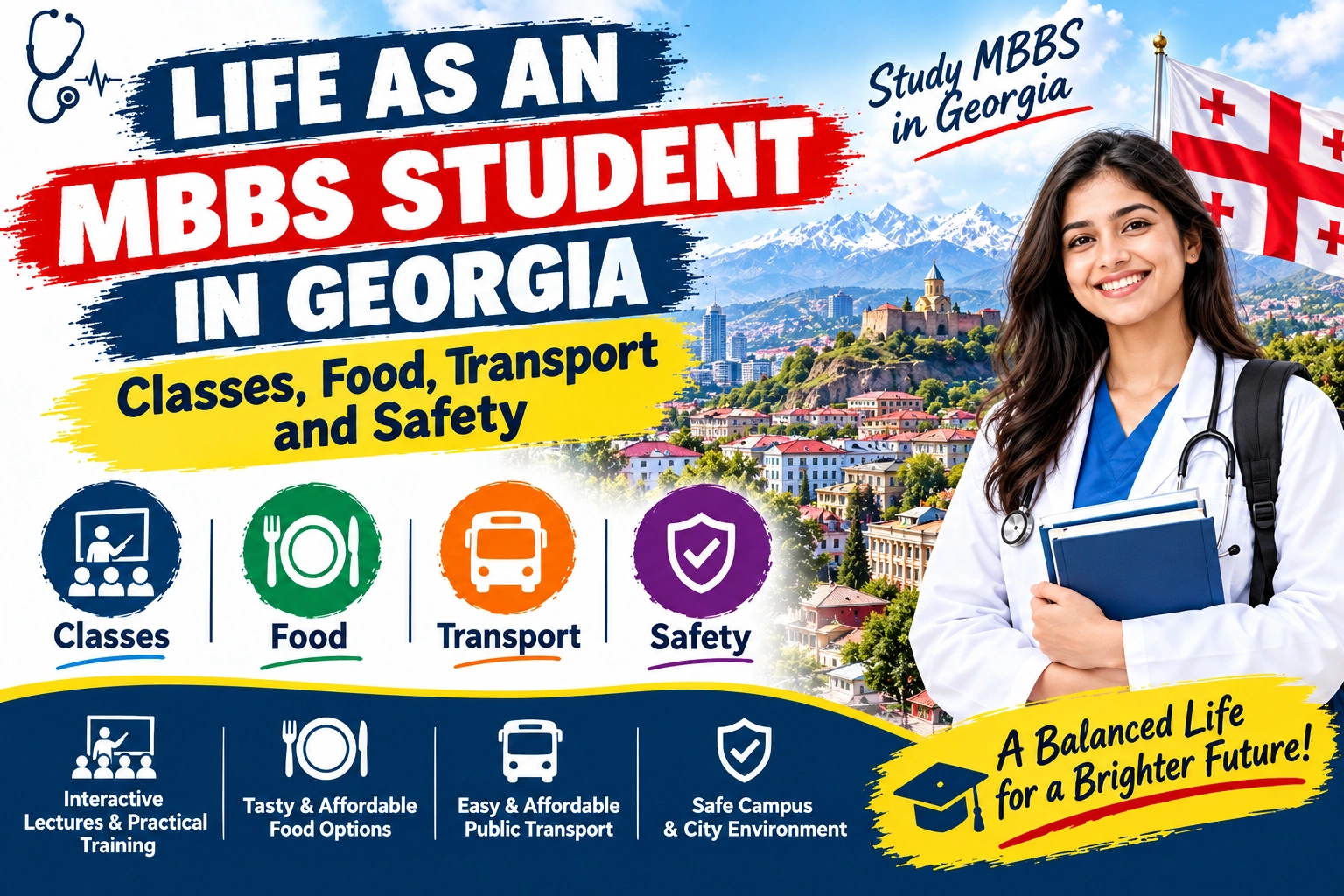
The first morning in Georgia rarely looks like a university brochure. You wake up in an unfamiliar room, check the bus route three times, realise the weather is colder than expected, and wonder whether the professor will pronounce your name correctly during attendance. Then classes begin. Life settles.For Indian students, MBBS in Georgia means much more than joining an English-medium medical programme. It means learning anatomy while adjusting to a new culture, finding affordable food, using public transport, managing rent and communicating with patients who may speak Georgian or Russian.
The medical course generally runs for six years. Tuition at many universities falls around USD 4,500–8,000 per year, though certain programmes can cost more. Tbilisi State Medical University, for example, currently lists USD 8,000 per year for its English-medium Medical Doctor programme. Accommodation, food and personal spending come separately. So, is student life comfortable? Mostly, yes—if you arrive prepared. Georgia offers modern cities, public transport, international student communities and a growing number of English-taught medical programmes. But daily life isn’t automatically easy. Clinical communication, budgeting and independent living take real effort.
What Does a Normal Day Look Like?
A typical weekday may start between 7:00 and 8:00 am, especially if the hostel or apartment is located away from campus. Students usually attend lectures, seminars, laboratory sessions and small-group practical classes. During the later years, hospital rotations take up a larger part of the timetable. The schedule differs across universities. Some days finish by early afternoon. Others stretch into the evening because of practical sessions, presentations or travel between the academic building and an affiliated hospital. After classes, most students return home, prepare food, review lecture notes and join online licensing-exam sessions. Sounds manageable. It can be. The trouble starts when laundry, grocery shopping, cooking and assignment deadlines all arrive on the same evening. Students planning MBBS in Georgia should not expect someone else to organise every hour. Independence is one of the best parts of studying abroad, but it comes with boring responsibilities. Bills. Cleaning. Missed buses. All of it.
How Medical Classes Are Conducted
Medical education in Georgia commonly follows a semester-based structure, with English-medium programmes designed for international students. The degree is usually called an MD rather than MBBS, though Indian students often use “MBBS” while discussing undergraduate medical education abroad. Early academic years focus on subjects such as anatomy, physiology, biochemistry, histology, molecular biology and medical terminology. Later semesters introduce pathology, pharmacology, microbiology, internal medicine, surgery, paediatrics, obstetrics and gynaecology, psychiatry and other clinical areas.
Lectures and Small-Group Sessions
What surprises many first-year students? Attendance is taken seriously in several universities, and missing classes can affect eligibility for assessment or require additional academic work. Lectures introduce the main topic, while seminars may involve oral questioning, case discussions or student presentations. A student who only reads one night before the examination may struggle during regular classroom questioning. Some professors share slides. Some don’t. You’ll still need textbooks.
Practical and Laboratory Work
Anatomy practicals may include models, specimens, digital tools or cadaver-based teaching, depending on the institution. Laboratory classes in biochemistry, physiology and microbiology help connect theory with actual procedures. The teaching quality isn’t identical everywhere. MBBS in Georgia applicants should ask current students how often practical sessions happen, whether equipment is functional and how many learners share one laboratory station. A polished campus tour won’t answer those questions.
Clinical Rotations
Hospital exposure generally becomes more substantial during the clinical phase. Students observe patient assessment, case documentation, diagnostic planning and treatment under supervision. There is one catch. Language. The programme may be taught in English, but patients usually communicate in Georgian, and some may speak Russian. Without local-language ability, a student can follow the professor’s explanation yet struggle to take an independent patient history. Basic Georgian should be learned before clinical rotations. Seriously.
Tuition Fees and Monthly Living Budget
Fees vary by university, city and programme. A reasonable planning range for an English-medium medical course is approximately USD 4,500–8,000 per academic year, although students must verify the current amount from the university before applying.
|
Monthly Expense |
Approximate Student Budget |
|
Shared accommodation |
USD 150–350 |
|
Food and groceries |
USD 120–220 |
|
Public transport |
USD 15–30 |
|
Mobile and internet |
USD 10–25 |
|
Utilities |
USD 30–80 |
|
Personal and study expenses |
USD 40–100 |
|
Approximate monthly total |
USD 365–805 |
These figures can move considerably. A student sharing an apartment and cooking daily may spend near the lower side, while private accommodation in central Tbilisi can push the budget much higher. Initial expenses are easy to underestimate. A rental deposit, bedding, kitchen utensils, winter clothes, residence-related formalities and insurance may all be needed during the first few weeks. Fees aren’t the only cost. Not even close.
Food: Can Indian Students Manage Comfortably?
Food is usually the first major lifestyle adjustment. Georgian cuisine includes bread, cheese, beans, vegetables, meat and dishes such as khachapuri, khinkali and lobio. Vegetarian students can find suitable local options, but they should still learn basic food-related words to avoid ordering something unexpected. Indian restaurants and grocery stores are available in Tbilisi and other student hubs. Imported spices, lentils, rice, flour and ready-to-cook products may cost more than they do in India. Eating restaurant food regularly also raises the monthly budget quickly. The practical answer is cooking. Most Indian students studying MBBS in Georgia share cooking duties with roommates. One person makes dal, someone handles rice, and another disappears conveniently when dishes need washing. Very normal.
A simple weekly plan keeps costs under control:
- Buy vegetables, fruit and basic groceries from local markets or supermarkets.
- Cook larger portions during weekends.
- Carry lunch when classes run for several hours.
- Keep instant food for busy days, not every day.
- Check whether hostel kitchens permit cooking before booking a room.
- Don’t ignore nutrition during examination weeks.
Honestly, students discuss Indian food availability a lot but rarely ask about kitchen access. That question matters more.
Public Transport in Tbilisi and Other Cities
Tbilisi has a practical network of metro trains, city buses and minibuses. The standard municipal fare is currently 1 Georgian lari for 90 minutes of travel, including permitted transfers, according to the city transport tariff. A reusable Metromoney card costs extra and can be topped up as required. The metro is usually the fastest option during busy hours. It operates across two main lines, while buses connect areas not directly served by a station. Apps and digital maps make route planning easier, although students should leave additional time during rain, snow or peak traffic. Taxis booked through established apps are widely used. They are convenient for late travel or carrying groceries, but daily taxi use can quietly damage a student budget. Batumi has buses and minibuses but no metro. It is smaller than Tbilisi, so travel distances may be shorter depending on the campus and accommodation location. Before accepting a hostel, check the route at actual class time. A place described as “15 minutes from university” may be 15 minutes by car at midnight and 50 minutes by bus on a weekday morning.
Hostel or Private Apartment: Which Is Better?
I generally find the first semester easier in a well-managed hostel or university-arranged accommodation. Students meet classmates quickly, receive help with the city and don’t have to negotiate a rental agreement immediately after arrival. Hostel rules, however, can be strict. Shared kitchens may be crowded, bathrooms may be limited, and privacy isn’t always great. Private apartments offer more freedom. Two or three students can split the rent, cook comfortably and choose a location near the university. The downside? Deposits, utility bills, landlord communication and repairs become the students’ responsibility.
|
Accommodation Type |
Advantages |
Possible Problems |
|
University or private hostel |
Easier first-year adjustment, student community |
Shared facilities, fixed rules |
|
Shared apartment |
More privacy, cooking freedom, divided rent |
Deposits, bills, landlord issues |
|
Private studio |
Maximum independence |
Higher rent and greater isolation |
|
Homestay |
Local cultural exposure |
Less freedom and possible language difficulty |
Students should ask whether heating, electricity, water and internet are included in the rent. Georgian winters can be cold, and heating expenses can noticeably increase utility bills.
Is Georgia Safe for Indian Medical Students?
Georgia is generally treated as a destination where ordinary precautions are appropriate, but safety conditions can vary by area and political situation. Demonstrations occur in Tbilisi, and foreign travel advisories commonly recommend staying away from protests and large political gatherings. Certain regions, including Abkhazia and South Ossetia, carry serious travel warnings and should not be visited casually. Students must follow local law, university advice and current embassy or government alerts.
For everyday safety:
- Use recognised taxi applications rather than accepting an unknown roadside ride late at night.
- Keep passport copies and residence documents stored separately.
- Avoid isolated streets after dark.
- Don’t display large amounts of cash.
- Stay away from demonstrations, even if they initially appear peaceful.
- Share late-night travel details with a trusted friend.
- Save local emergency, university and Indian mission contact details.
- Report harassment or theft instead of quietly ignoring it.
Female students should check hostel entry systems, lighting, transport after clinical duties and access to a female warden. MBBS in Georgia can be comfortable for women, but “the country is safe” is too broad an answer. The exact neighbourhood and accommodation arrangement matter.
Weather and the Winter Adjustment
By November, the suitcase packed in India may start looking slightly optimistic. Tbilisi winters can be cold, with occasional snow and temperatures sometimes dropping near or below freezing. Batumi is usually milder but receives more rain and can feel damp. Good shoes matter. So does heating. Students should buy a proper winter jacket, thermal layers and waterproof footwear rather than filling luggage with several light sweaters. Indoor heating can also make the air dry, so hydration and basic skin care help. Summer in Tbilisi can be hot. The seasonal difference is wider than many Indian students expect, and commuting during either extreme takes adjustment.
Social Life, Weekends and Homesickness
The first month feels exciting. The third month can feel strangely quiet. International students build friendships through classes, shared apartments, sports, student associations and cultural events. Tbilisi has cafés, parks, museums and historic neighbourhoods, while Batumi offers the Black Sea promenade and a slower coastal lifestyle. Weekend travel is tempting because Georgia has mountains, monasteries and scenic towns. Enjoy it, but don’t treat every weekend like a holiday package. Medical coursework accumulates quickly. Homesickness often appears during festivals, illness or examination pressure. Regular calls with family help, but staying connected only to people back home can make local adjustment harder. Build a small circle in Georgia too. Two reliable friends are better than fifty group-chat contacts. The World Health Organization recognises mental health as part of overall health. If anxiety, isolation or sleep problems begin affecting classes, use university support services or speak with a qualified professional. Don’t wait until everything collapses.
NEET, NMC Rules and Returning to India
Daily life matters, but regulatory eligibility matters more. Indian students who intend to practise in India after graduating abroad must meet the applicable NEET requirement and foreign medical graduate conditions. Candidates should verify examination notices through the official NEET portal. The National Medical Commission has prescribed requirements involving course duration, subjects, medium of instruction, clinical training, internship and eligibility for local registration. Current rules have referred to at least 54 months of medical education and a 12-month internship, alongside other conditions. Don’t check only whether the degree lasts six years. Confirm where the internship occurs, whether the programme is taught completely in English, and whether the qualification allows the graduate to seek a medical licence in Georgia. For students planning MBBS in Georgia, written verification is essential because programme structures can differ between universities.
WDOMS Listing and University Recognition
A university’s name appearing in the World Directory of Medical Schools is useful, but it isn’t a complete approval certificate. WDOMS itself states that a listing does not mean recognition, accreditation or endorsement. Check the exact institution and programme. Then separately verify Georgian accreditation, NMC compatibility, clinical training and local licensing eligibility.The phrase “WHO-approved medical university” also deserves caution. WHO does not operate a simple approval list that guarantees an Indian student’s right to practise after graduation. Big claim. Weak meaning.
FMGE or NExT Preparation During the Course
Waiting until the sixth year to think about Indian licensing is a poor plan. Students should connect their university subjects with Indian examination requirements from the beginning. This doesn’t mean joining heavy coaching during the first semester. Learn the core subjects properly, revise regularly and start using India-oriented question banks once the fundamentals are clear. The applicable screening or licentiate examination may change during a six-year programme. Students hear both FMGE and NExT discussed, but they should follow official announcements rather than guessing which system will apply at graduation. Clinical knowledge matters beyond the exam too. A student who can solve multiple-choice questions but cannot take a patient history has a bigger problem.
FAQs
Is the medical course in Georgia taught in English?
Many universities offer six-year English-medium MD programmes for international students. Verify the medium for the complete course, including clinical training, before admission.
How much does an Indian student spend monthly in Georgia?
A shared-living budget may fall around USD 365–805 per month, depending on the city, rent, food habits and lifestyle. Private accommodation can cost more.
Is Indian food available in Georgia?
Yes, particularly in Tbilisi and major student areas. Indian restaurants and grocery stores are available, though cooking at home is usually cheaper.
Is public transport expensive in Tbilisi?
No. The standard municipal fare is currently around 1 GEL for 90 minutes of travel with permitted transfers. Students should confirm current tariffs after arrival.
Is Georgia safe for female MBBS students?
Many female international students live and study there safely, but accommodation location, late-night transport and hostel security must be checked carefully. Students should also avoid demonstrations.
Does a WDOMS-listed university guarantee registration in India?
No. WDOMS listing does not guarantee accreditation or NMC compliance. Every programme must be checked against current Indian and Georgian requirements.
Conclusion
Life as a medical student in Georgia is a mixture of serious classes and ordinary struggles. You’ll revise anatomy in a café, miss Indian food after three days, learn Georgian phrases from a taxi driver and discover that cooking rice correctly is apparently a group achievement. It changes you. The experience can provide an English-medium medical education, international exposure and a comparatively manageable lifestyle, but success depends on disciplined study, language learning and careful university selection. MBBS in Georgia helps Indian students compare universities, fees, admission conditions and regulatory requirements before making that choice. Look beyond tuition. Check clinical exposure, transport, accommodation and the full six-year structure. Once those pieces fit, Georgia can feel less like a foreign destination and more like the place where your medical career genuinely starts.