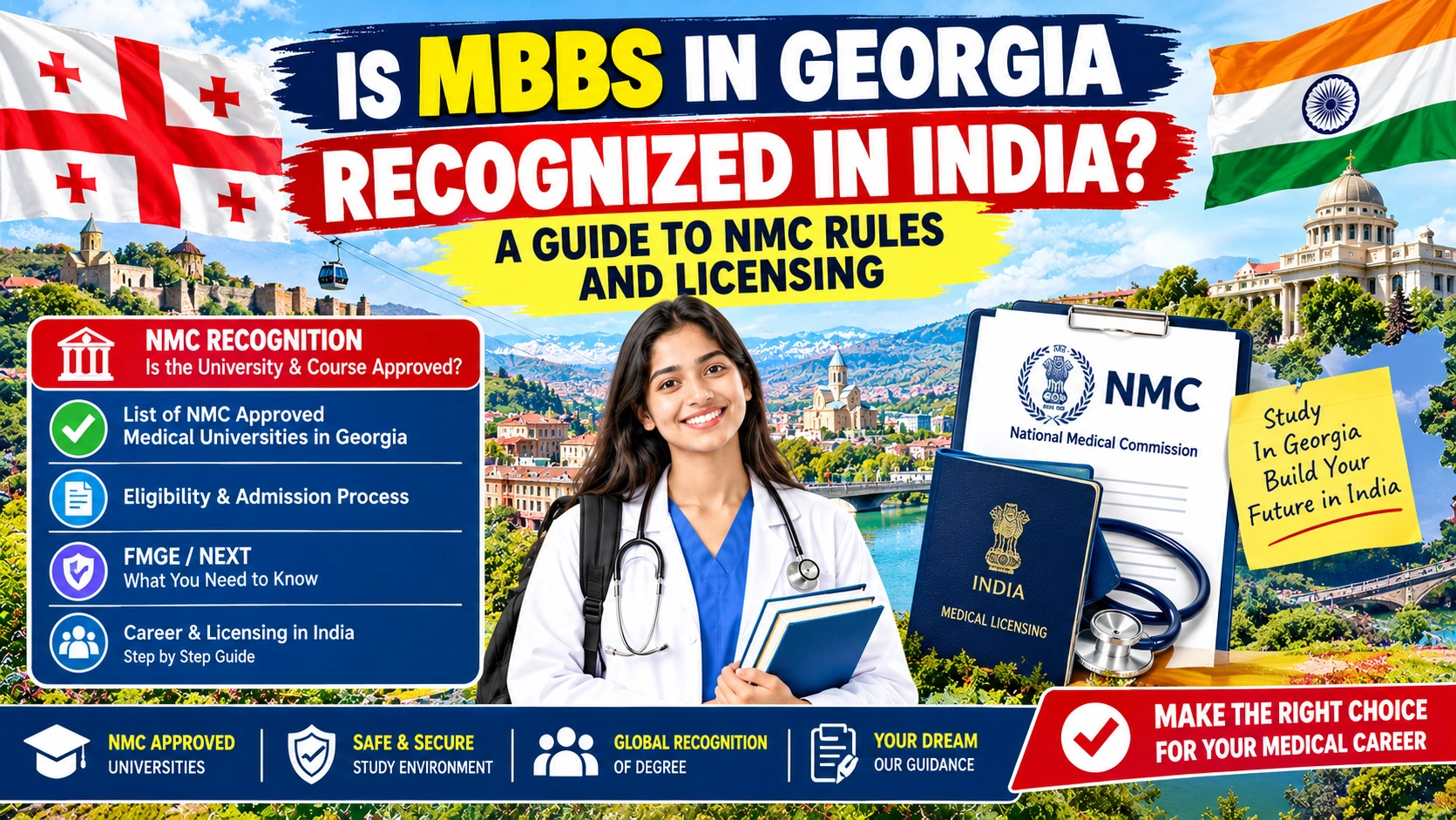
A medical degree from Georgia can lead to medical registration and practice in India, but there is a catch. Actually, several of them. Simply graduating from a Georgian university doesn't automatically give an Indian student the right to start practising medicine back home. For Indian students considering MBBS in Georgia, the bigger question isn't just whether Georgia offers good medical universities. The real question is whether the course, internship, clinical training and qualification satisfy the rules laid down by the National Medical Commission. That distinction matters a lot. Under the Foreign Medical Graduate Licentiate Regulations, 2021, students covered by these rules need a foreign medical programme of at least 54 months, a minimum 12-month internship at the same foreign medical institution, English as the medium of instruction, the prescribed medical subjects and clinical training, along with other licensing requirements. So yes, an MBBS-equivalent medical degree from Georgia can be acceptable for the Indian licensing pathway. But don't select a university because an agent says "NMC approved." Check the actual course. Check the internship. And definitely check whether the qualification makes you eligible for medical registration in Georgia itself.
Does NMC Recognize MBBS Degrees from Georgia?
Here's where students often get confused. The NMC doesn't work on the simple idea that every foreign university appearing on a particular list is automatically "approved" for Indian students. What matters is whether the foreign medical qualification and the student's complete education satisfy the applicable NMC regulations. NMC has repeatedly advised students planning medical education abroad to make sure their foreign university follows the requirements related to duration, syllabus, clinical training, internship and other conditions necessary for registration in India. This means two students studying medicine in the same country can potentially face very different situations. One may complete a compliant programme and proceed towards Indian registration. Another may discover later that some part of the curriculum, internship or licensing structure doesn't meet the applicable requirements. Honestly, this is something students should investigate before paying even the first-year tuition fee.
NMC Rules Indian Students Need to Check Before Admission
The NMC's Foreign Medical Graduate Licentiate Regulations came into force on November 18, 2021. Students covered by these regulations need to pay close attention to several conditions.
The major requirements include:
- The medical course leading to the foreign medical degree should have a minimum duration of 54 months.
- A minimum 12-month internship should be completed at the same foreign medical institution.
- The medium of instruction should be English.
- Students must study the required theoretical, practical and clinical subjects comparable to the Indian MBBS curriculum.
- The graduate should satisfy the condition relating to registration/licensing with the competent professional regulatory body in the country where the medical qualification is awarded.
- The student must clear the screening/licensing examination applicable in India.
- The required supervised internship in India must also be completed for registration, subject to the applicable rules.
The NMC FAQ specifically distinguishes clinical postings during the 54-month academic programme from the separate internship. They aren't treated as the same thing. That last detail is easy to miss. Very easy. A university advertising a "6-year MD programme" isn't enough information by itself. Indian applicants should obtain the detailed curriculum, internship structure, clinical rotation arrangement and licensing eligibility in writing.
Is a Six-Year Medical Course in Georgia Suitable for Indian Students?
Most popular Georgian medical programmes marketed to international students run for approximately six years, and English-medium programmes are available at a number of institutions. For example, current WDOMS records for some Georgian medical programmes show a six-year curriculum and English as the language of instruction. Sounds straightforward. Still, don't stop at "six years." For students pursuing MBBS in Georgia, the internal division of those six years matters. Ask how many months are academic study, how internship or clerkship is structured, where clinical rotations happen, and whether the programme satisfies current NMC conditions for foreign medical graduates. A typical Georgian medical degree may be called MD (Medical Doctor) rather than MBBS. The title itself isn't the main issue. The curriculum, duration, clinical education, internship and eligibility for professional registration are much more important from an Indian student's perspective.
NEET Is Still Important for Indian Students Going to Georgia
No shortcut here. Indian students who want to study medicine abroad and later follow the Indian registration route need to understand the applicable NEET requirement. The official NEET portal should always be checked for the latest examination notices, eligibility information and current-year rules rather than relying on screenshots circulating through student groups. NEET is conducted by the National Testing Agency as India's common undergraduate medical entrance examination. So an advertisement saying "MBBS abroad without NEET" deserves caution if your long-term goal is to return and practise medicine in India. A student might find admission possibilities abroad under a university's own rules, but that doesn't automatically mean the student will meet India's requirements later. Different thing entirely.
WDOMS Listing: Useful, But Don't Misread It
Another phrase students regularly hear is "WDOMS-listed university." Checking the World Directory of Medical Schools is sensible. The directory contains information on medical schools worldwide, and multiple Georgian medical schools appear in its records. Current directory information includes institutions such as Tbilisi State Medical University, University of Georgia, Georgian National University SEU, European University, BAU International University and others. But here's the detail that matters. WDOMS itself states that inclusion in the directory does not by itself mean recognition, accreditation or endorsement by WDOMS, WFME or FAIMER. So don't use this formula:
WDOMS listed = automatically NMC compliant.
It doesn't work that way. Use WDOMS as one verification point, then separately investigate the university's accreditation, curriculum, clinical facilities, internship arrangement and NMC-rule compatibility.
What About WHO Recognition?
Students also come across phrases such as "WHO recognized medical university." The World Health Organization is an important international public-health institution, but Indian students shouldn't treat a WHO-related claim as a substitute for checking NMC licensing requirements. For your ability to practise in India, the relevant Indian regulatory conditions are what ultimately matter. This is where marketing language creates unnecessary confusion. "Internationally recognized," "WHO listed," "globally accepted" — all sound impressive. None should replace proper regulatory verification.
FMGE, NExT and the Licensing Route After MBBS in Georgia
Finishing MBBS in Georgia is one stage. Becoming a registered medical practitioner in India is another. Under the NMC framework, an eligible foreign medical graduate must pass the screening test, National Exit Test, or another examination mandated under the rules, as applicable. NMC's FMGL FAQ expressly refers to the screening test/NExT or other mandated test as part of the requirements. Because examination and implementation arrangements can change, students graduating several years from now shouldn't build their entire plan around today's exam name alone. Check the NMC notifications applicable in your graduation year.
The broad pathway is easier to understand:
- Qualify NEET and meet the applicable eligibility requirements before foreign medical admission.
- Join a Georgian medical programme that satisfies relevant NMC conditions.
- Complete the required academic and clinical education.
- Complete the prescribed internship requirements.
- Obtain the foreign medical qualification and satisfy local licensing/registration eligibility requirements.
- Return to India and clear the applicable screening/licensing examination.
- Complete the required supervised internship in India.
- Apply for registration through the appropriate medical regulatory authority.
NMC's published FAQ states that FMGs covered by the 2021 rules must complete at least 12 months of supervised internship in India in addition to the required foreign internship.
The Local Licence Requirement Can Become a Serious Issue
This part deserves extra attention. Under the FMGL framework, the foreign medical graduate has to satisfy the requirement concerning registration with the relevant professional regulatory body, or otherwise be eligible for a licence to practise medicine in the jurisdiction where the degree was awarded, at par with citizens of that country. Read that carefully. Before choosing a Georgian university, ask exactly what happens after graduation. Can an international graduate obtain or become eligible for the required professional registration in Georgia? Is an additional examination required? Does language proficiency affect licensing? Does the programme itself provide the necessary clinical and internship components? Get current answers. Preferably documented ones. Rules can change during a six-year medical programme, so students should keep checking both Georgian regulatory requirements and NMC notices throughout their studies.
Clinical Training Matters More Than the Campus Photos
A beautiful campus is nice. A large lecture hall too. Neither will prepare you for licensing exams or real clinical practice if patient exposure is weak. Medical students need actual clinical learning — history taking, physical examination, case discussions, hospital rotations, interaction with patients and exposure across core specialties. For MBBS in Georgia, check whether clinical training happens in university-owned hospitals or affiliated hospitals, when rotations begin, what kind of patient flow those hospitals receive and how international students participate. There's another practical issue: language. The academic programme may be taught in English, but patients in Georgian hospitals may naturally communicate in Georgian. Students should therefore ask how universities handle bedside communication and whether Georgian-language training is provided for clinical years. Honestly, brochures don't talk enough about this.
Approximate Cost of Studying Medicine in Georgia
Recognition isn't the only consideration, although it should come first. For many established Georgian universities, international medical tuition commonly falls somewhere around USD 4,000–8,000 per year, depending on the institution and intake. Living expenses, accommodation, insurance, food, transport and personal spending come separately. A broad six-year budget for an Indian student can therefore move into roughly ₹30–50 lakh or more, depending heavily on university fees, exchange rates, lifestyle and accommodation. These aren't fixed quotations. Tuition can be revised, and currency conversion changes constantly. Always request the latest official fee letter from the university before calculating your total budget. A cheaper university isn't automatically a better deal. If its programme creates problems with clinical training or licensing eligibility later, saving a few lakh upfront doesn't look very clever anymore.
How to Check a Georgian Medical University Before Paying Fees
Instead of asking only, "Is this university NMC approved?", ask better questions. Check whether the medical school appears in WDOMS, then verify the exact programme and campus. Read the current NMC FMGL regulations and advisories yourself. Confirm that teaching is in English and obtain the complete curriculum showing academic duration and clinical subjects.Then ask the university specifically about internships. Where is it completed? How long does it last? Is it part of the same medical institution? What document is issued after completion? Can an international graduate meet Georgia's professional licensing or registration requirements? Also confirm hospital affiliations instead of accepting a vague statement such as "clinical exposure available." Paperwork now. Fewer surprises later.
Pros and Risks of MBBS in Georgia for Indian Students
There are genuine reasons why Indian families consider Georgia. Several universities offer English-medium medical education, six-year programmes are common, international student populations are established, and Georgia has medical schools listed in WDOMS. But MBBS in Georgia isn't automatically the right choice for every student. The main risk is choosing a university based primarily on fees, rankings or consultant recommendations while ignoring NMC compliance. Clinical exposure, internship structure, local licensing eligibility and preparation for the Indian licensing examination deserve equal attention. A foreign medical degree is a long investment. Six years abroad, followed by licensing requirements back home. That's why university selection should be regulatory-first, not brochure-first.
FAQs
Is MBBS from Georgia valid in India?
A Georgian medical qualification can be used toward the Indian medical registration pathway if the student and programme satisfy the applicable NMC requirements and the graduate completes the required licensing steps. A foreign degree doesn't itself provide an automatic licence to practise in India.
Does NMC approve Georgian medical universities?
Students shouldn't depend on the phrase "NMC-approved university." NMC regulates the conditions foreign medical graduates must satisfy for registration in India. Check the current FMGL regulations and NMC advisories before admission.
Is NEET compulsory for MBBS in Georgia?
Indian students intending to pursue the Indian medical registration pathway after studying abroad should qualify NEET according to the applicable rules. Always verify the current admission-year requirement through the official NEET website.
Is a WDOMS-listed Georgian university automatically valid in India?
No. WDOMS clearly says that a school's inclusion in its directory does not itself constitute recognition, accreditation or endorsement. Students must separately verify NMC compliance and other regulatory conditions.
Can I practise immediately after returning from Georgia?
No. Completing the foreign medical degree alone doesn't give an automatic right to practise medicine in India. Eligible foreign graduates have to complete the applicable examination, internship and registration requirements prescribed by Indian authorities.
Is Georgia a good option for Indian medical students?
It can be, provided the university and programme are selected carefully. Course structure, clinical training, internship, local licensing eligibility, total cost and future Indian registration requirements should all be checked before admission.
Conclusion
So, is an MBBS-equivalent degree from Georgia recognized in India? Potentially yes, provided the complete medical education and the graduate satisfy the NMC rules applicable to them. That second half is more important than the first. Don't select a university just because it has a six-year course, an English website and an attractive fee structure. Verify the 54-month academic requirement, separate internship requirement, clinical subjects, English-medium instruction, local licensing eligibility, WDOMS information and the Indian licensing route. If you're planning MBBS in Georgia, spend a little more time checking these details before admission. A university decision takes a few weeks. Its impact can stay with you for years.