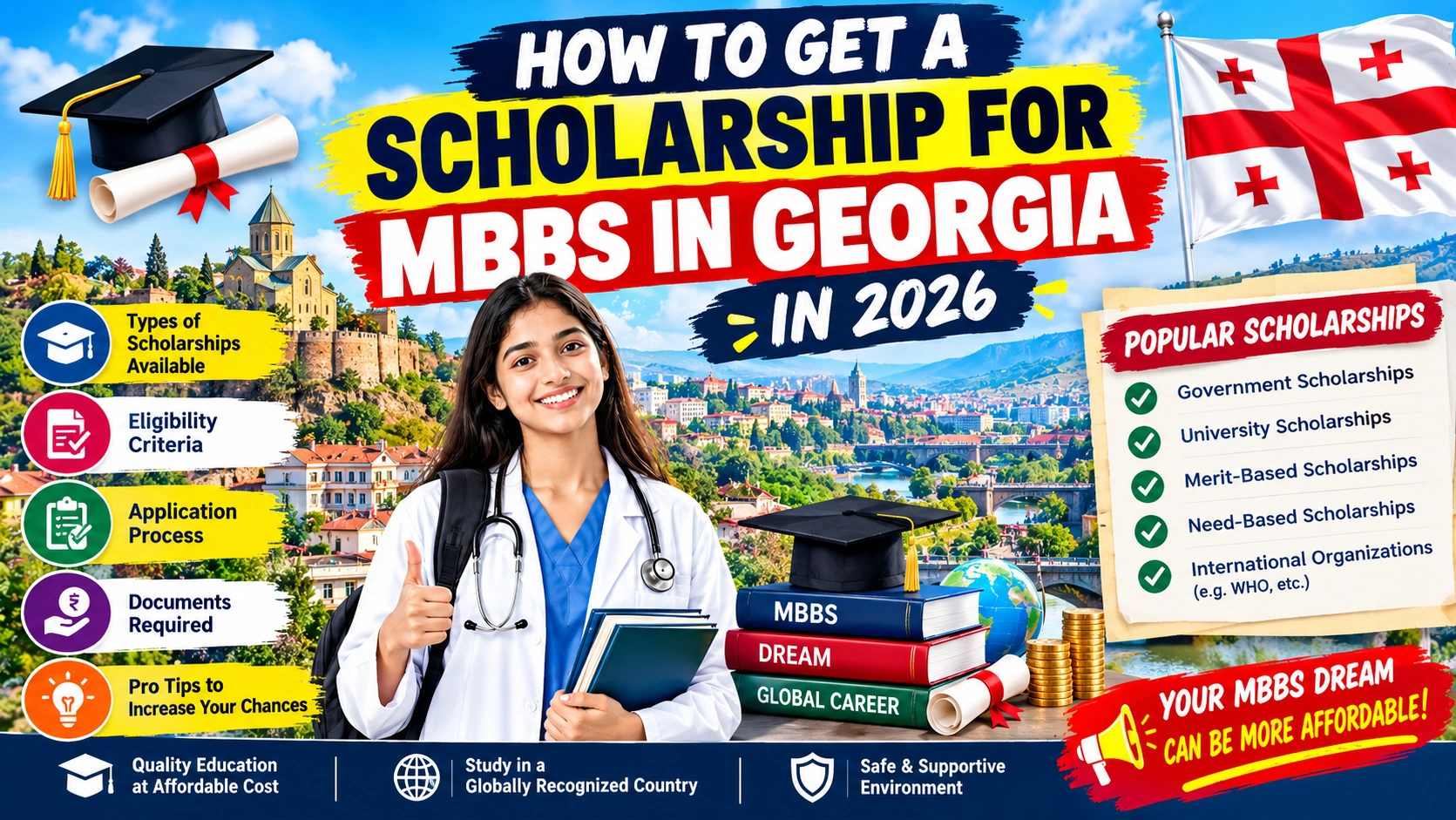
A medical degree in Georgia can cost far less than a private MBBS seat in India, but “affordable” doesn’t automatically mean cheap. Tuition alone at many Georgian medical universities can run roughly USD 5,000–8,000 per year, and then you still have accommodation, food, insurance, visa-related expenses, books, travel and personal spending. Over six years, that adds up. Quite a bit. This is exactly why students planning MBBS in Georgia often start searching for scholarships before they even shortlist a university. Here’s the catch: full scholarships covering an entire medical degree are not commonly available to international students. Partial tuition waivers, merit awards, university-funded discounts and performance-based scholarships are much more realistic. Some are available at admission, while others become accessible only after you complete a semester or academic year with strong grades. So yes, getting financial support is possible. But don't plan your entire Georgia admission assuming somebody will pay 100% of your tuition. A better strategy is to shortlist affordable universities first, then treat a scholarship as a cost-saving opportunity rather than the foundation of your budget. Students exploring universities, fees and admission options can also check the MBBS in Georgia guide before finalising their shortlist.
Are Scholarships Actually Available for MBBS in Georgia?
Yes, but the word “scholarship” can mean several different things here. One university may offer a merit-based tuition reduction, another might have an internal academic award after the first year, while a third may offer a limited scholarship competition with only a few successful students. And sometimes the advertised “scholarship” is simply a one-time tuition discount. Not the same thing.
For international medical students, financial assistance generally falls into these categories:
- Merit-based university scholarships
- Academic performance scholarships after enrolment
- Partial tuition-fee waivers
- Need-based assistance, where available
- Government or institutional scholarship programmes
- External/private educational scholarships
- One-time admission discounts or grants
Honestly, this distinction isn't discussed enough. If someone tells you, “This university gives a 50% scholarship,” ask the next question immediately: 50% for one semester, one year, or the entire six-year programme? That small detail can mean several lakhs of rupees.
How Much Can a Scholarship Actually Save?
Think in realistic numbers rather than advertisements. Suppose your medical programme costs USD 6,500 annually. The University of Georgia, for example, currently lists its English-language Medical Education MD programme at USD 6,500 in tuition. A 10% tuition reduction on USD 6,500 saves USD 650 for that year. A 25% award saves USD 1,625. At an illustrative exchange rate of ₹90 per USD, that's roughly ₹58,500 and ₹1.46 lakh respectively. Exchange rates change, obviously, so calculate again before paying.
|
Example Tuition |
Scholarship/Discount |
Approx. Annual Saving |
|
USD 5,000 |
10% |
USD 500 |
|
USD 6,000 |
20% |
USD 1,200 |
|
USD 6,500 |
25% |
USD 1,625 |
|
USD 7,000 |
30% |
USD 2,100 |
|
USD 8,000 |
50% |
USD 4,000 |
These are examples to explain the maths, not guaranteed scholarship amounts offered by every university. Scholarship rules can change between admission cycles. Always get the current scholarship policy directly from the university in writing.
What Are the Main Types of MBBS Scholarships in Georgia?
You’ll usually come across a few practical routes while researching MBBS in Georgia. Some sound similar on paper, but their eligibility can be very different.
Merit-Based Scholarships
Strong marks can help. Students with a consistently good academic profile in Physics, Chemistry and Biology may have an advantage where a university offers admission-stage merit awards. Universities may look at your Class 12 performance, entrance/interview performance, previous academic record or a combination of these factors. A 90% PCB student, for instance, may have a stronger scholarship profile than someone just meeting the minimum admission requirement. But there is no universal “90% = scholarship” rule across Georgia.
Performance-Based Scholarships After Admission
This route is often overlooked.Instead of giving you financial assistance before joining, a university may reward students who perform exceptionally well after enrolment. Your GPA, credits completed, attendance, academic conduct and examination results may all matter.This means your first semester can become surprisingly important. Study properly from day one. A scholarship earned through university performance is usually more realistic than waiting for a mysterious “100% MBBS scholarship” before admission.
Need-Based Financial Assistance
Some institutions or external organisations may consider financial circumstances along with academic merit. These opportunities tend to be limited and documentation-heavy.You could be asked for family income evidence, financial statements or other supporting documents.Don't assume that every Georgian medical university has a need-based scheme for foreign students. Ask specifically.
External and Private Scholarships
Indian students can also explore scholarships offered by charitable trusts, educational foundations, state-level programmes or private organisations. Eligibility can depend on family income, academic marks, category, domicile or other conditions.The crucial part? Check whether the scholarship allows funding for an undergraduate medical programme outside India. Many general study-abroad scholarships don't cover medicine.
Basic Eligibility You Should Build Before Applying
Scholarship eligibility and medical admission eligibility are two different things. You need both.A student may have excellent Class 12 marks but still fail to satisfy an essential regulatory condition for returning to practise in India. That is a much bigger problem than missing a scholarship.For Indian students, check the latest requirements on the National Medical Commission website before taking admission. NMC's Foreign Medical Graduate Licentiate Regulations include requirements concerning course duration, English-medium instruction, medical subjects, clinical training and other conditions relevant to foreign medical graduates. NMC's published FAQ specifies a minimum 54-month foreign medical course under the applicable FMGL framework.
A competitive scholarship applicant will generally benefit from:
- Strong Class 10 and 12 academic records
- Good PCB performance
- Qualified NEET where required for an Indian student pursuing medical education abroad
- A clean academic record
- Strong English communication
- A well-written scholarship statement
- Relevant extracurricular or community activities, where considered
- Complete documentation submitted before the deadline
Check your current NEET information and scorecard through the official NEET website. The 2026 portal currently provides NEET UG scorecard and examination information.
How to Get a Scholarship for MBBS in Georgia: Step-by-Step
Getting a scholarship isn't usually about filling one random form and waiting. You need to approach it alongside your university application.
1. Shortlist Universities Based on Total Cost First
Start backwards.Instead of asking, “Which university offers the biggest scholarship?” Ask, “Which university can my family afford even if I don't receive the scholarship?”That approach protects you financially.Compare annual tuition, hostel or private accommodation, insurance, residence permit expenses, food, transport, annual fee increases and miscellaneous university charges. A USD 1,000 scholarship isn't particularly useful if the university is USD 3,000 more expensive than another suitable option.
2. Check Whether the Medical Programme Meets Indian Requirements
Here, a little caution matters more than a discount.Indian students intending to return to India should assess the foreign medical programme against applicable NMC requirements before paying tuition. NMC has repeatedly advised students to conduct due diligence on foreign institutions, particularly regarding course duration, medium of instruction, curriculum, clinical training and internship arrangements.Also search the institution in the World Directory of Medical Schools (WDOMS) and check relevant international information through the World Health Organization where appropriate.One caution, though: appearing in a directory should not be treated as automatic proof that every aspect of a programme satisfies NMC requirements. Course structure matters too.
3. Contact the University’s International Admissions Office
Don't rely only on agents, social media reels or old scholarship posts.Write directly to the international admissions department and ask four precise questions: Is there a scholarship for international MD students in the 2026 intake? What percentage or amount does it cover? Is it renewable every year? What GPA or academic condition is required to retain it?Get the response by email. Save it.If somebody promises you a scholarship verbally but the university fee letter shows the full amount, don't transfer money until the discrepancy is explained.
4. Prepare a Strong Scholarship File
This part doesn't need fancy tricks. It needs completeness.Keep scanned copies of your Class 10 and 12 marksheets, passport, NEET scorecard, passport-size photographs, admission documents and any certificates showing academic achievements ready.If a Statement of Purpose or scholarship essay is requested, don't write generic lines such as “I have wanted to become a doctor since childhood” for half the page.Be specific. Explain your academic performance, why medicine, what you've done to prepare yourself, why financial assistance matters and how you intend to maintain strong academic performance.
5. Apply Early
Medical admissions for international students may have different application windows depending on the university and intake, so don't wait until the final few weeks.Scholarship funds can be limited. Even where admission remains available, a particular financial award may already have reached its quota.Ideally, start researching several months before your planned intake. For a 2026 admission, confirm the university's actual application and scholarship deadlines rather than relying on last year's dates.
6. Don't Stop Looking After First-Year Admission
Got no scholarship before joining? Fine. The search isn't necessarily over.Once you start MBBS in Georgia, maintain a strong GPA, avoid unnecessary academic backlogs and regularly check university announcements. Internal merit awards may depend on performance after enrolment.This is where discipline can literally save money.
What Does MBBS in Georgia Cost Without a Scholarship?
Numbers first. Tuition at Georgian medical universities can broadly fall around USD 5,000–8,000 annually for many English-medium medical programmes, although individual universities can sit outside this range and fees can change.The University of Georgia currently publishes USD 6,500 as the tuition fee for its English Medical Education MD programme.For Indian families, tuition isn't the whole budget. Add accommodation, food, local transportation, health insurance, residence-related expenses, air tickets, books and personal spending. Depending on lifestyle and university location, total expenditure across the course can become substantial.That’s why a partial scholarship still matters. Even USD 1,000 saved annually can become USD 6,000 across six years if—and this “if” matters—the award is renewable for the complete programme.
Can Scholarship Students Still Return to India and Practise?
A scholarship has nothing to do with your eligibility to practise medicine in India. Your medical qualification, programme structure, clinical training, internship and compliance with applicable Indian regulations do.NMC's current rules page continues to list the Foreign Medical Graduate Licentiate Regulations, 2021, along with subsequent FAQs and notices.So don't select a questionable medical programme merely because someone offers an attractive tuition waiver. Saving ₹3–4 lakh today makes little sense if the course creates registration problems later.Students pursuing MBBS in Georgia with plans to practise in India should therefore verify current NMC rules both before admission and during their studies, because regulatory requirements and examination arrangements can change.
Scholarship Traps Students Should Avoid
One pattern keeps appearing: a very large scholarship is advertised, but the original tuition has been inflated first. On paper, the discount looks impressive. In reality, the final fee isn't especially low.Watch for scholarship offers with unclear renewal rules, verbal promises without university confirmation, “guaranteed 100% scholarship” claims, compulsory service charges, unusually high processing fees or conditions hidden in the admission agreement.Another trap is assuming hostel and living costs are included. Usually, a tuition scholarship means exactly that—tuition. Your accommodation, meals, insurance, travel and daily expenses may remain completely separate.Ask for the final payable amount. In writing.
Is a Full Scholarship for MBBS in Georgia Realistic?
Possible opportunities may exist, but a full six-year scholarship for an international medical student should not be treated as the normal route.Partial assistance is more realistic.If your family budget only works on the condition that you receive a 100% scholarship, reconsider the financial plan before enrolling. Medical education lasts years, not months, and exchange-rate changes alone can alter your overall expenditure.For many students, the smarter combination is an affordable university + manageable family budget + merit scholarship + controlled living expenses.Not glamorous. Much safer.
FAQs
Can Indian students get a scholarship for MBBS in Georgia?
Yes. Indian students may be eligible for university merit scholarships, performance-based awards, tuition discounts or external funding, depending on the university and scholarship provider. Availability isn't uniform, so verify the 2026 policy directly with the institution.
Is NEET required if I receive a scholarship?
A scholarship doesn't replace regulatory eligibility. Indian students planning foreign medical education and later registration in India should check the applicable NEET and NMC requirements through the official NEET portal and NMC before admission.
How much scholarship can I get?
There is no standard percentage across Georgian medical universities. Awards may range from small tuition reductions to larger merit-based assistance, while some universities may not offer an admission-stage scholarship to international medical students at all.
Can I get a scholarship after starting MBBS in Georgia?
Potentially, yes. Some university scholarship systems may reward enrolled students based on GPA or academic performance. Ask your university whether international MD students qualify and what minimum academic performance must be maintained.
Does a scholarship cover hostel and food expenses?
Usually don't assume so. Many scholarships or fee waivers apply only to tuition. Accommodation, meals, insurance, transportation, flights and personal costs may remain the student's responsibility unless the scholarship terms explicitly include them.
Is Georgia worth considering if I don't receive a scholarship?
It can still be an option if the total cost fits your family's budget and the chosen medical programme satisfies the requirements relevant to your future career. Compare universities by total six-year expenditure, clinical education and regulatory compatibility rather than tuition alone.
Conclusion
Getting a scholarship for MBBS in Georgia in 2026 isn't about finding one magical application form. Start with a financially sensible university shortlist, verify the medical programme carefully, contact universities directly, prepare your documents early and keep your academic record strong enough to compete for merit awards after enrolment too.And keep expectations practical. A partial scholarship that genuinely reduces tuition by USD 1,000–2,000 can be far more valuable than an impressive-looking “50% scholarship” attached to unclear conditions.If Georgia is on your shortlist, compare university fees, admission requirements and medical education options through MBBS in Georgia, then confirm the latest 2026 scholarship terms directly with the university before paying any deposit. Scholarship policies change. Your admission decision shouldn't be based on an old brochure.