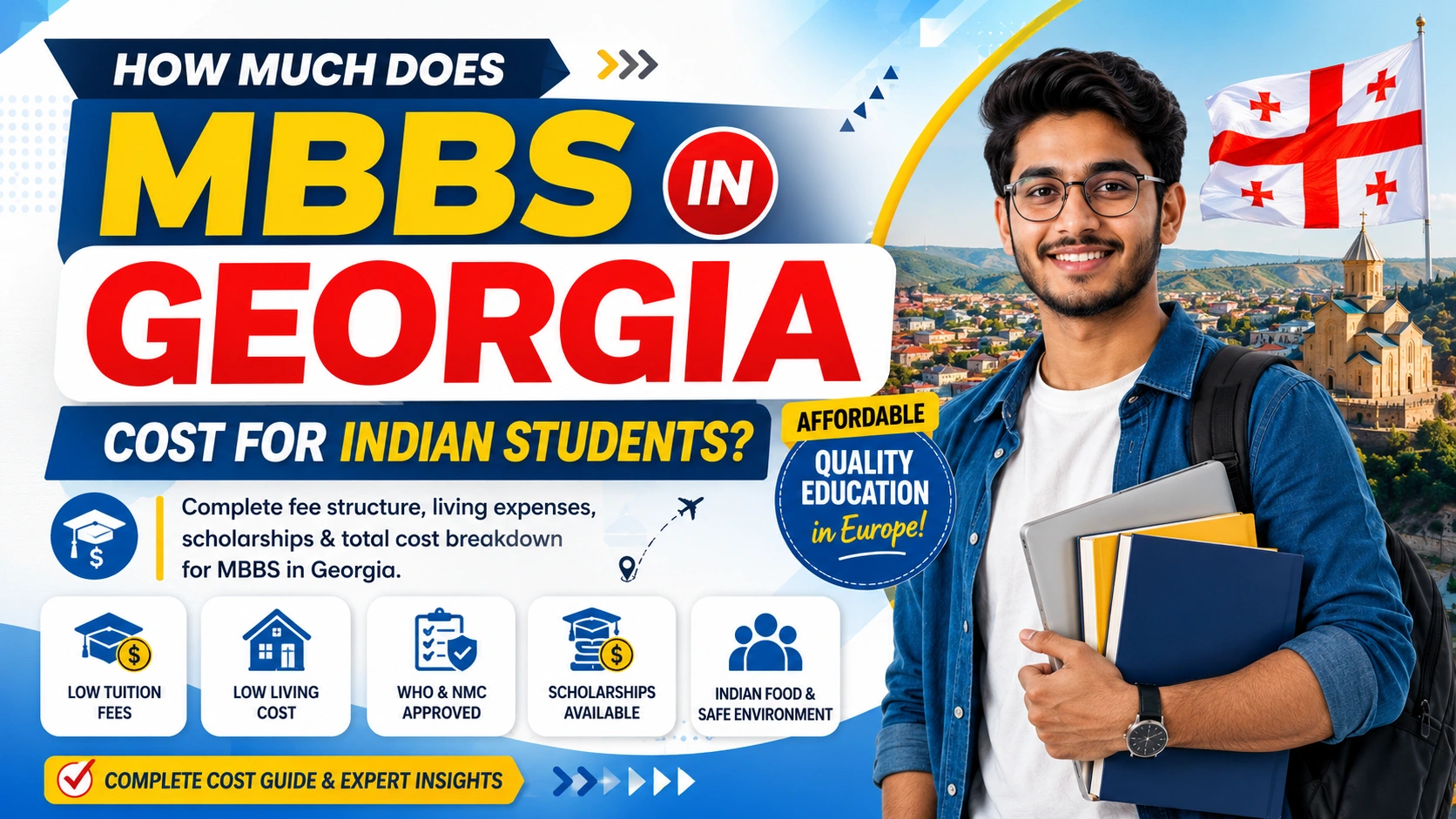
"Sir, MBBS in Georgia mein total kitna lag jayega?" I get some version of this question at least twice a week, every March, without fail. And for the first time in years, I can't just give the usual number.
Because the usual number is wrong now.
If you've spent even an hour researching MBBS in Georgia, you've seen the ₹25 lakh figure everywhere. Every second blog quotes it like it's gospel. It isn't wrong, technically — it's just describing a version of Georgia that stopped existing this year. Georgia's public universities have stopped taking new international students starting the 2026-27 academic year. That changes the entire budget conversation, and most of the internet hasn't caught up yet.
So let's actually go through this properly.
Why Georgia Got Popular in the First Place
Low fees. No brutal entrance test beyond NEET. English-medium teaching. A country that felt genuinely safe enough for parents to send a 17-year-old alone. That combination is basically why Georgia went from a niche option to one of the more searched MBBS-abroad destinations in the last five years.
Then this year happened. Tbilisi State Medical University. Batumi Shota Rustaveli State University. Ivane Javakhishvili Tbilisi State University. Akaki Tsereteli State University. All government-run, all closed to new foreign applicants now. I know at least two consultancies still quoting fees from these exact universities in their brochures. Not because they're lying — just because nobody updated the PDF.
What's left are Georgia's NMC-approved private medical universities, roughly nine of them still actively enrolling Indian students. Private, in this case, doesn't mean expensive. Not compared to India anyway. But the numbers below are different from what you've probably read elsewhere, so bear with me. The current list of active partner universities is on the MBBS in Georgia site, and it gets revised as intake status shifts — worth bookmarking honestly.
Eligibility, Quickly
Nothing dramatic here.
50% marks in Physics, Chemistry, Biology at 10+2, general category. 40% if you're SC/ST/OBC. Minimum age 17. And a NEET score — which brings me to the next bit, because this is where people cut corners they shouldn't.
NEET Is Not Optional
I'll just say it plainly. Yes, it's compulsory.
Some agents will pitch a "without NEET" route for MBBS in Georgia, and a small number of universities do technically allow it. What they conveniently skip mentioning is that a degree earned this way can't be used for FMGE or NExT registration back in India. No NEET, no legal practice rights at home. Full stop. Verify current NEET requirements and dates directly on the official NTA portal rather than take an agent's word for it — this one detail decides whether six years of your life count for anything here.
The Actual Fee Numbers for 2026
Here's where the internet gets genuinely confusing, so let me just lay out what different sources are saying instead of pretending there's one clean figure.
Older estimates — built around the now-closed government universities — put six years at roughly ₹22-40 lakh. That number is circulating everywhere. But with the shift to private universities, plus a weaker rupee against the Georgian Lari, the realistic range now sits closer to ₹40-65 lakh for the full course, tuition and living costs combined.
Tuition alone runs $4,000 to $8,500 a year depending on the university. In rupees, roughly ₹3.5-8 lakh annually. Add hostel and food, another ₹1.5-2.5 lakh a year, and you're looking at ₹7-11 lakh per year overall.
|
Expense Head |
Approximate Annual Cost |
|
Tuition Fees |
₹3.5 – ₹8 lakh |
|
Hostel/Accommodation |
₹80,000 – ₹1.5 lakh |
|
Food & Daily Living |
₹70,000 – ₹1 lakh |
|
Visa, Insurance, Misc. |
₹40,000 – ₹80,000 |
Honestly? Don't take my number as final either. Exchange rates move, universities revise fees mid-year, and I've seen two consultants quote a ₹10 lakh gap for the exact same college. The MBBS in Georgia fees breakdown page is a decent starting reference, but get the actual written fee structure from the university before anyone signs anything.
Still — even at the higher end, this beats a private medical seat in India, where the total can cross ₹1 crore without much trouble. That comparison hasn't really changed.
Duration
Six years. Five years of academics, one year of clinical internship. Fairly standard, matches what NMC expects for foreign MBBS degrees to be recognized here.
Recognition Isn't Optional Either
Check three things before you shortlist anything.
Is the university actually listed on the National Medical Commission's official database — not a screenshot an agent sent you, the actual site. Is it in the World Directory of Medical Schools, which ties into WHO standards. And does its general recognition status hold up when you cross-check through WHO itself.
"Verbal approval" isn't a thing. Either it's on the list or it isn't, and agents claiming otherwise are usually stalling.
How Admission Actually Works
Roughly like this — appear for NEET, get a qualifying score, shortlist among the NMC-approved private universities still open, send in your documents (academics, passport, NEET scorecard), wait for the offer letter, apply for your Georgian student visa, pay the first installment, and travel.
Doesn't sound complicated on paper. It rarely is, actually — the mistakes happen with timing, not process. One thing worth doing: apply for your visa and your NMC Eligibility Certificate at the same time, right after the offer letter lands. Don't sequence them. Students who wait for one before starting the other are, almost every single time, the ones who end up missing intake. The MBBS in Georgia has university-specific deadlines if you want to plan around a particular college.
Intake usually falls in September or October. A smaller secondary window sometimes opens in spring. Confirm exact dates with the specific university — they do shift slightly.
The Costs Nobody Mentions Upfront
This bit gets left out of most guides, and it quietly costs families real money.
Currency conversion fees, for one. Every wire transfer from India to Georgia eats a small percentage through the bank or remittance service. Doesn't sound like much per transaction. Over six years, it adds up more than people expect.
FMGE or NExT coaching after you're back in India — that's another ₹50,000 to ₹2 lakh, depending on how much support you need.
And then the small stuff. Flights home during breaks. A weak rupee one semester, a slightly better one the next. Eating out because hostel food starts feeling repetitive by year two — nobody budgets for that, but everyone spends on it.
Georgia vs India, Side by Side
|
Factor |
MBBS in Georgia |
Private MBBS in India |
|
Total Cost |
₹40-65 lakh (2026 revised est.) |
₹60 lakh – ₹1 crore+ |
|
Entrance Requirement |
NEET score |
NEET + high cutoff/donation |
|
Duration |
6 years |
5.5 years + internship |
|
Medium of Instruction |
English |
English/regional |
|
Recognition Check Needed |
NMC, WHO, WDOMS |
NMC only |
Pros and Cons, Without the Sugarcoating
In Georgia's favor — genuinely cheaper than Indian private colleges, no donation culture, English-medium classes, decent safety track record. Also — and this actually surprised me when I first looked it up — Georgia's FMGE pass rate has ranked among the highest globally for MBBS-abroad countries in recent NBEMS data. That's not something most consultancies advertise.
On the other side — fewer university options now that the government ones have shut their doors, which has also pushed costs up. Climate adjustment can be genuinely tough if you're coming from a warmer Indian state. And clinical exposure, while fine, doesn't match the sheer patient volume you'd get at a strong Indian medical college.
FAQs
Is MBBS in Georgia recognized in India? Yes — as long as the specific university is on the NMC list and follows the required curriculum length. Not automatic across every institution, so check individually.
Can I do MBBS in Georgia without NEET? Technically some universities allow it. Practically, you won't be able to register for FMGE or NExT with that degree. Skip this route if practicing in India matters to you. Confirm current NEET rules on the NTA site directly.
What's the real total cost in 2026? Somewhere between ₹40-65 lakh for the full six years at private NMC-approved universities. Older sources quoting ₹25 lakh are describing government universities that no longer admit international students.
How long is the course? Six years — five academic, one clinical internship.
Are public universities in Georgia still open to Indians? No, not for new admissions from 2026-27 onward. Check intake status in MBBS in Georgia before shortlisting anything.
Do I need IELTS or TOEFL? Usually not, though a few universities might ask for basic English proficiency confirmation during the process.
Conclusion
Most of what's written about MBBS-abroad options online right now is stale. Not deliberately misleading, just outdated — policies moved faster than the blogs tracking them this year, and Georgia is a pretty clean example of that gap.
So don't take any single source at face value. Not this one either. Call the admission office yourself. Cross-check recognition on NMC and Wdoms directly. If you can, find a current student and ask what they actually paid last semester — that number tells you more than any brochure will.
And if you'd rather not do all this legwork alone, reaching out to a counselor for an updated, university-specific fee breakdown this intake is probably worth the half hour it takes.