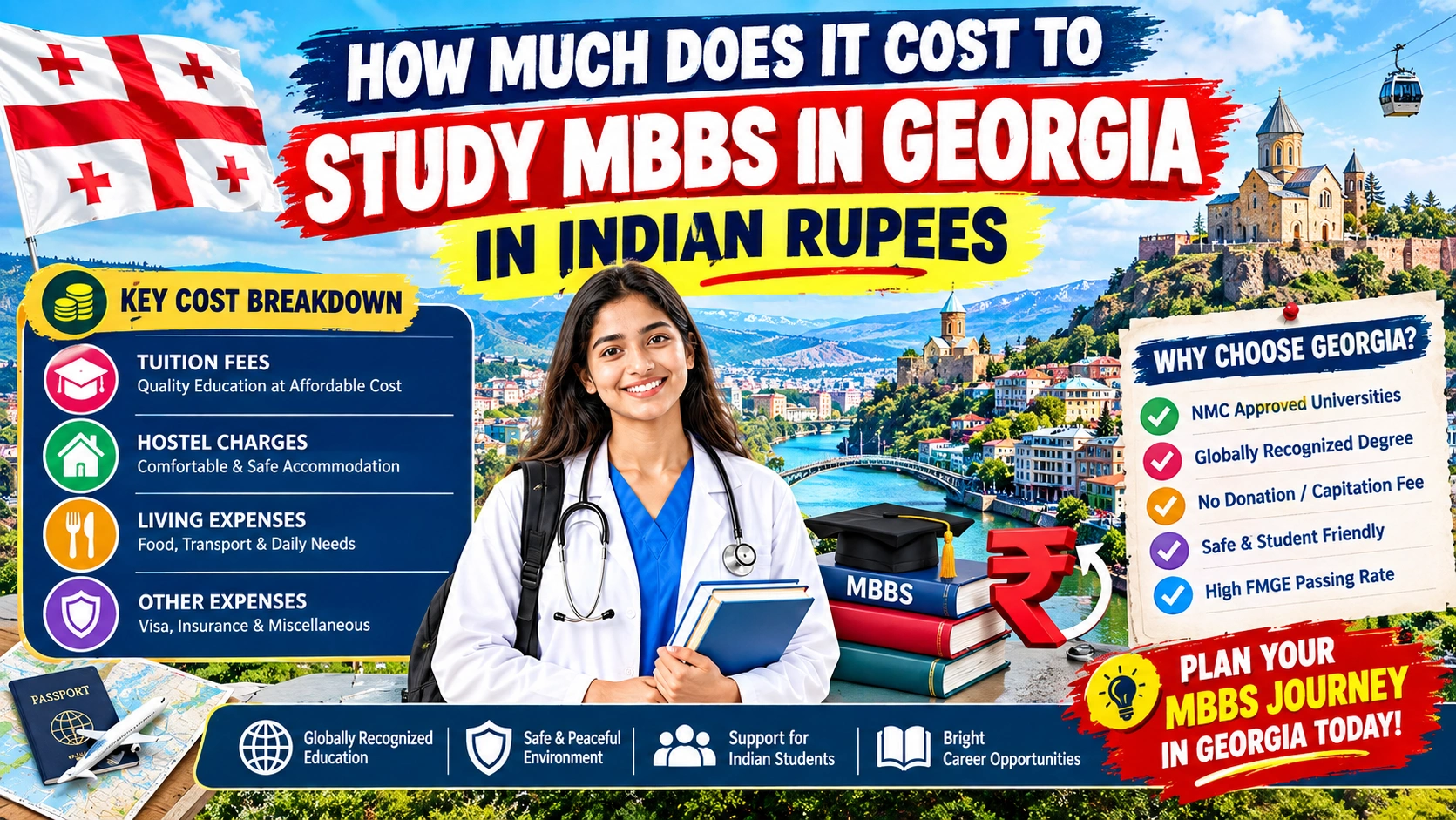
For an Indian student comparing overseas medical options, one question usually comes before everything else: what will the complete degree actually cost? Not just the tuition printed on a university brochure. The real amount—tuition, hostel, food, insurance, visa expenses, travel, daily spending, and those smaller charges families often discover after admission. For MBBS in Georgia, a sensible working budget is roughly ₹30 lakh to ₹50 lakh for the complete course, depending heavily on the university, exchange rate, accommodation choice, and lifestyle. Some students may manage below this range at a lower-fee university with controlled living expenses, while a premium university and private accommodation can push the total above ₹50 lakh. That gap is big. Very big. So simply hearing that “Georgia MBBS costs around ₹35 lakh” isn't enough to make a decision. Families should calculate the cost university by university and year by year. The official MBBS in Georgia resource can be used to explore universities and admission-related information, but fees should always be reconfirmed directly with the chosen university before paying anything. The National Medical Commission itself advises students planning medical education abroad to verify the fee structure, course details, duration, and internship directly with the foreign institution.
What Is the Average Cost of MBBS in Georgia in INR?
Start with the bigger picture. Medical programs in Georgia are commonly offered as six-year MD programs, and international tuition varies considerably between institutions. A practical tuition estimate is around USD 4,000–8,000 per year, although individual universities can fall outside this band. Using an approximate conversion of ₹88–₹90 per USD purely for budgeting, annual tuition can work out to roughly ₹3.5 lakh to ₹7.2 lakh. Currency rates move, though. Sometimes noticeably. So don't prepare a six-year budget assuming today's exchange rate will remain unchanged.
A typical family budget may look something like this:
|
Expense |
Approximate Cost |
|
Annual tuition fee |
₹3.5–₹7.2 lakh |
|
Hostel/accommodation |
₹1–₹2 lakh per year |
|
Food & personal expenses |
₹1.2–₹2 lakh per year |
|
Insurance/local charges |
₹20,000–₹50,000 per year |
|
Flights |
₹35,000–₹70,000 per trip, approximately |
|
Initial documentation/visa-related expenses |
Varies |
|
Estimated complete budget |
₹30–₹50+ lakh |
These aren't fixed official rates. Think of them as planning numbers rather than a final quotation.
University-Wise MBBS Fees in Georgia: What Should You Expect?
Here is where things become interesting. Two students can both study medicine in Georgia and still spend several lakhs differently over six years because their university tuition isn't the same. For example, the University of Georgia currently publishes a tuition fee of USD 6,500 per year for its English Medical Education MD program. At an assumed exchange rate of ₹89 per dollar, that's approximately ₹5.79 lakh annually, or around ₹34.7 lakh in tuition alone over six years if the fee and exchange rate stayed unchanged. For comparison, students researching universities such as Tbilisi State Medical University, Batumi Shota Rustaveli State University, Georgian National University SEU and other Georgian institutions may encounter different fee structures.
A broad comparison for initial budgeting can look like this:
|
Medical University |
Approx. Annual Tuition Range |
|
University of Georgia |
Around USD 6,500 |
|
Tbilisi State Medical University |
Around USD 8,000 range |
|
Georgian National University SEU |
Around USD 5,500–6,000 range |
|
Batumi Shota Rustaveli State University |
Around USD 4,000–5,000 range |
|
Other Georgian medical universities |
Around USD 4,000–8,000+ |
Here’s—well, this is exactly where students should slow down. Online fee figures become outdated surprisingly quickly. The University of Georgia figure above comes from its official tuition page; the other ranges are indicative planning figures and should be checked on the respective university's current official admission or fee page before application.
Tuition Is Only Half the Story
A brochure may show USD 5,000 tuition and suddenly the degree looks extremely affordable. But that's not your complete cost. Accommodation matters. Food matters. Flights matter too. Students staying in university hostels or shared apartments might budget approximately ₹8,000–₹18,000 per month for accommodation, depending on city, room type, sharing arrangement and facilities. Private apartments, especially in Tbilisi, can cost more. Food and everyday expenses could add another ₹10,000–₹18,000 monthly for a reasonably controlled student lifestyle. Someone cooking regularly and sharing accommodation will usually spend less than someone eating outside frequently. Over six years, even a difference of ₹8,000 per month becomes ₹5.76 lakh. That's why lifestyle isn't a tiny part of the calculation. It can change the final number quite a lot.
A Realistic Six-Year MBBS in Georgia Cost Breakdown
Suppose a student chooses a university charging around USD 5,500 annually. At ₹89 per USD, that's approximately ₹4.90 lakh per year. Six years of tuition would therefore come close to ₹29.4 lakh, assuming neither tuition nor the exchange rate changes. Now add accommodation and normal living expenses. If those together average approximately ₹2.2 lakh annually, that's another ₹13.2 lakh over six years. Then come flights, insurance, residence-related expenses, documentation, local transportation and miscellaneous university charges. Even another ₹2–₹4 lakh across the course isn't difficult to imagine. Suddenly, a “₹29 lakh tuition degree” becomes a ₹44–₹47 lakh overall education budget.Honestly, this is the number families should focus on. Not the headline tuition figure.
Hidden Costs Students Often Forget
Small expenses don't look dangerous individually. Combined over six years? Different story. A student may need money for residence permits, health insurance, document translation or notarisation, medical examinations, university registration-related charges, SIM/mobile expenses, textbooks or digital resources, local transport, winter clothing, airport transfers and occasional travel back to India. There is also currency fluctuation. Imagine annual tuition is USD 6,000. At ₹84 per dollar, that's ₹5.04 lakh. At ₹90, it becomes ₹5.40 lakh. The university hasn't increased its fee at all, yet the Indian family's expense has risen by ₹36,000 for that year. Across several years... it adds up. Keep a 10–15% contingency amount above your calculated budget. That's a much safer way to plan.
Is NEET Required for MBBS in Georgia?
Yes, Indian students intending to return and pursue medical registration in India need to pay serious attention to Indian eligibility rules rather than treating NEET as an optional admission formality.The official NEET UG portal is the right place to check the current examination bulletin, qualifying requirements and results information. The 2026 portal currently provides the official NEET information bulletin and candidate updates. Students generally need to have completed 10+2 with Physics, Chemistry, Biology/Biotechnology and English while satisfying applicable eligibility conditions. Don't choose a university only because an agent says admission is possible with low marks. Admission and future eligibility to practise in India are two separate questions.
NMC Rules Matter More Than a Cheap Fee
Here's the part where saving ₹3 lakh can become an expensive mistake. Under the NMC's Foreign Medical Graduate Licentiate Regulations, the foreign medical course for covered students must meet specific requirements. NMC's published FAQ states, among other requirements, a minimum course duration of 54 months, English as the medium of instruction, and theory, practical and clinical training comparable to the Indian MBBS curriculum. Students therefore need to evaluate the complete medical program, clinical training, internship arrangement, local registration eligibility and compliance with the regulations applicable to their admission batch. Read the latest NMC regulations before paying a university deposit. NMC's current rules page includes the Foreign Medical Graduate Licentiate Regulations 2021 as well as updated FAQs published in June 2026. Cheap isn't automatically good. And expensive isn't automatically compliant either.
What About WHO and WDOMS Recognition?
Students often hear phrases such as “WHO approved” or “WDOMS approved.” Be careful with that language. The World Health Organization is an important international health authority, but students shouldn't treat a marketing statement involving WHO as proof that a medical degree automatically qualifies them for registration in India. Similarly, use the World Directory of Medical Schools to check the medical school and its listing details. But there is an important catch: WDOMS itself clearly states that inclusion in its directory does not by itself mean recognition, accreditation or endorsement of that medical school.This distinction gets missed. A lot. For an Indian student considering MBBS in Georgia, NMC compliance and the student's eventual eligibility for Indian medical registration deserve far more attention than marketing labels.
FMGE/NExT and the Cost After Graduation
Your financial planning shouldn't necessarily stop on graduation day. Foreign medical graduates who want to practise in India have to satisfy the registration framework applicable to them. NMC continues to list the Foreign Medical Graduate Licentiate Regulations and Screening Test regulations, while NExT has its own regulatory history and implementation status. That means students should check the rule applicable at the time they graduate rather than assuming today's examination arrangement will remain identical six years later. There may also be post-graduation expenditure for exam preparation, travel, documentation, registration procedures or additional training. Budget for that possibility. Even if approximately.
Is MBBS in Georgia Worth ₹30–50 Lakh?
For the right student, it can be. Georgia attracts Indian students because several universities offer English-medium medical education, international student intake and tuition that can remain below the total cost charged by many private medical options elsewhere. The country is also relatively accessible from India. But MBBS in Georgia shouldn't be selected only because ₹35–40 lakh sounds affordable compared with an Indian private medical college. Look at clinical exposure. Check the curriculum. Ask how an internship works. Verify whether the qualification provides the required eligibility in Georgia. Study NMC's current foreign medical graduate regulations yourself. And ask existing students uncomfortable questions—not just “How is the university?” Ask how many patients students actually interact with. What language is used during hospital interaction? Are clinical rotations genuinely hands-on? What does a normal month cost? Are there compulsory charges that weren't mentioned before admission? Those answers are useful.
How Can You Reduce the Cost Without Compromising Your Degree?
Saving money doesn't necessarily mean picking the cheapest university available. Often, the smarter savings happen outside tuition. Share accommodation instead of immediately renting a private studio. Cook regularly. Compare cities rather than assuming Tbilisi is the only sensible destination. Book India–Georgia flights early when possible, and maintain an emergency fund separately instead of treating it as spending money. More importantly, compare universities on total six-year cost. University A charges ₹4 lakh annually but requiring expensive accommodation may eventually cost nearly as much as University B charging ₹5 lakh with cheaper housing options. Do the full calculation first. Then choose.
Pros and Cons of Studying MBBS in Georgia
There are genuine advantages. English-medium medical programs are available, students have multiple university choices, and the overall budget can be attractive compared with some private medical education options. The downsides deserve equal space. Six years abroad is a serious financial commitment. Exchange-rate changes can increase expenses. Georgian language skills may become relevant during clinical interaction with local patients. And Indian students need to remain careful about NMC requirements throughout their education, not just during admission. So yes, the option is attractive. But it isn't a shortcut.
FAQs
How much does MBBS in Georgia cost in Indian rupees?
A reasonable complete budget is approximately ₹30 lakh to ₹50 lakh or more, including tuition and living expenses. Your actual expenditure depends on university fees, accommodation, lifestyle and USD-INR/GEL-INR exchange rates.
What is the annual MBBS fee in Georgia?
Many medical universities fall broadly around USD 4,000–8,000 annually, which can translate to roughly ₹3.5–₹7.2 lakh at an assumed exchange rate of ₹88–₹90 per USD. Always verify the current fee directly with the university.
Can I complete MBBS in Georgia under ₹30 lakh?
Possibly in specific low-cost circumstances, but students shouldn't build their entire plan around that figure without a detailed calculation. Tuition alone at some universities can approach or exceed ₹30 lakh across six years.
Is NEET compulsory for Indian students going to Georgia?
Indian candidates planning foreign undergraduate medical education and eventual medical registration in India should meet the applicable NEET and NMC eligibility requirements. Check the current NEET website and NMC regulations before admission.
Is Georgia cheaper than private MBBS in India?
It can be considerably cheaper than high-fee private or deemed-university options in India, but comparisons should include six years of tuition, accommodation, food, travel and post-graduation licensing-related expenses—not tuition alone.
How much money should parents keep aside for emergencies?
Keeping roughly 10–15% above the planned six-year budget is sensible because exchange rates, airfare, rent and personal expenses can change during such a long course.
Conclusion
So, how much does it cost to study MBBS in Georgia in Indian rupees? For most families, planning around ₹30–50+ lakh for the complete journey is more realistic than relying on an attractive tuition-only figure advertised online. Before choosing MBBS in Georgia, shortlist universities first, verify the current tuition directly with each institution, calculate accommodation and living expenses for six years, and then check the program against current NMC requirements. A university that saves ₹2–3 lakh but creates problems with clinical training or regulatory compliance isn't really cheaper. If Georgia fits your academic plans and family budget, explore university options through MBBS in Georgia and compare them on total cost, clinical exposure and regulatory suitability—not fees alone.