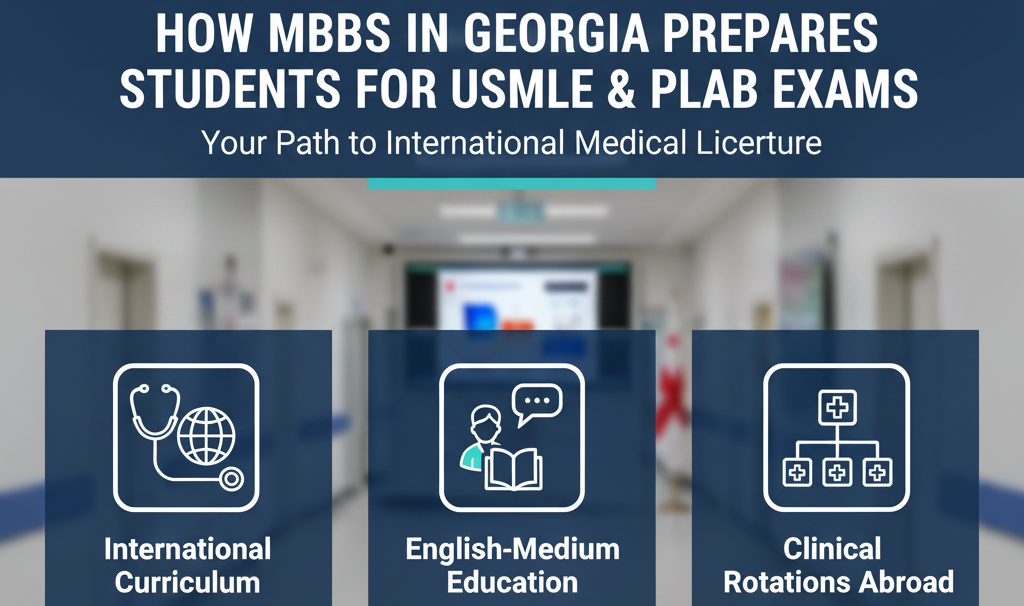
Georgia's affordable tuition rates and internationally recognized curriculum have made it an attractive option for Indian medical students and other international students. Aspirants are not only interested in obtaining an international medical degree, but also want to pass licensing exams like the USMLE and the PLAB to be able to practice medicine in the USA and UK. The medical universities of Georgia are important in preparing their students to pass these exams. They provide the necessary knowledge, clinical skills and language fluency.
Curriculum aligned with global standards
Medical schools in Georgia have curricula which meet international standards. These are recognized by the World Health Organization, India's National Medical Commission and other bodies. The structured syllabus puts a strong emphasis on the basic medical sciences, including anatomy, physiology biochemistry pathology microbiology pharmacology. These are all part of the knowledge base that is tested by USMLE Part 1, and Plab Part 1. Students learn core concepts through regular assessments, problem-based learning, and integrated clinical case discussion.
English medium instruction
The majority of Georgian medical colleges teach in English. It is a great advantage for international students to be able to take the PLAB and USMLE in English. The constant exposure to English lectures and tutorials as well as case presentations will improve your medical English vocabulary, communication skills, and other important aspects of the clinically-oriented PLAB Part 2.
Strong clinical training and exposure
Georgian universities are affiliated with teaching hospital where students receive practical clinical training as early as the first year. Clinical rotations, teaching at the bedside, and supervised encounters with patients develop skills in history-taking and clinical reasoning. They also improve diagnosis and patient management. These competencies are directly related to USMLE step 2 CK/CS scenarios, and PLAB practical assessments.
Problem-based learning, research, and critical thinking
USMLE and PLAB assess analytical thinking as well as the ability to apply complex knowledge. Georgian medical schools encourage students to participate in research projects, journal club meetings, case presentations and problem-based learning modules. These activities help improve critical thinking, decision-making, and evidence-based practices, which are skills that can be used by candidates when they tackle higher-order case-based questions.
Exam support and mentoring
Many Georgian university and student groups offer workshops, mock tests and coaching sessions that are specifically tailored to USMLE or PLAB patterns. The mentorship of faculty, alumni networks and seniors who have passed these exams provides practical advice on study plans and resources.
Global opportunity with affordability
Compared with studying in Western countries, MBBS is more financially accessible in Georgia. Students can allocate more funds to quality resources, mock tests, and clinical electives abroad.
Conclusion
Pursuing an MBBS degree in Georgia is more than just a medical degree. It builds a solid scientific foundation, sharpens clinical skills, improves English language communication, and offers focused support. Together, these factors create a pathway to success for the USMLE or PLAB. See our detailed guide on MBBS Programs in Georgia at this internal resource MBBS In Georgia. Visit the National Medical Commission for information about Indian recognition of international medical graduates and relevant guidelines. NMC - National Medical Commission in India.