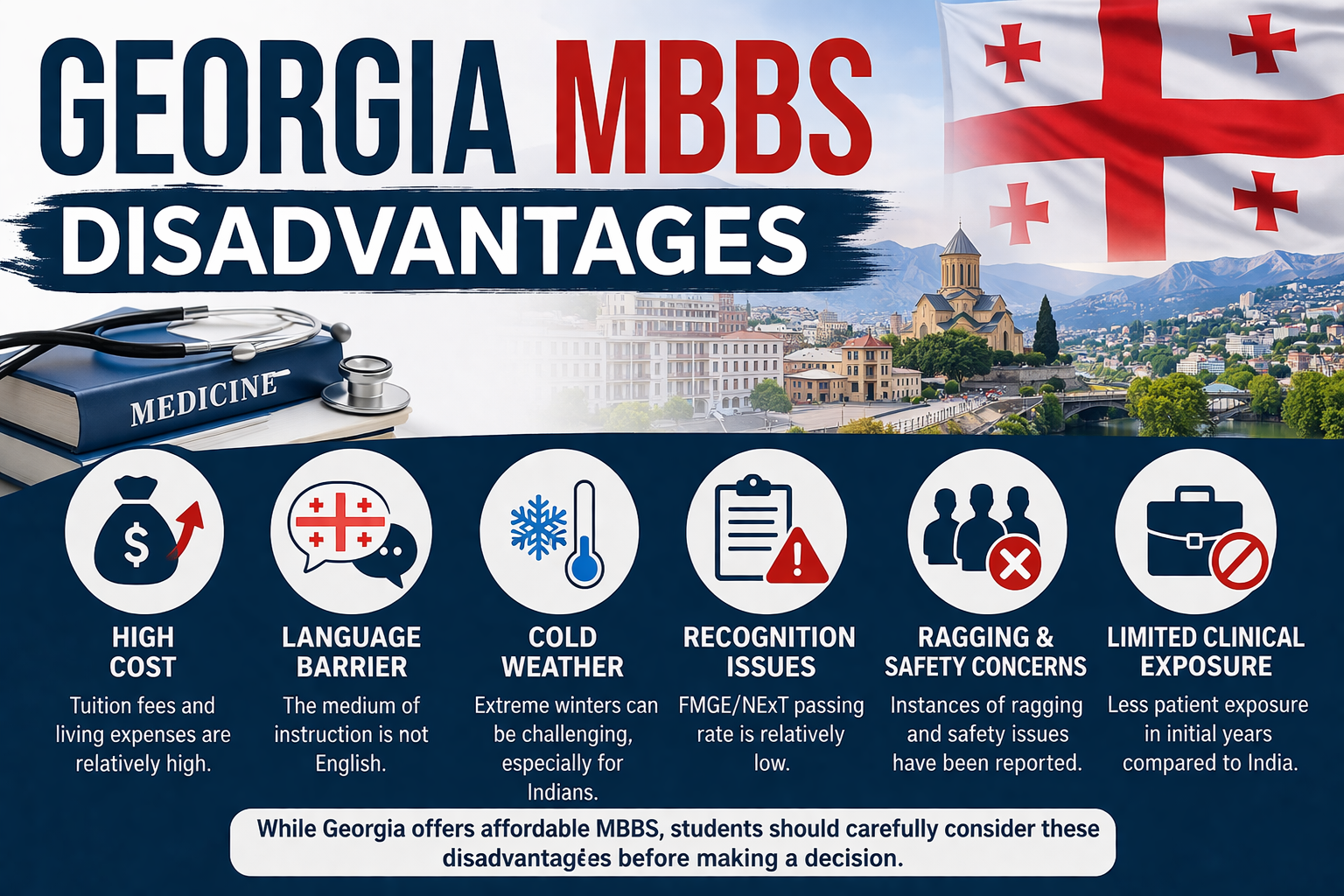
MBBS in Georgia Disadvantages: Indian Students Should Know This Before Admission in MBBS in Georgia
Introduction to MBBS in Georgia
The course of mbbs in georgia has become one of the most preferred options for all the Indian students who are unable to secure a government medical school seat within India. Low tuition fees, world-class universities, and English-speaking education make Georgia intriguing. Nevertheless, getting an MBBS in Georgia just like any other international option has its own pros and cons which every student should weigh up seriously.
This comprehensive guide discusses the major cons of MBBS in Georgia, while providing insights into National Medical Commission, World Health Organization, World Directory of Medical Schools, and the role of tools like NEET Rank Predictor in ensuring students make informed choices.
Less Exposure to Early Clinical Studies Compared to India
The biggest disadvantage of mbbs in georgia is that the patient inflow in hospitals is not as much as in India. Indian government hospitals handle a huge patient load every day, so students get excellent clinical experience.
Conversely, Georgia’s smaller population results in:
- Fewer real-life case studies
- Too much exposure to rare diseases
- Less practical training during MBBS
This directly impacts the confidence and practical skills of students when they return to India for practice.
FMGE/NExT Passing Challenges
Indian students are required to pass the Foreign Medical Graduate Examination (FMGE) or a new exam called NExT in order to practice in India after pursuing an MBBS abroad as per the National Medical Commission guidelines.
Disadvantages include:
- Foreign graduates with a low pass rate of FMGE
- Curriculum | Georgia vs India
- Providing additional support even after graduation
While universities listed in World Directory of Medical Schools and accredited by the World Health Organization are legitimate, accreditation will not compromise success in FMGE/NExT.
Language Barrier During Clinical Practice
Patients in Georgia mainly speak Georgian, although the medium of instruction is English.
This creates challenges such as:
- Difficulty in communicating with patients
- Reliance on interpreters in clinical rotations
- Limited patient interaction
This can result in practical learning being of a lesser quality and skill development being slower.
Cultural and Lifestyle Adjustment
Note: You are move to a different country, with cultural differences that may or may not sit well with you.
Common issues include:
- We-Newcomers (to a different food culture)
- Weather conditions (cold winters)
- Homesickness and loneliness
Many Indian students take their own time to adjust in Georgia which affects their studies initially.
Hidden Costs and Financial Planning
Although mbbs in georgia is usually advertised as the cheap, students must also be realistic about other costs:
- Hostel and accommodation costs
- Food and living expenses
- Visa renewal and travel costs
- Medical insurance
The actual budget might be much higher and leave you wondering why these hidden costs were not considered before.
Limited Indian Food Availability
In addition food is a big problem for Indian students outside India. Other Indian restaurants exist in bigger towns such as Tbilisi, but they tend to be on the pricier side.
Students may face:
- Not managing to get food that you could eat daily in India
- Need to cook on their own
- Adjustment to local cuisine
This can be tough, particularly in the early months.
Recognition vs Practical Value
Most of the universities in Georgia are contained in World Directory of Medical Schools and accredited by the World Health Organization, thus they gained worldwide acceptance. Students mistake this, though, as a mark of excellence.
Important points:
- Recognition ensures eligibility, not quality
- The education in different universities is not uniform
- Private universities may not offer any infrastructure
Students need to do their own research rather than simply trusting brand names.
Risk of Picking the Wrong University
There has many universities offering mbbs in georgia, not all are best.
Risks include:
- Poor faculty quality
- Lack of proper hospital tie-ups
- Limited clinical exposure
- Low FMGE success rates
Hence, it is vital to confirm whether the university is approved by National Medical Commission and registered in World Directory of Medical Schools.
India — Licensing and Practice Issues
MBBS in Georgia with Guidelines to practice: Students pursuing MBBS from Georgia must adhere to strict requirements prescribed by NMC after the completion of studies.
Challenges include:
- Clearing FMGE/NExT exam
- Completing internship requirements in India
- Documentation and verification process
That can be a long and nerve-wracking process.
Competition with Indian Graduates
Reasons why Indian MBBS graduates stand in advantage:
- They are trained for the conditions related to Indian طبیعت
- They have better clinical exposure
- They know the Indian healthcare system
Foreign graduates from Georgia might find it hard to reach this level at first.
Dependence on Self-Study
Students are often left to self-learn in many Georgian universities.
This includes:
- Self Preparation for FMGE/NExT
- Studying Indian medical curriculum separately
- Taking extra coaching classes
This could turn into a huge disadvantage, without discipline.
Visa and Legal Formalities
But while the visa process is relatively straightforward for Georgia, students still need to navigate:
- Visa renewals
- Residence permits
- Documentation requirements
Any documentation error can arise a problem in the stay.
Weather Conditions
Georgia winters can be harsh, a bitter transition for Indian students.
Issues include:
- Making the adjustment to snow and sub-zero temps
- Health concerns
- Seasonal depression for some students
It can impact productivity and the overall daily routine.
Lack of Awareness Among Students
Most students know nothing about why they should choose mbbs in georgia except the fact that someone told them so.
They ignore:
- FMGE passing rates
- University quality
- Practical exposure
Before going abroad, a NEET Rank Predictor is helpful for students to find out their chances in India.
Internship Challenges
Internship forms an integral part of medical education.
In Georgia:
- Internship exposure could be below Indian standards
- Internship may have to be done again in India by students
- Lack of patient exposure is hindering skill acquisition
This extends the length of time you must spend working toward a medical career.
Conclusion
Although mbbs in georgia has several pros like low fee structure and global recognition through World Health Organization and World Directory of Medical Schools, it also has some cons. There are many challenges that can make or break a student’s journey like limited clinical exposure, difficulty in FMGE/NExT, language barrier and adjustments to the local culture.
Students should do the following before deciding:
- Use a NEET Rank Predictor to check their chance in India
- Verify National Medical Commission approval of universities
- Check both WDOMS listing and WHO recognition
- Research FMGE passing rates
- Plan finances carefully
However doing MBBS overseas is indeed a very judicious decision and one truly needs to understand both the pros and cons behind it. An informed decision can spare you long years of struggle and allow you to build a successful career in the medical field.