Introduction
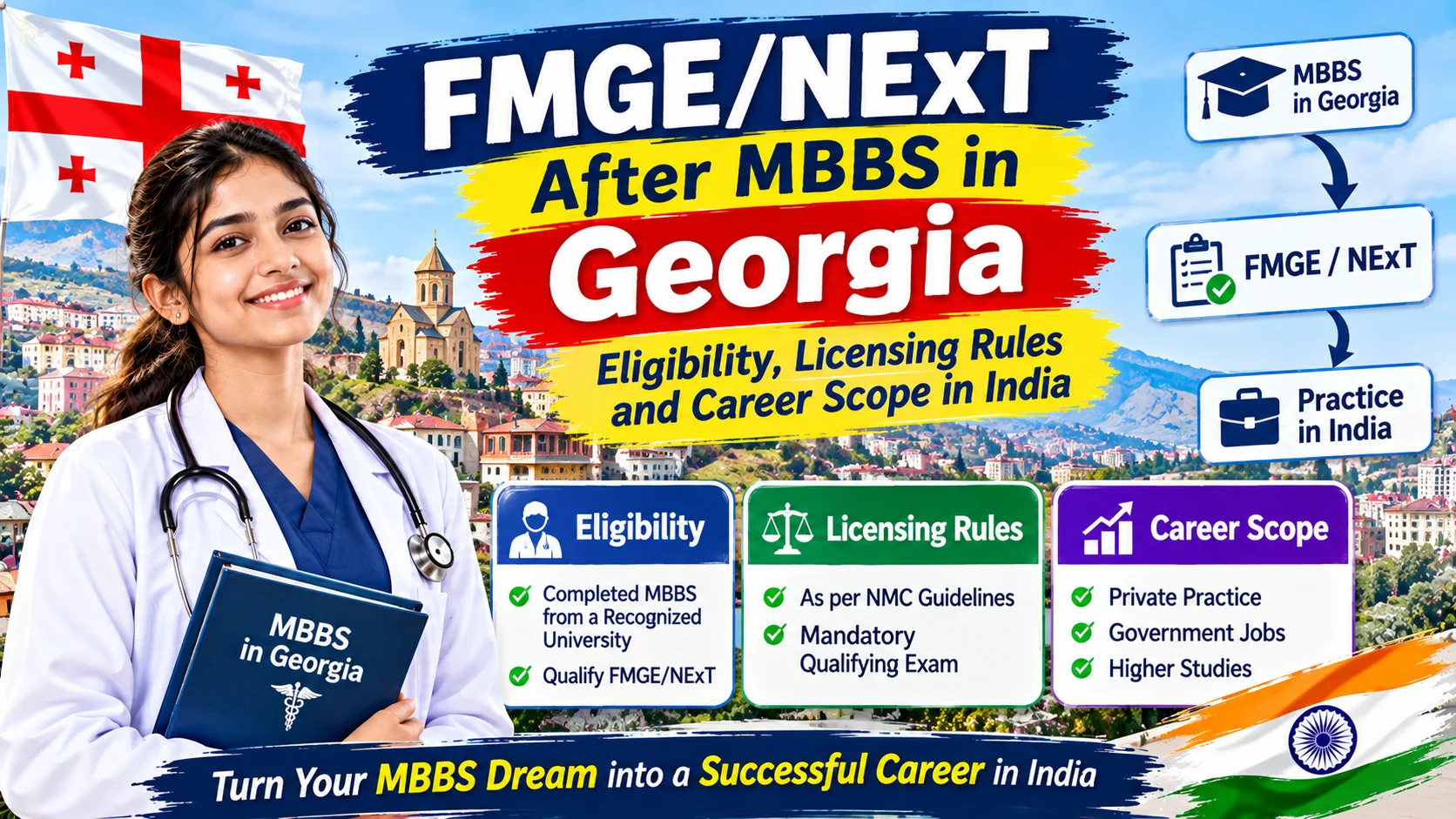
If you're going to study medicine abroad, it's important that you know the licensing processes involved when you return to India. Indian students will need to meet the requirements set out by the Foreign Medical Graduate Examination, National Exit Test and National Medical Commission. By knowing the requirements needed for MBBS in Georgia you can avoid any issues when you finish your studies. This will include ensuring that you complete the correct requirements for recognised medical study, correct amount of study, clinical training and completion of internships.Currently, the FMGE is the screening exam that needs to be passed by Indian foreign medical graduates. The NExT has been delayed and so we advise you not assume that you will be completing this exam instead of the FMGE unless there is a new official notification. Below we will outline the requirements for eligibility, exam, licensing and career opportunities for Georgian medical graduates.
1. FMGE and NExT After MBBS in Georgia
Generally, Indian citizens who complete their primary medical qualification outside of India will need to meet the licensing requirements for foreign medical graduates.
What Is the FMGE?
The Foreign Medical Graduate Examination is a screening exam created by the National Board of Examinations in Medical Sciences (NBEMS). It will ensure that foreign medical graduates have the medical knowledge required to move forward with their registration. Candidates who pass the exam can apply for provisional registration and complete the required compulsory rotating internships.
The exam will cover the following major medical subjects:
- Anatomy and Physiology
- Biochemistry and Pathology
- Pharmacology and Microbiology
- Forensic Medicine
- General Medicine and Surgery
- Obstetrics and Gynaecology
- Paediatrics
- Community Medicine
For more information regarding the exams, please visit the official NBEMS website.
What Is the NExT?
The National Exit Test is a proposed common exam to assess medical graduates. It will aid with licensing and postgraduate admissions. The NExT Regulations were notified by the NMC in 2023. However, the exam has been delayed due to a public notice issued on the 13th July 2023. We recommend that you follow the exam system that is currently in place at the time of your graduation. For up-to-date information, please visit the NMC NExT regulations and notices.
2. Eligibility for Indian Students Graduating from Georgia
Not all foreign medical qualifications will be eligible for registration in India. You will need to ensure that your university meets the requirements for the correct amount of study, structure and clinical training. The following are key points to take note of under the Foreign Medical Graduate Licentiate (FMGL) Regulations, 2021.
Academic Requirements
|
Requirement |
NMC Requirement |
|
Minimum medical study |
54 months |
|
Internship abroad |
Minimum 12 months |
|
Medium of instruction |
English medium |
|
Mandatory subjects |
See Schedule I of FMGL |
|
Registration |
Eligible for registration in the country of qualification |
|
Internship in India |
Minimum 12 months of supervised internship |
|
Screening examination |
Pass FMGE or applicable exam set by NMC |
You should also be aware of the entrance requirements for your year of entry.
Generally, Indian students will need to pass the NEET-UG to gain entry onto an undergraduate medical programme abroad. Please check the requirements for the NEET eligibility certificate and entry requirements using the National Testing Agency.
Why Course Structure Is Important
Medical Doctor courses in Georgia last 6 years and include both academic study and clinical training. However, having a 6 year course does not mean that it will meet the licensing requirements.
You should ensure that your specific course meets the requirements for the correct amount of academic study, internships and mandatory subjects. For information on accreditation of medical courses in Georgia please visit the Georgian National Center for Educational Quality Enhancement.
3. FMGE Exam Process After Completing MBBS in Georgia
Students who complete their medical studies in Georgia should plan ahead for the screening exam in India.
Exam Process
Complete Medical Qualification
Ensure that you have completed your medical programme.
Check Documentation
Ensure you have your academic transcripts, medical qualification, internship documentation, passport information and any other required documents.
Check if you are eligible for FMGE
Check What Is required for your eligibility certificate. The NMC have issued a public notice in 2026 regarding the eligibility certificate for candidates wishing to sit the FMGE Screening Test.
Apply for FMGE
Apply for the exam through the NBEMS website during the application period.
Sit the Exam
Ensure that you are studying using the official syllabus and information. The FMGE exam has traditionally consisted of 300 MCQs with 150 questions in each section. You will need to achieve the required score.
Complete Internship in India
Once you have passed your screening exam, you will need to complete the provisional registration and supervised internship.
4. Licensing Requirements in India Under the NMC FMGL Regulations 2021
The NMC Foreign Medical Graduate Licentiate Regulations, 2021 set out some important requirements. Foreign medical graduates will need to meet the requirements for the correct amount of study, internship, registration and exam.
Supervised Internship in India
One of the key requirements is that you will need to complete a supervised internship for a minimum of 12 months in India.
This should be completed at an institution approved for compulsory rotating medical internships. The relevant State Medical Council will handle this. For more information, please visit the NMC Compulsory Rotating Medical Internship Regulations.
Registration Abroad
You will need to ensure that your medical qualification allows you to register with the relevant medical regulatory body in the country of qualification. Therefore, you should check that your chosen university in Georgia and medical qualification meets the relevant licensing requirements.
The World Directory of Medical Schools (WDOMS) can be a useful resource to check if your institution is listed. However, this does not guarantee that you will be eligible for medical registration in India.
5. Required Documents for FMGE and Medical Registration
It is important that you keep your original documents throughout your medical studies. You will generally need the following:
- NEET-UG Qualification.
- Passport and ID.
- University letter of entry.
- Medical qualification.
- Academic transcripts and mark sheets.
- Internship certificate.
- Evidence of the English medium.
- Evidence of clinical training.
- Evidence of medical registration abroad.
- NMC eligibility certificate (if applicable).
- FMGE qualification certificate.
Further documents may be requested by the NBEMS, NMC or State Medical Council. For advice on your studies, please visit the MBBS Advisor.
6. Career Opportunities After FMGE
Once you have passed your screening exam you will still need to meet the requirements for registration and internships.
Career Opportunities
Once you have met the licensing requirements you can look into the following career opportunities:
Hospital Medical Officer
Apply for medical officer and junior doctor roles at a government or private healthcare institution.
Clinical Practice
Once you have received your registration you can work in a clinical setting.
Postgraduate Medical Studies
If you are eligible, you can prepare for NEET-PG or relevant postgraduate entrance exam.
Government Medical Roles
Registered doctors can apply for roles within government healthcare. This will depend on the relevant entrance exam, eligibility and service requirements.
Medical Research
If you are not looking to work in a clinical setting, you can look into medical research, epidemiology, healthcare management and public health.
7. Choosing the Right Medical University in Georgia for Licensing in India
When choosing your university you should not simply look at the cost of the tuition and hostel. You should ensure that your medical course will meet the requirements for future registration.
Before starting your studies, ensure that:
- The institution is officially recognised in Georgia.
- The medical course is accredited.
- The course is a minimum of 54 months.
- The course has a minimum of 12 months internship at the same foreign institution.
- The course is taught in English.
- All mandatory subjects are included.
- Graduates can obtain the required local registration.
- There is enough clinical rotation.
For international health information please visit the WHO. For information on accreditation of your course please visit the Georgian education quality authority. This information will not guarantee that you will be licensed by the NMC.
For further advice on your MBBS in Georgia entry please visit the MBBS in Georgia entry information and MBBS Advisor.
8. Common Errors to Avoid
Many licensing issues can occur before you even start your medical studies. By checking a few things before starting your studies, you can avoid any issues.
- Do not choose a university simply because it is cheap.
- Do not assume that all 6 year medical courses in Georgia will meet the NMC requirements.
- Do not ignore the mandatory internship requirements.
- Do not rely solely on WDOMS and claims of recognition.
- Do not keep track of your clinical training.
- Do not assume that the NExT has replaced the FMGE.
- Do not delay checking your eligibility certificate and registration.
If you are planning to complete your medical studies in Georgia, you should independently check that your course meets the latest requirements for India and Georgia.
FAQs
1. Is FMGE required after MBBS in Georgia?
Generally, Indian students graduating from Georgia will need to pass the relevant screening exam. This will depend on the requirements of your category of entry and graduation.
2. Has the NExT replaced the FMGE in 2026?
As of November 2026 there has been no confirmed notification that the NExT has replaced the FMGE. The NExT exam has been delayed until July 2023. We recommend that you follow the current NMC and NBEMS notices.
3. Is NEET required for MBBS admission in Georgia for Indian students?
Indian students wishing to work in India will need to meet the relevant NEET-UG eligibility requirements for foreign medical study. Please check the relevant NMC regulations and NTA guidelines.
4. How long is the MBBS course in Georgia?
Medical Doctor courses generally last 6 years in Georgia. You should independently check that your course meets the NMC requirements for the correct amount of study and internships.
5. Is a 12 month internship required in Georgia?
Under the FMGL Regulations, 2021 graduates will need to complete a minimum of 12 months internship at the same foreign medical institution.
6. Do Georgian medical graduates need to complete an internship in India?
Yes. Graduates under the FMGL Regulations, 2021 will need to complete a minimum of 12 months supervised internship in India.
7. Will I be eligible for FMGE if my course is listed on WDOMS?
No. You will need to meet the relevant requirements set by the NMC for your institution, course, internship and other requirements.
8. Can Georgian medical graduates sit NEET-PG?
Eligible graduates can complete postgraduate medical studies in India once they have met the requirements for screening, registration and internships. They will also need to meet the requirements for postgraduate entry.
9. Can I work in India after passing the FMGE?
No. Passing the FMGE will not allow you to work freely. You will need to complete the requirements for registration and internships.
Conclusion
Studying medicine in Georgia can give Indian students an international medical education. However, you will need to follow the licensing requirements when returning to India. The FMGL Regulations, 2021 require that you complete the correct amount of study, English medium studies, foreign internship, local registration and supervised internship in India. As of November 2026 the FMGE is the screening exam that needs to be completed. The NExT will depend on official notification. Before choosing your university you should check that it is accredited, the course meets the requirements, clinical training and local registration. By checking the latest information from the NMC and NBEMS before you start your studies and upon graduation you can avoid any unnecessary licensing issues.