For Indian international students and their parents planning to pursue an MBBS (Bachelor of Medicine, Bachelor of Surgery) overseas, Georgia has long emerged as a mainstream study-abroad destination that has surged in popularity in recent years. The medical programs offered there are highly compliant with relevant standards, and their admission thresholds align with the needs of most Indian students, making it a cost-effective choice for many families to achieve their goal of working as medical practitioners.
However, when these families start researching Georgian medical school programs, they almost universally run into a common scenario: local higher education institutions are clearly divided into two categories: low-cost and premium.
Many study-abroad consultants offer oversimplified judgments—either claiming that more expensive schools are inherently better, or only pushing low-cost institutions to cut overall expenses, which leaves many families caught in a dilemma:
- Will paying higher tuition necessarily guarantee a higher-quality educational experience?
This article maintains a strictly neutral stance, and will not evaluate which of the two types of institutions is superior. It only aims to help readers match their own circumstances to the most suitable option.
It clarifies that high tuition does not automatically equal access to high-quality academic resources, while also warning of the hidden compliance and teaching-related risks that come with blindly choosing low-cost schools.
This article first lays out four core reference dimensions to guide school selection decisions, then will break down all real differences between the two types of institutions layer by layer, to help readers make informed school choices.
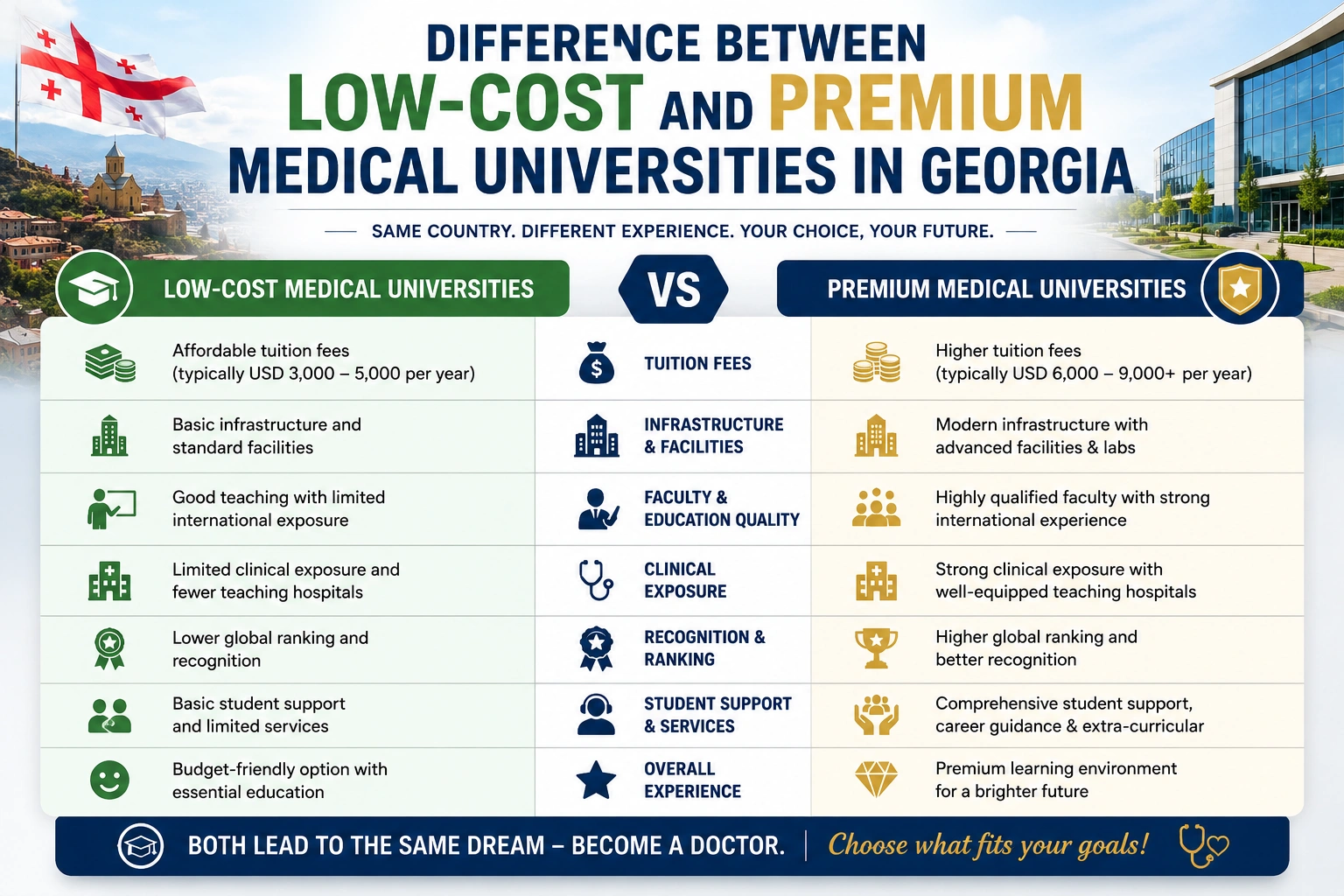
For now, we first introduce the basic characteristics of the two categories of schools
Low-cost institutions
Low-cost institutions are suited for four groups of applicants:
- Those with clear budget limits
- Those who wish to minimize the size of their student loans
- Those seeking compliant, accredited institutions with no price premiums
- Those who prioritize earning a degree at a reasonable cost
Premium institutions
In contrast, the higher tuition of premium institutions corresponds to five specific value-added benefits:
- Advanced medical simulation laboratories
- Complete full-function campus facilities
- Small-class teaching
- International partnership programs with transnational medical schools
- An upgraded dedicated student support system
In subsequent content, we will expand on comparisons of differences across more dimensions to help readers grasp the core logic of school selection.
This paper, which serves as a school selection analysis for medical students planning to study in Georgia
This paper, which serves as a school selection analysis for medical students planning to study in Georgia, first categorizes local medical universities into two groups:
- High-tuition institutions
- Low-tuition institutions
It breaks down the differences between the two groups across five core educational dimensions, upholds the core stance of opposing the "tuition-only" mindset for school selection, and provides actionable school verification indicators for international students.
Physical facilities
In terms of physical facilities:
- High-tuition universities are equipped with top-tier resources including high-tech simulation centers, digital libraries, and research labs.
- Low-tuition universities have modest but fully compliant facilities that meet all academic standards.
- These schools prioritize resource allocation for core teaching activities and do not invest in non-essential luxury amenities.
In-class learning experiences
Regarding in-class learning experiences:
- High-tuition universities have lower student-to-faculty ratios, which allow them to offer personalized tutoring and more access to instructor guidance.
- Low-tuition universities tend to have larger class sizes, but most of their students still achieve strong academic results through self-discipline and active participation in learning.
Clinical practice training
On the dimension of clinical practice training:
- High-tuition universities partner with large teaching hospitals to run systematic training programs, so students can interact with patients early and accumulate experience with a wide range of medical cases.
- The scale and organizational quality of clinical training at low-tuition universities vary widely.
The author of this paper reminds international students that they must verify four core indicators:
- The qualification of partner hospitals
- The start time of internships
- The number of patients the hospital receives
- The frequency of departmental rotations
These indicators are far more reliable than content in university promotional brochures.
International student demographics
In terms of international student demographics:
- Georgia itself attracts students from countries across the world.
- The student body at high-tuition universities covers multiple regions including India, Africa, Europe, the Middle East, and Central Asia.
- Low-tuition universities also enroll international students, but their international student populations are concentrated in far fewer regions.
The only gap between the two types of universities is the scale of their international student enrollment, not the quality of study opportunities they offer.
Out-of-class support services
For out-of-class support services:
- High-tuition universities provide a full set of support measures, including dedicated international student coordinators, airport pickup, housing arrangement, and career counseling.
- Low-tuition universities only offer basic guidance, requiring students to take more initiative to be independent.
Many students agree that this model helps them build problem-solving skills early on.
So, does a higher tuition fee translate to better scores on the FMGE or NExT exams?
So, does a higher tuition fee translate to better scores on the FMGE or NExT exams?
We will examine this correlation in subsequent sections of this paper.
Many Indian families planning to send their children to Georgia to pursue an MBBS in Georgia hold a common misconception: that medical schools with higher tuition fees can better guarantee their children will pass the medical licensing exam.
In fact, passing both the current FMGE and the upcoming NExT exam depends primarily on a student’s own 5 core competencies.
We have observed numerous students from low-cost schools successfully obtain their practice licenses, while some students who paid high tuition to attend top-tier medical schools ultimately failed.
Medical schools can only provide learning resources; the utilization of these resources is entirely determined by the student.
If a family forces a choice of a school that exceeds its financial capacity, the enormous financial burden will also severely undermine the student’s mental health.
Therefore, before selecting a school, families must first complete an assessment of 5 household financial indicators, and prioritize long-term financial sustainability over a school’s reputation.
We have sorted out 16 actionable school selection assessment questions
We have sorted out 16 actionable school selection assessment questions across four categories:
- Academics
- Accreditation
- Student support
- Finance
To replace the one-sided judgment that only compares tuition fees.
We also remind all families not to credulously accept claims from education agents, and to verify a school’s qualifications through four official channels:
- The World Directory of Medical Schools (WDOMS)
- The National Medical Commission (NMC) of India
- Official NEET requirements
- The World Health Organization (WHO)
Finally, it should be clarified that no universal optimal school selection plan works for everyone
Finally, it should be clarified that no universal optimal school selection plan works for everyone.
Both affordable schools and high-end institutions have appropriate groups of students they suit.
All prospective students should cross-check their situation against 6 personal fit dimensions one by one, to select a target school that best aligns with their own circumstances.
Many Indian international students planning to pursue a Bachelor of Medicine, Bachelor of Surgery (MBBS) in Georgia
Many Indian international students planning to pursue a Bachelor of Medicine, Bachelor of Surgery (MBBS) in Georgia often fall into two common misconceptions when selecting a medical school:
- They either only choose institutions with the lowest tuition fees.
- Or wrongly assume that the most expensive schools can guarantee academic success.
In fact, both low-cost and high-tier local medical schools are capable of training qualified physicians.
The core principle for school selection is to pick an institution that matches one’s own personal needs, and to make full use of on-campus resources.
Students should first clarify all costs related to studying for an MBBS in Georgia, evaluate the supporting service systems of prospective schools, verify their official qualifications, and also assess each school’s recognition, clinical practical training resources, affordability, and long-term sustainability.
Never use tuition fees as the only selection standard, or naively trust marketing slogans. Medical outcomes ultimately depend on individual effort. Only by choosing a suitable, well-matched learning environment and upholding one’s commitment to studies can students grow into excellent physicians who serve patients with professional competence and empathy.