So you've decided on MBBS in Georgia. Good choice, honestly — low fees, English-medium teaching, and a degree that opens more doors than most people realize. But there's a question almost every parent asks at some point during the admission process: "Will this degree actually work outside Georgia?"
Fair question. Let's answer it properly.
Why Recognition Actually Matters
A medical degree isn't worth much if you can't practice with it. That's the blunt truth. Before you even shortlist a university, you need to know two things — is the degree recognized in India, and can you use it to practice or study further in other countries too?
This is where most students get confused. They see a university's name on a list somewhere and assume that's enough. It isn't. Recognition works on multiple layers, and each layer decides where you can actually work once you graduate.
NMC Recognition: The First Checkpoint
For any Indian student, the National Medical Commission is the starting point — not the finish line, just the start. If a foreign medical degree isn't accepted by the NMC, you cannot register as a doctor in India, full stop, no matter how good the university was.
The good news? Most established medical universities in Georgia are approved under NMC norms, provided the student clears the required screening test after returning. You can check the current list and guidelines directly on the NMC website — and honestly, this should be one of the first things you verify before paying any admission fee, not after.
MBBS in Georgia has become a popular option precisely because a good number of its universities meet these NMC requirements. But — and this matters — not every university does. Some smaller, newer institutions haven't been vetted properly. Do your homework here.
WHO and WDOMS Listing — What It Actually Means
Here's something a lot of consultants gloss over. WHO doesn't "approve" medical schools anymore in the way people think it does. What exists now is the World Directory of Medical Schools, a joint initiative that essentially replaced the old WHO directory system, and it's maintained with backing from the World Health Organization itself.
Being listed on WDOMS matters for one big reason: many countries, including the US (for ECFMG certification) and several Gulf nations, will only consider your degree valid if your university appears in this directory. Before applying anywhere, search the exact university name on WDOMS. Not the country. Not "Georgia medical universities" in general — the specific institution.
Most reputed Georgian medical universities do appear here, which is part of why MBBS in Georgia keeps attracting Indian applicants year after year. Still, always verify individually. Assumptions cost people a year, sometimes more.
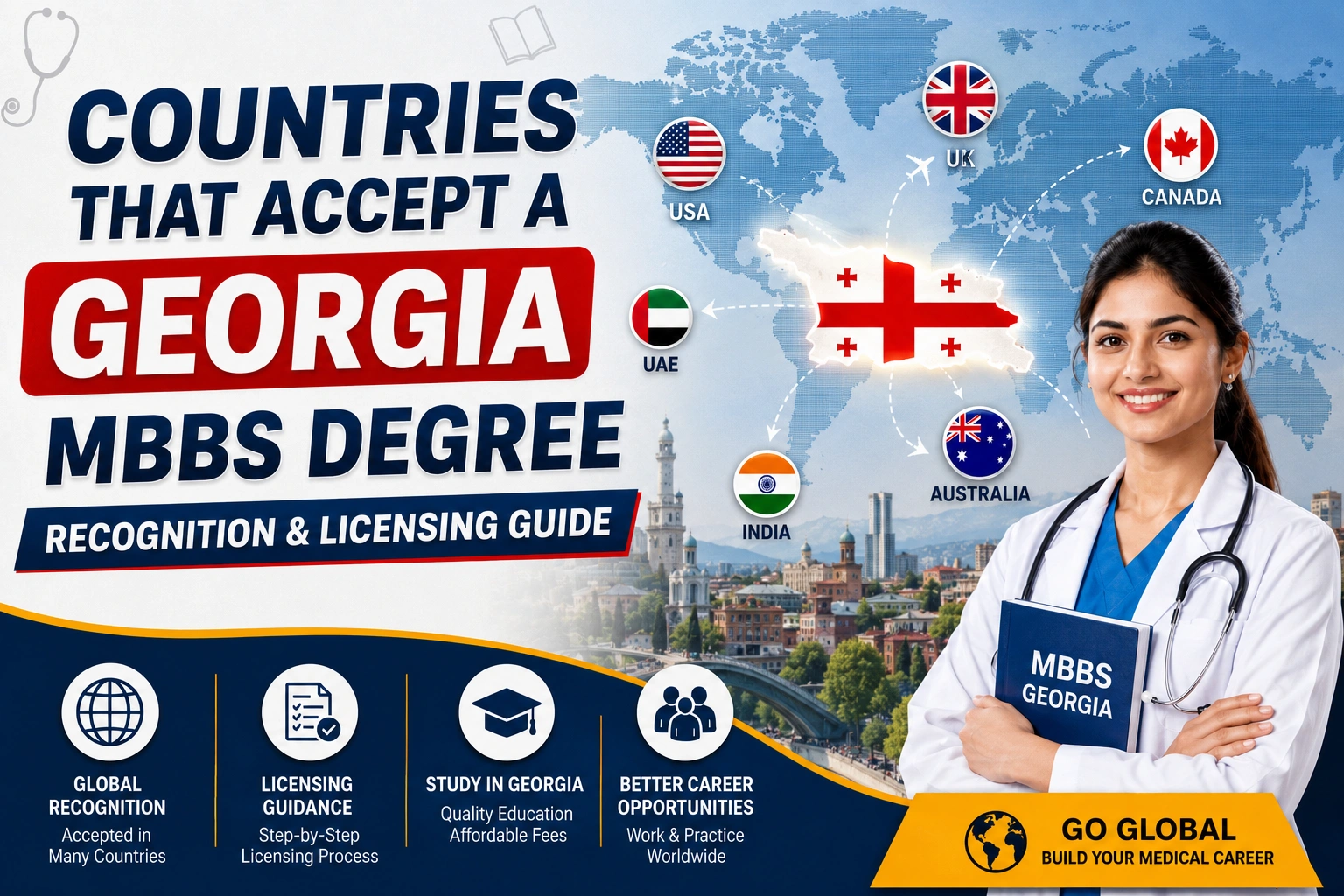
Country-Wise Breakdown: Where Does This Degree Actually Work?
India
This is the big one for most readers. To practice in India after MBBS in Georgia, you need to:
- Clear the Foreign Medical Graduate Examination (FMGE), now called the National Exit Test (NExT) once fully implemented
- Have graduated from an NMC-recognized institution
- Complete the required internship period as per current guidelines
FMGE isn't easy — pass rates for foreign medical graduates have historically hovered lower than people expect. That's not meant to scare you, just to be honest. Students who take their Georgia coursework seriously, rather than treating it as a formality, tend to clear it without too much drama.
United States
Want to practice in the US eventually? You'll need ECFMG certification, and that depends entirely on your university being listed in WDOMS at the time of your enrollment (or graduation, depending on when the listing changed). After that comes USMLE Steps 1, 2, and eventually 3. It's a long road. Doable, but long.
United Kingdom
The UK route runs through the GMC and the PLAB exam. A Georgia MBBS degree, from a recognized university, is generally accepted as a starting qualification here — same as degrees from most other non-UK institutions. PLAB 1 and 2 are what actually determine whether you get to practice.
Canada
Canada's a bit stricter. You'll go through the Medical Council of Canada Qualifying Examination, and your medical school needs to be on their accepted list — which again ties back to that WDOMS listing.
Gulf Countries (UAE, Saudi Arabia, Qatar)
These markets have grown popular for graduates of Georgian universities, mostly because licensing bodies like DHA, HAAD, and MOH primarily check for WDOMS listing and a valid license exam clearance (Prometric exams). Less bureaucratic than the US route, generally.
European Union
If you're aiming to practice within the EU, things get more country-specific — some EU nations recognize Georgian degrees more smoothly than others because Georgia has bilateral education agreements with a few of them. Worth checking individually rather than assuming EU-wide acceptance.
NEET Requirement — Non-Negotiable for Indian Students
No NEET, no admission. That's the rule, and honestly, it protects students more than it restricts them — it ensures a baseline standard before you commit lakhs of rupees to studying abroad.
You'll need to have:
- Appeared for and qualified NEET in the relevant academic year
- Met the minimum qualifying percentile (varies slightly year to year for general and reserved categories)
- Completed 10+2 with Physics, Chemistry, and Biology, scoring at least 50% aggregate (40% for reserved categories)
Age requirement is typically 17 years by December 31 of the admission year. Simple enough, but people still miss deadlines over these small details every single year.
Eligibility Criteria for MBBS in Georgia
Beyond NEET, universities generally ask for:
- A valid passport
- Academic transcripts from 10th and 12th grade
- Medical fitness certificate
- No specific entrance exam beyond NEET for most universities (unlike some other countries)
That last point is honestly one of the bigger draws. No separate entrance test, no lengthy interview process for most institutions — just NEET qualification and your documents in order.
Top Universities Worth Considering
A handful of names consistently come up when people research MBBS in Georgia seriously:
- Tbilisi State Medical University
- David Tvildiani Medical University
- Caucasus International University
- Georgian National University (SEU)
- New Vision University
Each has slightly different fee structures, hostel setups, and clinical exposure opportunities. Don't just pick the cheapest one — check faculty-to-student ratios and hospital tie-ups too. That stuff actually matters once you're three years deep into clinical rotations.
Fee Structure and Duration
Roughly speaking, total tuition across the 6-year program (including a compulsory internship year in most cases) runs somewhere between ₹18–30 lakhs, depending on the university and city. Tbilisi, being the capital, tends to run slightly higher than smaller cities like Kutaisi or Batumi.
Living costs add another ₹2.5–4 lakhs per year on average — rent, food, transport. Not dirt cheap, but still a fraction of what private medical colleges in India charge, and considerably lower than most Western options.
Admission Process, Step by Step
- Shortlist universities based on NMC and WDOMS status
- Submit documents (passport, mark sheets, NEET scorecard)
- Receive provisional admission letter
- Apply for a Georgian student visa
- Pay initial tuition installment
- Travel and complete enrollment formalities on campus
Most agents will tell you this takes "just a few weeks." Realistically, budget six to eight weeks minimum, especially during peak intake season when visa offices get backed up.
Pros and Cons — An Honest Take
What works in Georgia's favor:
- Affordable fees compared to private Indian colleges
- English-medium instruction from day one
- No donation or capitation fee culture
- Safe environment with a growing Indian student community
- Direct flights and manageable travel time from India
What doesn't:
- FMGE/NExT clearance rates for foreign graduates need serious preparation
- Some universities have weaker clinical exposure than others — research matters
- Climate and food adjustment takes a semester or two for most students
- Not every Georgian university carries equal weight — reputation varies more than people expect
Frequently Asked Questions
Is MBBS in Georgia valid in India? Yes, provided the university is NMC-approved and you clear FMGE/NExT after graduation.
Do I need to give any entrance exam besides NEET? No, most Georgian universities admit students directly based on NEET qualification and academic documents.
How long is the MBBS program in Georgia? Typically six years, including internship, though this can vary slightly by university.
Can I practice in the US or UK after this degree? Yes, but you'll need to clear the respective licensing exams — USMLE for the US, PLAB for the UK — and your university must be listed on WDOMS.
Is the cost of living high in Georgia? Not particularly. Compared to other study-abroad destinations, Georgia remains one of the more budget-friendly options for Indian students.
Conclusion
Recognition isn't something to figure out after you've enrolled — it's the first thing to check, before anything else. A degree that looks good on paper but doesn't hold up on WDOMS or with the NMC will cost you far more than money down the line.
If you're seriously considering MBBS in Georgia, take the time to verify your shortlisted university's status yourself. Don't just take an agent's word for it. For detailed, university-wise guidance and updated recognition status, you can explore more at MBBS in Georgia — it's worth spending an evening going through the details before you commit six years and your family's savings to this decision.