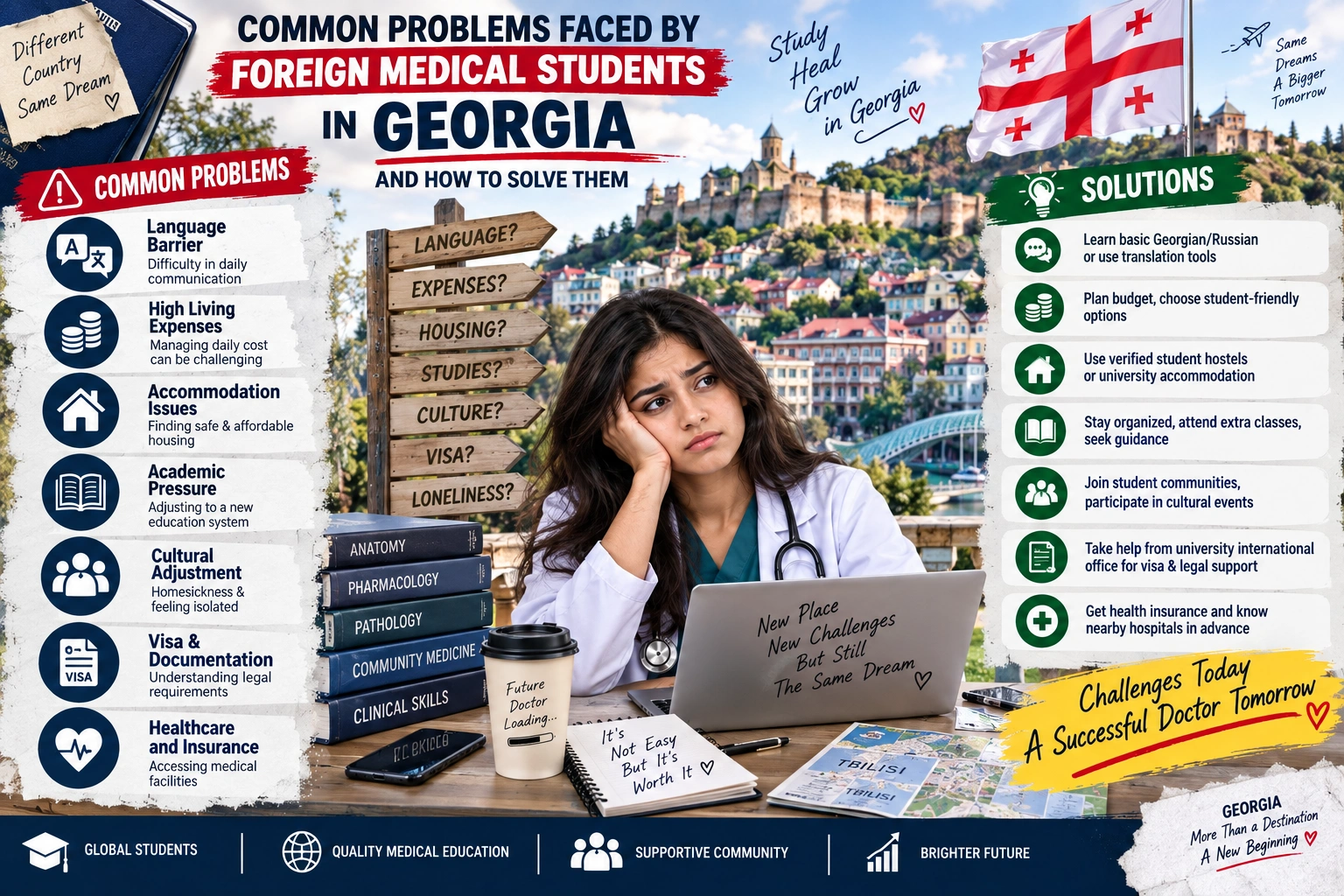
The first week usually feels exciting. A new city, unfamiliar currency, classmates from several countries, and finally that medical seat you worked for. Then ordinary problems begin. The landlord wants a deposit, lectures move quickly, Georgian patients don’t speak English, and the winter jacket you packed isn’t nearly warm enough. None of this automatically makes studying medicine in Georgia a poor decision. Far from it. But students who choose MBBS in Georgia after seeing only glossy campus photographs often arrive with unrealistic expectations. That’s where trouble starts. Let’s talk about the actual issues—academic, financial, personal, and regulatory—and the practical ways to handle them.
Problem 1: Confusion About Recognition and Eligibility
A university appearing in the World Directory of Medical Schools is useful information, but it isn’t a guarantee that its degree will qualify you to practise in India. WDOMS itself clarifies that a listing doesn’t mean recognition, accreditation, or endorsement. Small sentence. Big consequences. Indian students should examine whether the foreign medical programme meets the current requirements of the National Medical Commission. These generally include the prescribed duration of study, required subjects, clinical training, internship conditions, English-medium education, and eligibility for medical registration in the country where the qualification is awarded. Rules can be amended, so verify the latest NMC regulations before paying anything.
Be careful with phrases such as “100% NMC approved” or “direct registration guaranteed.” Honestly, those claims are a red flag. Ask the university for written answers covering:
- Total programme duration and internship structure
- Location of every clinical rotation
- Medium of classroom and clinical instruction
- Eligibility for medical registration in Georgia
- Degree title and awarding institution
- Transfer policy, if any
- Complete annual fee schedule
A good MBBS in Georgia decision begins with paperwork, not a counsellor’s promise over the phone.
Problem 2: The Language Barrier During Hospital Training
Here is the part: brochures rarely explain properly: the course may be taught in English, but patients in Georgian hospitals often speak Georgian. Some may speak Russian. During the early semesters this doesn’t feel serious because students are busy with anatomy, physiology, biochemistry, and laboratory sessions. Once clinical postings begin, it does. You can understand the professor and still struggle to take a patient’s history. Awkward. Sometimes frustrating too. The solution is to learn practical medical Georgian from the first year rather than waiting for hospital rotations. Start with greetings, pain descriptions, numbers, body parts, family history, allergies, and common symptoms. Even 20 minutes daily helps. Ask whether your university offers structured Georgian-language classes and whether interpreters or bilingual doctors are regularly present during training. Students should also practise case history formats in English, then rehearse key patient questions in Georgian. It won’t make you fluent overnight. It will make clinical postings much more useful—and patients tend to respond better when you make the effort.
Problem 3: Clinical Exposure May Differ Between Universities
Two medical universities in the same city can offer very different hospital experiences. One may place students in busy teaching hospitals with regular bedside discussions; another may rely heavily on classroom demonstrations and limited patient contact. Same country. Very different outcome. Before choosing an MBBS in Georgia programme, ask for the names of affiliated hospitals, the year clinical exposure begins, average group size during postings, and whether students are allowed to take histories or perform supervised basic procedures. Don’t settle for “excellent clinical exposure.” That tells you almost nothing. Try speaking with current fourth-, fifth-, or sixth-year students rather than only first-year students. Seniors can tell you whether rotations actually happen as promised, how frequently cases are discussed, and how much patient interaction international students receive. During the course, keep a personal clinical log. Record cases observed, histories taken, examination skills practised, and topics you couldn’t understand. If a posting feels passive, request additional case discussions, join student medical societies, and use simulation labs whenever available. You’ll need initiative. Quite a lot of it.
Problem 4: Underestimating the Academic Workload
Medical school abroad isn’t an extended European holiday. Attendance rules may be strict, assessments can happen throughout the semester, and some universities use oral examinations alongside written tests. Students accustomed to last-minute board-exam preparation sometimes get caught badly. The six-year medical programme commonly offered in Georgia is usually structured across pre-clinical, para-clinical, and clinical stages, often totalling about 360 ECTS. Exact curricula vary by institution. Anatomy alone can involve lectures, practical work, identification tests, presentations, and oral questioning. Miss a few weeks and the backlog grows fast.
Build a weekly routine from day one:
- Review lecture notes on the same evening.
- Study one standard textbook alongside university slides.
- Make short revision sheets for difficult systems.
- Discuss cases with two or three serious classmates.
- Begin Indian licensing-exam preparation gradually, not during the final semester.
MBBS in Georgia can offer a manageable learning environment, but nobody carries a student through six years. You still have to sit down and study. No shortcut there.
Problem 5: Budget Estimates That Leave Out Half the Costs
Tuition is only one column. Many universities charge roughly USD 4,500–8,000 per year for English-medium medical programmes, depending on the institution and intake. Fees can change, exchange rates move, and payment terms aren’t identical, so obtain the current invoice directly from the university. Living expenses require a separate plan. A student sharing accommodation might spend approximately USD 150–350 per month on rent, USD 120–220 on food, and another USD 80–200 on transport, utilities, mobile service, winter clothing, study materials, and personal expenses. Lifestyle changes everything, of course. Tbilisi will usually cost more than a smaller city. Then come the easily forgotten items: residence documentation, health insurance, security deposit, visa-related travel, airport transfers, laboratory coats, university registration charges, examination fees, and flights to India. A “cheap package” can stop looking cheap quite quickly. Keep an emergency reserve covering at least two or three months of living costs. Pay university fees only through an authorised channel, retain every receipt, and ask whether the quoted tuition remains fixed across all six years. For planning support, compare the advertised package against the actual cost categories explained by MBBS in Georgia before committing.
Problem 6: Accommodation, Food, and Daily-Life Stress
I’ve noticed that students worry about anatomy before departure, yet accommodation creates more immediate arguments than anatomy ever does. Shared kitchens. Cleaning schedules. Electricity bills. One roommate wants silence, another takes calls at 2 a.m. Normal stuff, but exhausting. University hostels can make the first semester easier, though availability and quality vary. Private apartments offer freedom but may require one or two months’ deposit, agent charges, and separate utility payments. Always request a written rental agreement. Photograph the apartment when moving in and record existing damage. Indian food is available in parts of Tbilisi and around popular student areas, but eating at restaurants daily will stretch the budget. Learn six or seven basic meals before leaving India. Rice, dal, eggs, vegetables, chicken, pasta. Nothing fancy. Transport is generally affordable in Tbilisi, with metro, buses, and cards used for city travel. Still, live near a practical transport route rather than choosing the prettiest apartment on social media. A cheap room that requires two buses and a long walk to morning classes isn’t really cheap.
Problem 7: Homesickness, Isolation, and Mental Pressure
By November, the excitement can fade. The weather turns colder, daylight feels shorter, exams arrive, and family celebrations continue back home without you. This catches even confident students. Don’t treat homesickness like a personal failure. Set a regular call schedule with family, but avoid spending every free hour on video calls because that can keep you emotionally stuck between two countries. Make friends outside your regional group. Join sports, student clubs, volunteer activities, or study circles. Sleep matters too. So does food. A student surviving on instant noodles, four hours of sleep, and panic-driven study sessions will eventually struggle. If sadness, anxiety, or poor concentration continues for weeks, contact the university’s student-support or counselling service. The World Health Organization treats mental health as part of health, not as something separate or embarrassing. Honestly, medical students need to hear that more often.
Problem 8: Safety, Scams, and Document Problems
Most daily safety issues are ordinary ones: careless late-night travel, unlicensed taxis, lost passports, rental disputes, online payment scams, or joining a public gathering without understanding the situation. Simple precautions work. Use recognised transport apps, keep digital copies of your passport and residence documents, and avoid carrying large amounts of cash. Check official travel advice during demonstrations or periods of political tension. Students should stay away from restricted or disputed regions and follow directions issued by local authorities and their university. Residence rules, insurance requirements, and document procedures can change. Don’t depend on a two-year-old YouTube video. Confirm the current position with the Georgian embassy, relevant government office, and your university’s international department. Keep reminders for passport validity, insurance renewal, residence deadlines, and tuition dates. Boring admin, yes. Missing a deadline is worse.
Problem 9: Assuming Part-Time Work Will Pay the Fees
Let’s be direct. A medical student shouldn’t build the entire financial plan around getting a part-time job in Georgia. Work opportunities may be restricted by immigration or employment rules, and language can reduce the number of suitable roles. Medical classes, laboratory work, attendance, and hospital rotations also leave limited free time. Even where lawful work is available, earnings may cover a portion of food or personal expenses—not six years of tuition. Verify current work permission through official Georgian authorities before accepting any job. Never work informally just because another student says it’s safe. And don’t sacrifice clinical attendance for short-term income. That trade rarely ends well.
Problem 10: Delaying FMGE or NExT-Oriented Preparation
The final-year panic is very real. Students spend several years studying their university syllabus and suddenly realise that practising in India involves a separate regulatory pathway. Indian graduates of foreign medical institutions must meet the applicable NMC conditions and clear the licensing or screening route in force when they return. Students should monitor official notices about FMGE, NExT, internships, registration, and document requirements rather than relying on coaching-centre predictions. NEET qualification is also relevant for Indian candidates planning foreign medical education under current Indian rules. Check your result, eligibility period, counselling implications, and new notices through the official NEET website. Start Indian exam preparation alongside university subjects. Not ten hours daily. Just consistent work: revise standard concepts, practise clinical questions, and connect every hospital case with diagnosis and management. MBBS in Georgia gives you the degree programme; returning prepared is still your responsibility.
A Practical Problem-Solving Checklist
Before departure, create one folder—digital plus printed—with your admission letter, fee schedule, passport, NEET documents, insurance, academic certificates, accommodation agreement, university contacts, and emergency numbers. Share a copy with your parents.
After arrival, focus on five habits:
- Learn basic Georgian steadily.
- Track monthly spending.
- Maintain attendance and a clinical log.
- Recheck NMC notices every few months.
- Speak to senior students, but verify their advice independently.
That last point matters. Seniors are helpful, though their batch may follow different rules. One change in internship structure or registration policy can affect later students differently.
Frequently Asked Questions
Is studying medicine in Georgia difficult for Indian students?
The coursework is demanding but manageable with regular study. The larger adjustment often involves oral examinations, continuous assessments, patient communication, and independent living. Students who attend classes and revise weekly usually adapt better than those relying on last-minute preparation.
Is Georgian necessary for an English-medium course?
You may not need Georgian to understand classroom lectures, but basic Georgian is extremely useful in hospitals, shops, rental discussions, and daily travel. For clinical learning, it can make a major difference.
How much should a student budget each year?
Tuition may sit around USD 4,500–8,000 annually, while living costs can vary from roughly USD 4,500 to more than USD 8,000 per year depending on the city, housing, food habits, and travel. These are planning ranges, not fixed quotations. Verify the latest figures.
Does a WDOMS listing guarantee registration in India?
No. A directory listing doesn’t automatically establish NMC eligibility or guarantee registration. Check the university, complete programme structure, internship, local licence eligibility, and current NMC rules separately.
Can students transfer between Georgian universities?
Transfers may be possible in some cases, but credit acceptance, clinical subjects, programme duration, and NMC compliance can become complicated. Get written confirmation from both institutions before moving. A casual verbal assurance isn’t enough.
Is Georgia generally safe for international medical students?
Many students manage daily life without serious problems, but sensible precautions remain necessary. Use trusted transport, avoid demonstrations and restricted regions, protect your documents, and follow current official safety guidance.
Conclusion
The common problems are manageable. Language can be learned. Budgets can be planned. Weak study habits can be fixed. Even homesickness usually becomes lighter once routines and friendships settle in. The dangerous problems are the ones discovered too late—an unsuitable programme, missing clinical requirements, unexplained charges, or incorrect recognition claims. Choose carefully. Ask uncomfortable questions. Get answers in writing. If you’re comparing universities or checking whether an MBBS in Georgia programme matches your academic plans and Indian registration goals, review the institution’s documents with MBBS in Georgia before paying the first fee. A little caution at the admission stage can save years of stress later.