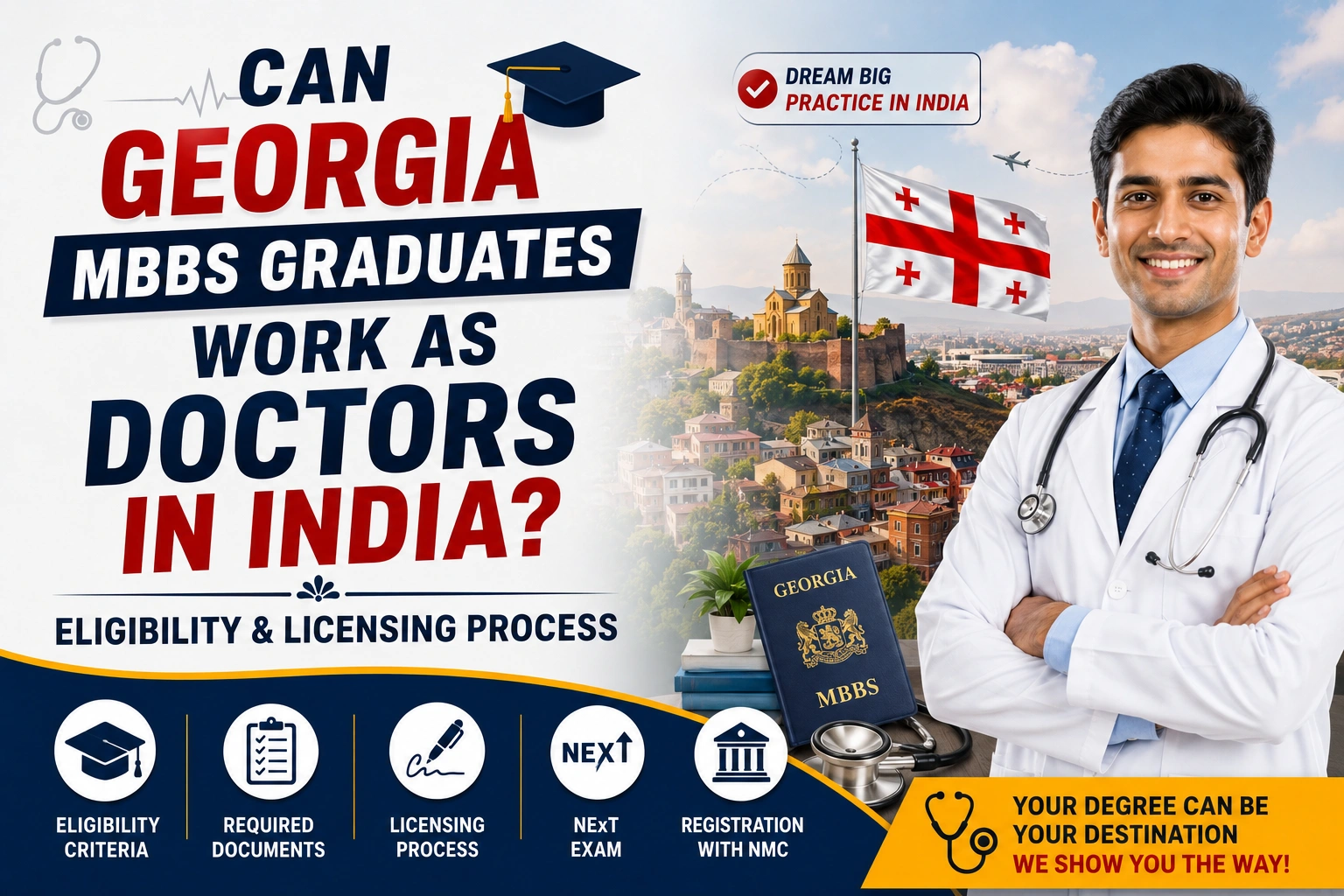
Getting an MBBS degree from Georgia is only one part of the journey for an Indian student. The bigger question usually comes later: what happens after graduation? Can you return to India, get a medical licence and actually work as a doctor?
The answer is yes, but it isn't automatic.
A student who completes MBBS in Georgia can pursue the process of becoming a registered doctor in India, provided the medical education and subsequent licensing requirements meet the rules applicable to foreign medical graduates. That's where things get serious. Your university, course duration, internship, clinical training and licensing examination can all matter.
Honestly, this is something many students don't think about enough while choosing a university. The first-year fee looks attractive. The campus photographs look good. But medical education is a six-year commitment, and the paperwork doesn't end on graduation day.
For students exploring universities and course options, MBBS in Georgia can be a useful starting point for research. Still, the final decision should always be backed by official regulatory information.
Can Georgia MBBS Graduates Practise Medicine in India?
Yes, they can apply for the pathway to practise medicine in India after completing their medical qualification. A Georgian degree, however, does not automatically give someone the right to open a clinic or work as a registered doctor in India.
Indian graduates from foreign medical schools have to fulfil the requirements set by the National Medical Commission and other competent authorities. Depending on the regulations applicable to their admission batch and graduation period, this may involve meeting educational requirements, completing prescribed training, clearing the required licensing examination and undergoing internship or supervised training as required.
The key point is simple: studying abroad and becoming licensed in India are connected, but they aren't the same process.
Students should regularly check the latest notices and regulations published by the National Medical Commission (NMC) because rules affecting foreign medical graduates can be updated over time.
Why Does University Selection in Georgia Matter So Much?
Not every medical university follows the same academic structure. That's the reality.
Georgia has several institutions offering medical programs to international students, but an Indian applicant shouldn't choose one simply because a consultant calls it “NMC approved” or promises an easy route back to India. The NMC does not provide a shortcut through a consultant's brochure.
Before taking admission for MBBS in Georgia, students should carefully check:
- The total duration of the medical program
- Medium of instruction
- Curriculum and clinical subjects
- Hospital and clinical training arrangements
- Internship structure
- The qualification awarded after graduation
- Whether the graduate can meet applicable registration requirements
- The university's official fee structure
This may sound like a lot of homework. It is. But it's better than discovering a problem after spending several years abroad.
Basic Eligibility for Indian Students
The licensing journey really starts before a student boards a flight to Tbilisi or another Georgian city.
Indian students generally need to meet the academic and regulatory conditions applicable to medical education abroad. Universities may have their own admission requirements, but applicants should normally have completed their senior secondary education with the required science subjects.
Common documents and eligibility requirements include:
- Class 10 marksheet and certificate
- Class 12 marksheet and certificate
- Physics, Chemistry and Biology/Biotechnology as required subjects
- A valid passport
- Passport photographs
- Medical fitness documents, where requested
- NEET qualification as required for Indian students pursuing primary medical education abroad
Minimum academic marks can differ between universities. So can document requirements. Don't assume that every Georgian university asks for exactly the same paperwork.
Is NEET Required for MBBS in Georgia?
For Indian students planning to pursue a primary medical qualification abroad and later return to India, NEET is a major requirement.
A common mistake is thinking that NEET only matters for getting an MBBS seat in India. That's not the full picture. Even if a foreign university is willing to offer admission based on its own selection criteria, Indian students need to consider the rules that apply to them in India.
Official NEET examination notices and updates can be checked through the NEET official website.
A student with a qualifying NEET score may explore MBBS in Georgia even if that score isn't enough to secure a government medical college seat in India. The score needed to win a highly competitive Indian seat and the requirement to qualify NEET for foreign medical education aren't the same thing.
That difference surprises a lot of families at first.
Which Georgian Universities Should Students Check?
Georgia has a number of universities that admit international medical students. Some of the names Indian applicants commonly research include universities based in Tbilisi and other Georgian cities.
Instead of blindly following a “top 10” list, students should verify each institution individually. A university may be popular with Indian students, but popularity alone doesn't answer the questions that matter for licensing.
A useful first step is checking the medical school through the World Directory of Medical Schools (WDOMS).
WDOMS provides information about medical schools around the world. Students should search for the specific institution and review the details available for its medical program. But here's an important distinction: a WDOMS listing by itself doesn't guarantee that a graduate will automatically receive registration in India.
The NMC requirements still have to be satisfied.
How Much Does MBBS in Georgia Cost?
Fees vary widely depending on the university and city. There isn't one fixed “Georgia MBBS fee.”
At many institutions, annual tuition for an English-medium medical program may fall roughly between $4,000 and $8,000 per year, although some universities may charge more or structure fees differently. Over a course lasting around six years, tuition can therefore become a substantial expense even before adding accommodation and living costs.
Students should also budget for:
- Hostel or private accommodation
- Food and groceries
- Health insurance
- Residence and visa-related expenses
- Air tickets
- Local transport
- Books and personal spending
Fees may look lower in a social media advertisement because only tuition has been mentioned. Ask for the complete yearly estimate. Better yet, ask for the complete six-year estimate.
For many families, that's the more honest number.
Course Duration and Clinical Training
Most medical programs in Georgia commonly run for around six years, though students should check the exact structure of the university they are considering.
Course duration alone isn't enough.
For Indian students, the way clinical training and practical education are delivered can be important under the applicable foreign medical graduate regulations. Classroom lectures are one thing; hands-on exposure is another. A good medical education needs both.
Before admission, students should ask the university direct questions:
- When do clinical rotations begin?
- Which hospitals are used for training?
- How are practical skills assessed?
- Is clinical teaching conducted in English?
- What is the internship or practical training arrangement?
- What documents are issued after completing the training?
Honestly, these questions are more useful than asking whether the university has a fancy campus.
Recognition: What Do NMC, WHO and WDOMS Actually Mean?
The word “recognised” gets used rather loosely in study-abroad marketing. That's where confusion starts.
The NMC is the key Indian regulatory authority whose requirements matter for Indian medical graduates seeking registration in India. Students should review official NMC regulations rather than relying on verbal assurances.
The World Health Organization (WHO) is a global public health organisation. You can learn more about its work through WHO. However, students should be cautious about advertisements claiming that a university is simply “WHO approved” and treating that phrase as proof of eligibility to practise in India.
Similarly, WDOMS is useful for checking information about a medical school, but a directory listing doesn't replace Indian licensing requirements.
For MBBS in Georgia, the safer approach is to check every layer separately: the university's status, the medical curriculum, WDOMS information and the latest NMC requirements.
A little boring? Maybe. Necessary? Absolutely.
Licensing Process After MBBS in Georgia
The exact process can depend on the regulations applicable to a particular student's batch. Still, the journey generally follows a sequence.
Step 1: Complete Your Medical Education
The student must successfully complete the prescribed medical program, including the required academic and practical components.
Keep your documents safely from day one. University transcripts, attendance records, clinical training certificates and internship documents can become important later.
Step 2: Meet the Required Professional and Educational Conditions
Foreign medical graduates may need to satisfy requirements relating to the qualification, course structure and professional standing of the degree, according to the rules applicable to them.
This is why choosing the university carefully at the beginning matters so much.
Step 3: Clear the Applicable Licensing Examination
Foreign medical graduates seeking to practise in India have to meet the licensing examination requirements applicable at the relevant time.
Students often hear different names—FMGE, NExT or other examination arrangements—and get confused. The examination system and implementation rules should be checked from current official NMC and relevant examination authority notices at the time of graduation.
Don't plan your career around a five-year-old YouTube video.
Step 4: Complete Internship or Supervised Training as Required
Depending on the regulatory framework applicable to the graduate, internship or supervised training requirements may apply before full registration.
The structure can be particularly important for foreign graduates because internship requirements involve both the medical education completed abroad and the rules applicable in India.
Step 5: Apply for Registration
After meeting the prescribed requirements, a graduate can proceed with the registration process through the appropriate authorities.
Only after completing the necessary legal and professional requirements can a person practise as a registered medical professional in India.
Admission Process for MBBS in Georgia
The admission process itself is usually much simpler than the licensing process after graduation. But don't rush through it.
A typical application may involve the following steps:
- Check eligibility and NEET status.
- Shortlist universities based on academics, training and budget.
- Verify the medical school using official sources and university information.
- Prepare academic and identity documents.
- Submit the application according to the university's admission procedure.
- Receive the admission or offer letter, if accepted.
- Arrange visa and travel documents.
- Travel to Georgia and complete university registration.
Admissions often have multiple intake periods or university-specific deadlines. The exact months can differ, so applicants should confirm dates directly with the institution instead of assuming that every university follows one calendar.
Pros and Cons of Working in India After a Georgia MBBS
Advantages
- A Georgian medical education can offer an overseas route for students who don't obtain a suitable medical seat in India.
- English-medium programs are available at several institutions.
- Students may gain experience in an international academic environment.
- After fulfilling applicable Indian licensing requirements, graduates can pursue medical careers in India.
Challenges
- A foreign medical degree doesn't provide automatic registration in India.
- Licensing requirements can involve examinations and additional training.
- University selection requires careful research.
- Documentation needs to be maintained throughout the course.
- Regulations can change during the years a student is studying.
The last point is easy to ignore when you're 18 and focused on getting admission. But six years is a long time.
FAQs
Can I work as a doctor in India after completing MBBS in Georgia?
Yes, you can pursue the process of practising in India after completing your medical degree, provided you meet the NMC and other applicable licensing, examination, internship and registration requirements.
Is NEET compulsory for Indian students going to Georgia for MBBS?
Indian students planning primary medical education abroad should meet the applicable NEET qualification requirement. Always check the latest official rules before applying.
Is every Georgian medical university accepted for practice in India?
Students shouldn't assume that every university will automatically satisfy all Indian regulatory requirements. The specific medical program, course structure, clinical training and other applicable conditions should be checked carefully.
How long is the medical course in Georgia?
Many medical programs are structured around approximately six years, but the exact duration and training arrangement vary by university.
Do Georgia MBBS graduates have to clear a licensing examination in India?
Foreign medical graduates seeking to practise in India must meet the licensing examination requirements applicable under the rules in force for their batch and graduation period.
Is WDOMS listing enough for Indian medical registration?
No. WDOMS is useful for verifying medical school information, but a listing alone does not guarantee eligibility for registration in India.
Conclusion
Georgia can be a sensible option for students who want to study medicine abroad, but the real value of the degree depends on more than getting an admission letter.
Choose the university carefully. Understand the full course structure. Keep your documents organised. And keep checking official NMC updates during your studies.
If you're seriously considering MBBS in Georgia, start your research before paying any booking amount. Compare universities, ask uncomfortable questions about clinical training and licensing, and read the fine print. You can also explore MBBS in Georgia for university and admission-related information while building your shortlist.
A medical career is a long road. Choosing the right starting point makes a difference.